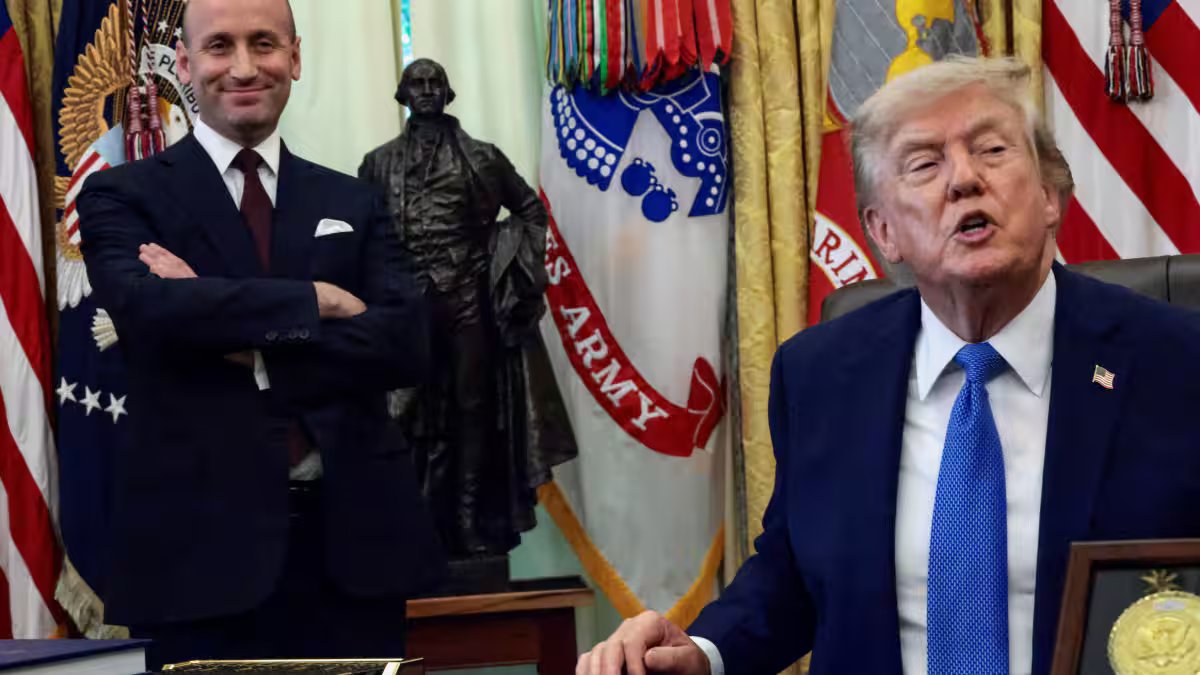
Donald Trump has made a second attempt to restrict birthright citizenship by signing two executive orders on the issue. While one expands the categories of children ineligible for automatic US citizenship, the other targets birth tourism. What do these actions mean for the several Indian NRIs and those living on H-1B visas?
Donald Trump has taken another swing at limiting so-called birth tourism and birthright citizenship. On Thursday (August 6), the US president signed two executive actions on immigration — one limiting the number of people eligible for US citizenship after being born in the United States, while another focused on stopping people from coming to the US to give birth.
Speaking after signing the executive orders, US President Trump said, “We had a very unfortunate decision in the Supreme Court concerning birthright. They’ve taken birthright citizenship, and they’ve made a joke out of it.
“We’re making adjustments because it’s very unfair,” he said.
Trump’s moves on Thursday come after the US Supreme Court in June struck down the American leader’s earlier executive order that attempted to end birthright citizenship for children born to many non-citizens.
But what do these two new executive orders mean? And will Indians be impacted?
What are the two new executive orders signed by Trump?
Trump has long railed against birthright citizenship and even made the effort a centerpiece of his second-term immigration crackdown. However, his efforts until now have not been successful.
 More from Explainers
In his first executive order signed on Thursday, Trump has expanded the definition of children who would not be able to receive birthright citizenship.
According to Stephen Miller, the White House deputy chief of staff and chief architect of Trump’s anti-immigration agenda, the categories have been expanded to include children of members of “foreign terrorist organisations”, as well as “large categories of people who lobby and act on behalf of foreign governments”. However, it is unclear who would fall into the latter category. The order also expands to children of those considered an “alien enemy” of the United States.
The order also extends to include children of more foreign government employees. It further refers to people born in “a territory or territorial waters of the United States where citizenship is not conferred by federal statute” as ineligible. At the moment, that only includes American Samoa.
The order would also deny birthright citizenship to children whose parents “engaged in fraudulent activity to obtain citizenship”.
The second executive order bans birth tourism. As the name suggests, it is the practice of travelling to another country for the purpose of giving birth in that country. The main reason for birth tourism is to obtain citizenship for the child in a country with birthright citizenship.
Trump said visitor visa rules will become stricter so that people travelling to the US mainly to give birth cannot use a child’s birth to secure American citizenship. Through the second order, Trump has directed federal agencies to target “birth tourism operators” who arrange such travel to the US.
Miller further added that the government considers the practice of birth tourism as “hereby banned.”
Trump has long railed against birthright citizenship and even made the effort a centerpiece of his second-term immigration crackdown. Representational image/Reuters
Will Trump’s executive orders hold up in court?
Shortly after Trump signed the executive orders limiting birthright citizenship, immigration activists criticised the move, stating that it wouldn’t hold up in a court.
The American Civil Liberties Union said the orders were another unconstitutional attempt to undo birthright citizenship after the administration’s defeat at the Supreme Court in June. “The Supreme Court already decided this issue: birthright citizenship is guaranteed by the constitution. No additional executive order can change the meaning of the constitution,” said Cody Wofsy, deputy director of the ACLU’s Immigrants’ Rights Project. “Any executive order that tries to rewrite birthright citizenship will meet the same fate as the last one.”
US immigration attorney Cyrus Mehta also noted on X that the order was “blatantly unconstitutional”. “Trump’s new EO on birthright citizenship is also blatantly unconstitutional when it precludes citizenship if the parents of the person engages in a commercial transaction to ensure that the person’s mother is present in the United States, or a territory of the United States to give birth. The meaning of commercial transaction is too vague and violates the 14th Amendment. It should be struck down,” said Mehta.
Legal challenges are expected to be taken up quickly, and courts could block the orders before they take effect, much like what happened the first time.
Why is Trump doing this despite losing in court earlier?
Trump called the Supreme Court ruling from June as “deeply unfair”.
The US president noted that birthright citizenship was done right after the Civil War. “This was for the babies of slaves, and what’s happening now? People are building businesses around it.”
He further pressed on about how people were misusing birthright citizenship in the US. “You have one man came in with a family head said he had 56 children. Another one came in. They said they had 98 children. This was not what it was for. This was meant for the babies of slaves. It was, it was right after one week or two weeks after the Civil War ended, Trump told journalists.
India is among the top countries of origin for birth tourism to the US, alongside China. Representational image/Reuters
Do these birthright citizenship orders impact Indians at all?
While Trump has claimed that thousands and thousands are involved in birth tourism, the data doesn’t suggest the same. According to the Migration Policy Institute, of an estimated 3.5 to 3.6 million births, 26,000 births could fall into the birth tourism category.
A separate 2020 estimate cited by Reuters, from the Center for Immigration Studies, puts the figure between 20,000 and 25,000 mothers a year.
It is often noted that India is among the top countries of origin for birth tourism to the US, alongside China.
As of now, the birthright citizenship orders don’t impact Indians living there on H-1B or other work and study visas. They are not considered “birth tourists” travelling on short-term visitor visas to have a child in the US.
However, the biggest impact would be on visitor visa applicants. Those pregnant could face stricter scrutiny about the purpose of their trip. Moreover, the executive orders empower visa officers to reject applications if birth tourism is suspected, even without formal proof.
The new screening could also lead to longer processing times for some visitor visa applications and extra questioning at airports.
All in all, the executive orders would create a further sense of uncertainty.
With inputs from agencies