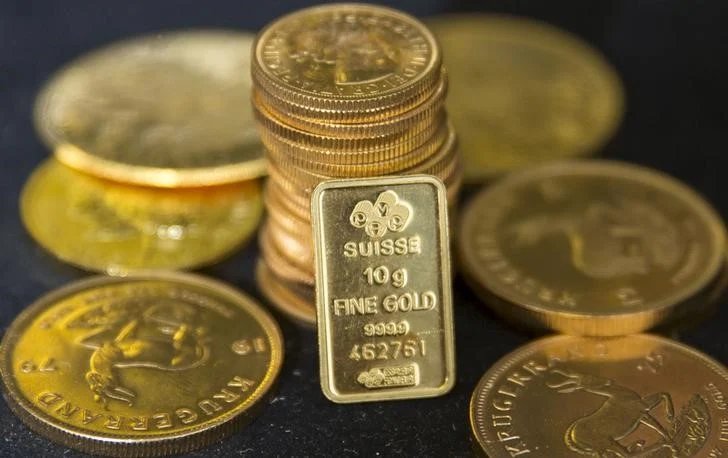
Investing.com — on Friday were headed for their best weekly performance since late January, helped by a combination of a falling dollar, sliding oil prices, and an easing in Federal Reserve rate hike expectations.
At 15:55 ET (19:55 GMT), had gained 2.4% to $4,343.46/oz, while gold futures rose 2.4% as well to $4,402.67/oz. Both contracts were at their highest levels since early June, and were headed for weekly gains of more than 7% each.
Track gold and macro market movers with InvestingPro – now 55% off
as traders pare rate hike bets after jobs report
According to the U.S. Bureau of Labor Statistics, nonfarm payrolls fell by 23k in July, compared to a consensus estimate for a rise of 85k. This marked the first monthly loss in jobs since February. Meanwhile, employment in May and June were revised lower by a combined 103k. The unemployment rate ticked down to 4.1% in July from 4.2% in June.
The decrease in payrolls was largely due to a nearly 50k monthly fall in local government education jobs.
The data comes at a complicated time for the Federal Reserve. On the one hand, despite the negative report, the overall labor market remains solid. On the other hand, inflationary risks are much higher amid ongoing volatility in oil prices due to the Middle East conflict, with some policymakers showing a clear bias towards raising rates at the Fed’s last monetary policy meeting in July.
The divergence in the Fed’s dual mandate presents a dilemma for the central bank. Elevated inflationary dynamics call for rate hikes, but resilience in the labor market suggests little room for rate cuts. While higher borrowing costs can help combat inflation, they come at the risk of denting the labor market and the wider economy.
“This morning’s report is a game changer in the sense that all of the recent focus has been on inflation and this report highlights the risks that are embedded in the labor market as well. Before today, many were expecting that the Fed had no choice but to raise rates in order to fight stubbornly high inflation, because the job market was so strong, but this report shows that isn’t the case,” Chris Zaccarelli, chief investment officer at Northlight Asset Management, said.
“Next week’s CPI release will be important – and if the data continues to come in higher than expected, it could raise the probability of a rate hike at the Fed’s next meeting – but today’s jobs numbers should be enough to keep the Fed on hold for at least another meeting,” he added.
As per the CME FedWatch tool, the odds of a quarter-point rate hike by the Fed in September slipped to 44% from 55% the previous day after the release of the July jobs report.
Higher rate environments tend to weigh on non-yielding assets such as gold. They can also strengthen the dollar, which in turn can put more pressure on bullion as a firmer dollar makes the yellow metal more expensive for foreign buyers.
On the lookout for a Hormuz deal
Turning to the Middle East, Axios reported that Iran was awaiting final approvals from its Supreme National Security Council on a deal with Oman and the U.S. to reopen the critical Strait of Hormuz, citing a diplomat from one of the mediating countries. Meanwhile Reuters said there had been progress on the deal, citing a U.S. official.
Iranian media on Thursday reported that Tehran had struck what it described as “hostile targets” in the strait and planned to bar U.S. and Israeli vessels from transiting the strategic waterway. The developments came after Iranian officials said an agreement with Oman aimed at reopening shipping lanes was in its final stages.
Separately, Iran-backed Houthi militants in Yemen reportedly carried out a fresh attack on Saudi Arabia, raising concerns that the conflict could broaden across the region.
Despite the renewed flare-up, President Donald Trump said he believed the war would end “pretty soon” and maintained that the U.S. remained in control of the Strait of Hormuz.
, the global oil benchmark, seesawed against this backdrop. Worries have abounded that prolonged disruptions to Middle East shipping routes could fuel a wave of energy-induced inflation and potential central bank tightening.
Roushni Nair and Scott Kanowsky contributed to this article