Last week’s avalanche that killed 10 climbers on Broad Peak was the latest in a long list of tragedies on the world’s 12th-highest mountain.
Broad Peak, on the Pakistan-China border in the Karakoram, has drawn climbers since its first ascent in 1957. The standard route mounts the West Spur from the Godwin-Austen Glacier through a series of camps to a long, exposed summit ridge that can turn lethal in a whiteout or high winds.
Many of the deaths on 8,051m Broad Peak over the years cluster into clear categories: avalanches, falls, exhaustion and altitude illness, disappearances in bad weather or on the way down, and a handful of rarer causes. Studying these categories, we can better understand how the mountain has claimed so many lives over the past seven decades. Today, we survey some of those past tragedies.
Avalanches
Avalanches have been a persistent threat on Broad Peak, especially on the lower and mid-sections of the route, where slopes load and release without warning. In May 1985, Canadian Hans Frick died in one such slide. Three years later, in August 1988, South Korean Yong-il Jang perished in another.
On June 16, 1997, an avalanche swept away American Jeffrey Ian Bubb and Japanese Fukuzo Yokotagawa at about 7,000m while they were descending between Camp 3 and Camp 2 on the standard West Ridge route. In July 2015, Pakistani climber Qamber Ali Jangjupa also perished in an avalanche.
These incidents often struck teams moving between camps or fixing lines, where the terrain funnels snow and ice into narrow gullies. Climbers have long noted that the slopes between Camp 2 and Camp 3 on the standard route, and around the higher camps, are prone to slab and serac activity after storms. Even experienced parties have been caught, despite seemingly stable conditions. The mountain’s broad face and the way snow accumulates on its western flanks make these slides both sudden and devastating.
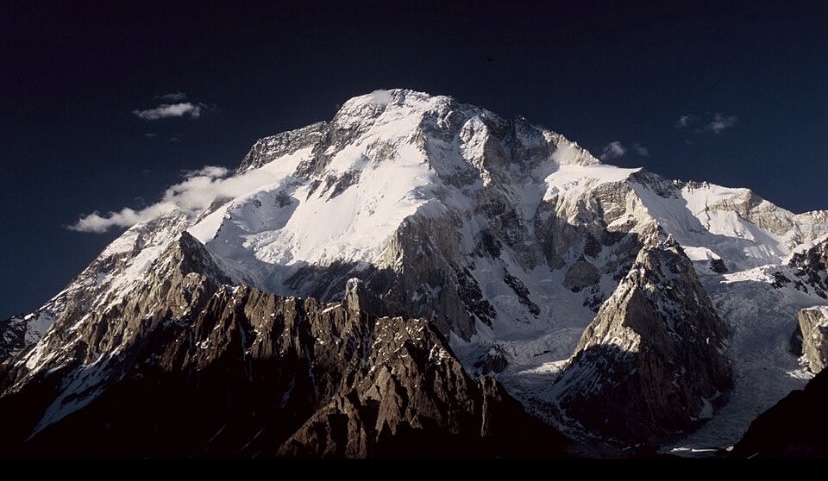
Broad Peak. Photo: Florian Ederer/Wikipedia
Falls
Falls account for a large share of the deaths. Many of them occurred during the descent, when fatigue sets in as climbers negotiate a narrow, cornice-laden ridge with little protection.
The first major tragedy on the mountain belonged to this category. In late July 1975, a Polish expedition reached the previously unclimbed Central Summit of Broad Peak. On the way down, in deteriorating weather and darkness, Bohdan Nowaczyk disappeared while setting up a rappel. After a desperate night bivouac in storm and extreme cold, Marek Kesicki and Andrzej Sikorski slipped on hard ice and plunged to their deaths the following day. Only two of the five summiters survived the descent.
Similar accidents continued for decades.
In August 1981, Catalan climber Enric Pujol reached the summit of Broad Peak with partner Manuel Hernandez, achieving the first Spanish ascent. They topped out at 4 pm on August 5 after a bivouac on the col. During their descent that evening, below the col, they slipped on a snow and ice plate. Pujol suffered a fatal head injury. Hernandez, though injured, managed to radio Base Camp for assistance, survived the ordeal, and safely descended.
British climber Liam Scott Elliott fell on Broad Peak in August 1986. German Kurt Lyncke-Krueger died in a fall in July 1990, and South Korean Hyun-jae Park fell in July 1995.
In July 2009, Italian mountaineer Cristina Castagna, the first Italian woman to summit Makalu and already a veteran of several 8,000ers, reached the foresummit of Broad Peak with her partner, Giampaolo Casarotto, in poor weather. On the descent at around 7,800m, she slipped, struck rocks, and fell into a crevasse. Casarotto reached her but could do nothing. Castagna’s body remains on the mountain at an altitude where recovery is nearly impossible.
In July 2011, Hong Kong climber Jeffrey Wai Hung Chung fell into a crevasse. Pakistani Muhammad Baqir fell in July 2012.
South Korean Kim Hong-bin, who had lost fingers to frostbite on earlier climbs, fell from the summit ridge of Broad Peak in July 2021 after summiting. He could not be rescued despite efforts by Vitaly Lazo’s team. Kim’s incident later sparked controversy and debate. (Lazo later wrote a report on the incident.)
British climber Gordon Henderson fell near the summit in July 2022.
Falls often occur after successful summits, when climbers are exhausted, visibility is poor, and a single misstep on the exposed ridge ends everything. The long summit traverse, with its cornices and sudden drops, has proven particularly unforgiving once the adrenaline of summiting fades.
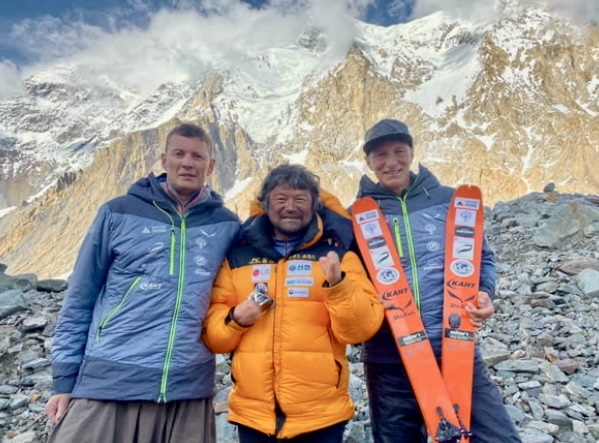
From left to right: Anton Pugovkin, Kim Hong-bin, and Vitaly Lazo in Base Camp. Photo: Vitaly Lazo and Anton Pugovkin via mountainplanet.com
Exhaustion
Exhaustion and altitude-related illness form another deadly category, particularly above 7,500m, where the body deteriorates rapidly. British climber Peter Thexton died of pulmonary edema on June 29, 1983. Czech climber Bohuslav Bilek succumbed to the same condition on June 11, 1994.
The most documented case of this category on Broad Peak is that of Austrian Markus Kronthaler in July 2006. Kronthaler, a former policeman and experienced high-altitude climber, reached the summit but collapsed from exhaustion and dehydration during the descent along the summit ridge.
His partner, Sepp Bachmair, struggled to help him but could not prevent his death the following morning. Kronthaler’s body remained on the mountain until the following year, when his brother Georg organized a recovery expedition that brought down his remains from 7,900m. It was the highest such recovery at the time.
In July 1996, three South Korean climbers (Dong-keun Han, Jae-mo Yang, and Sun-taek Lim) died on the way down in bad weather. In July 1998, French climbers Pascale Bessieres and Eric Escoffier vanished. South Korean Seung-Kwon Hur disappeared in July 1999. Czech climber Zuzana Hofmannova disappeared in July 2012.
The year 2013 brought two major losses of this kind. During the first winter ascent of Broad Peak in 2013, Polish climbers Maciej Berbeka and Tomasz Kowalski became separated on the way down after summiting in extreme cold. They never reached Camp 4.
Four months later, three Iranian climbers (Aidin Bozorgi, Pouya Keivan, and Mojtaba Jarahi) completed a partial new route on the Southwest Face of Broad Peak, but became disoriented on the descent. They ran out of food and water after multiple high bivouacs and disappeared. Search parties found no trace.
Other causes
A smaller number of deaths fall into other categories. In August 1985, Polish climber Barbara Kozlowska drowned in a glacial stream above Base Camp. Dana Heide of Germany likewise slipped into a glacial stream near Base Camp and died in July 2013. In August 2024, falling rocks killed Pakistani climber Murad Sadpara.
In July 2022, Pakistanis Sharif Sadpara and Imran Karim also lost their lives. We can see that danger exists even near Base Camp or from objective hazards such as rockfall that can strike without warning.
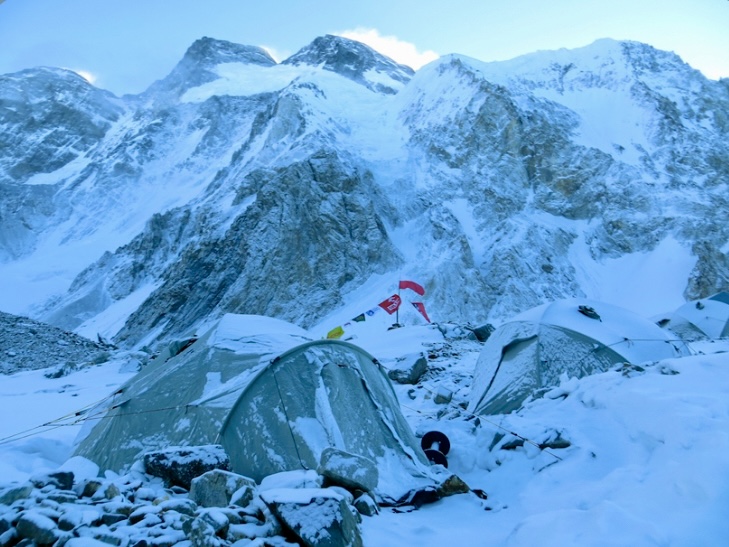
Broad Peak Base Camp in bleak winter after a storm. The standard route, followed by the 2013 Polish team that made the first winter ascent of the mountain, climbs the prominent col (above the foreground tent) and then up to the main summit on the right. Photo: Adam Bielecki via American Alpine Journal
A clear pattern
Taken together, the pattern on Broad Peak is clear. Most fatalities, though not all, occur on the way down, when climbers are depleted, and the long ridge offers little room for error.
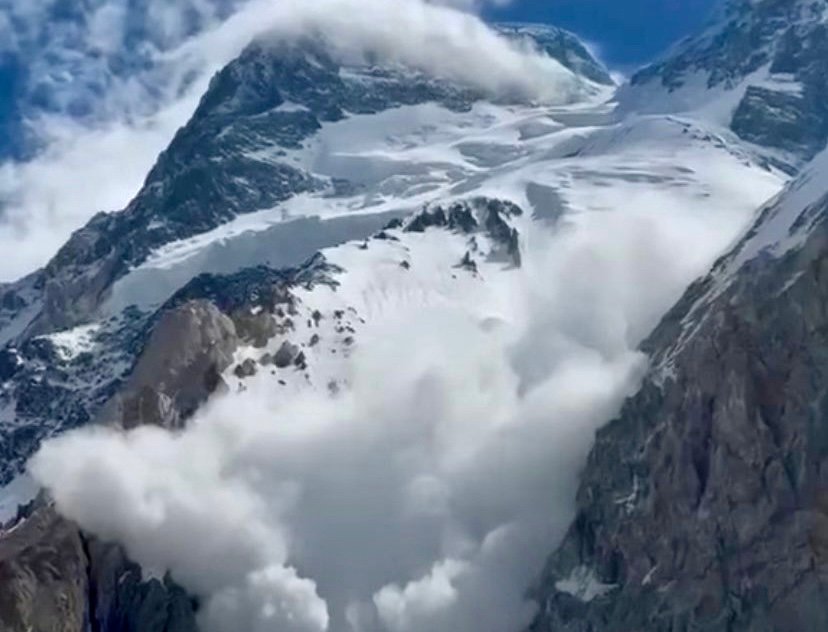
Avalanches strike the lower and mid-mountain sections with sudden force, as happened last week. There may be avalanches, such as the recent one, where the violence and force of the avalanche is so strong that a climber can be swept away 800m to 1,600m down the mountain in two minutes. There is no way to survive such a fall.
Falls claim those who lose their footing on ice or cornices. Exhaustion and altitude sickness finish off climbers who have already reached the top. Disappearances follow storms or navigational mistakes high on the mountain. Broad Peak has never been the deadliest of the 8,000’ers, but its combination of relative accessibility and objective hazard has produced a steady, varied death toll across nearly 70 years.
Historical context
Until last week, Broad Peak’s long record of individual and small-group losses stood in contrast to the rare but catastrophic multi-fatality avalanches elsewhere.
The deadliest single avalanche in mountaineering history remains the Lenin Peak disaster of July 13, 1990. An earthquake in Afghanistan dislodged a serac on neighboring Chapaev Peak, triggering a massive slide that buried Camp 2 on Lenin Peak in the Pamirs. Of the 45 climbers present, 43 were killed. Only two men survived. Many bodies remain entombed in the glacier to this day.
Seventeen climbers died in a single avalanche on the still unclimbed Kawagarbo in China’s Meili Snow Mountains on the night of January 3–4, 1991. A joint Chinese-Japanese expedition was at Camp 3 when a huge slide estimated at more than 300,000 tons of snow and ice obliterated the camp. All 17 climbers — 11 Japanese and 6 Chinese — perished. Most of the bodies were recovered years later when glacial melt revealed them. (We published a detailed account of that disaster: “Where Shepherds Stop: The 1991 Tragedy on Kawagarbo“.)
On Everest, the Khumbu Icefall claimed 16 Sherpas in a single serac collapse and avalanche on April 18, 2014. A year later, the magnitude 7.8 Nepal earthquake sent avalanches into Everest Base Camp, killing at least 22 people.
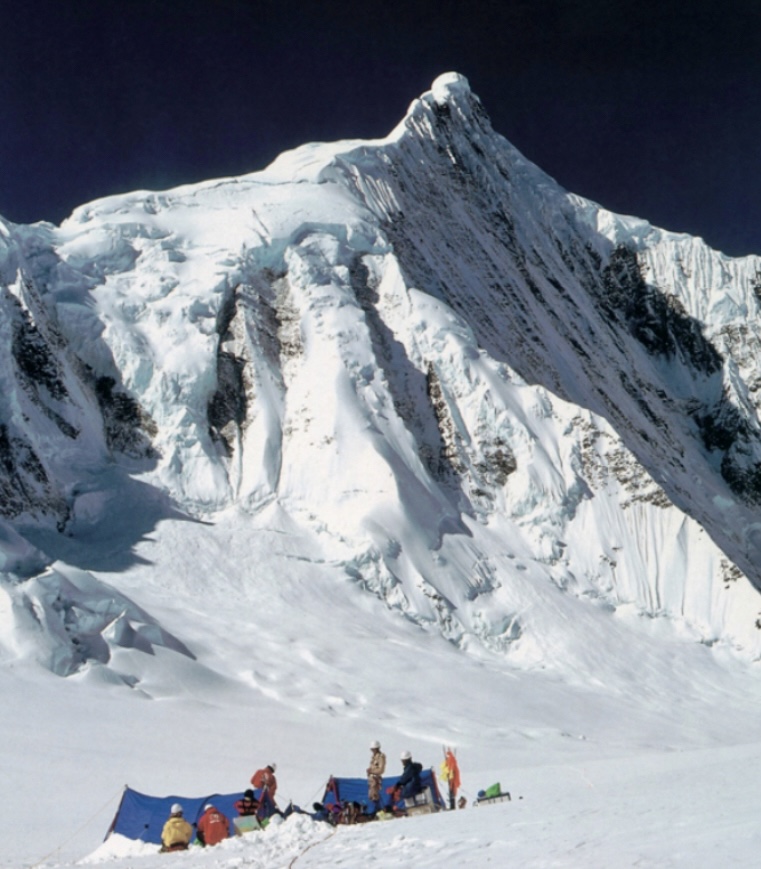
The last photo on the camera of one of the dead climbers, before the deadly avalanche on Kawagarbo that killed all 17 members. Photo: Min News
Previous multi-fatality incidents on Broad Peak involved a relatively modest number of deaths, compared to the above, until the violent avalanche of July 30. It is the mountain’s deadliest disaster to date.
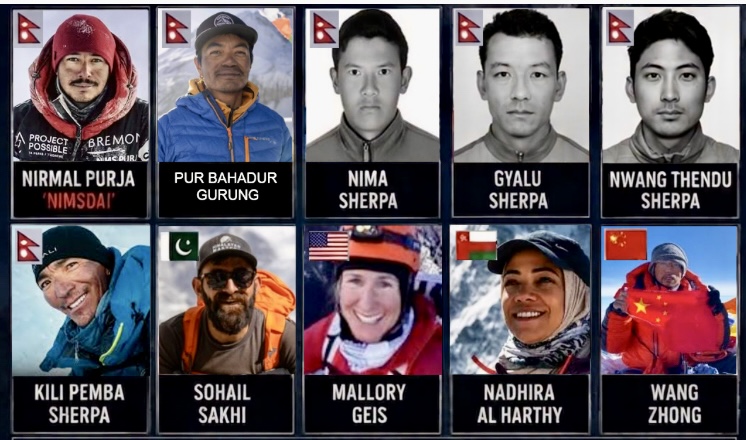
The ten climbers who lost their lives in the avalanche on July 30, 2026. Photo: Askmeaboutnepal