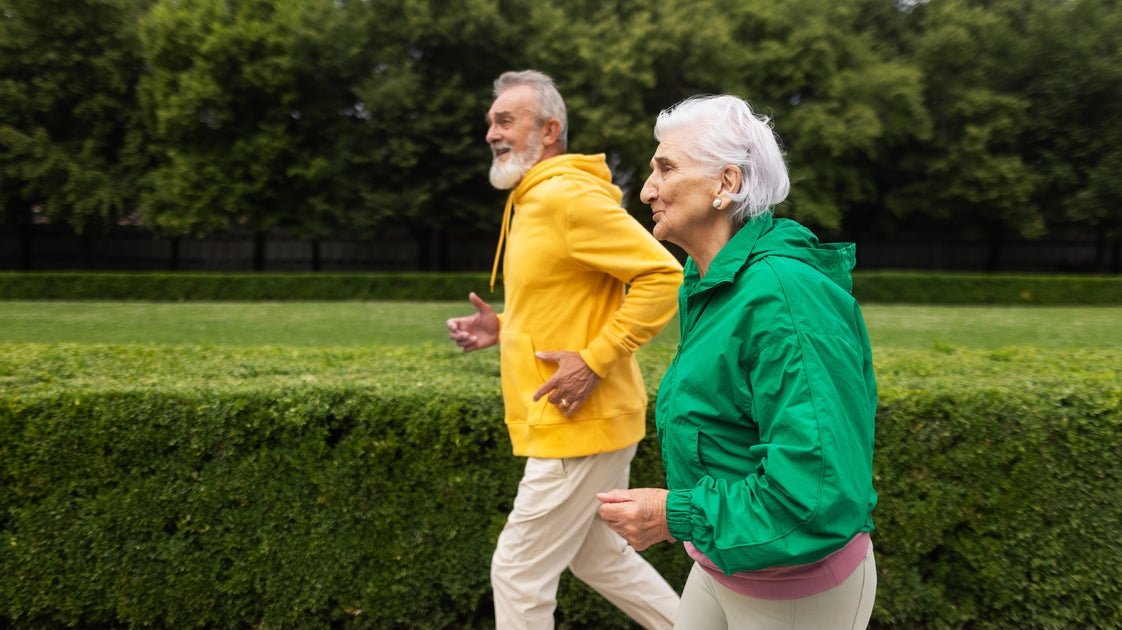
If you’ve ever been told you walk too fast, we have good news for you.
A recent study published in the journal Neurology found that adults 80-plus who walk as fast as adults in their 40s and 50s have less cognitive decline than slower-walking older adults.
Researchers from the Albert Einstein College of Medicine, Columbia University and Stony Brook University in New York tracked 3,989 adults, all 80 or older, for an average of 3.4 to 5.4 years. Those who had cognitive impairment at the start of the study were not included in the research.
Walking speed was measured on timed walking tests, and those who walked the fastest — referred to as “super movers” — kept up a roughly 2.9-mile-per-hour walking speed and walked at least 1.5 standard deviations above other people in their age group.
Roughly 9% of participants were categorized as super movers.
When compared to slower walkers, super movers were about 50% less likely to have cognitive impairment over the course of five years and about 60% less likely to have an Alzheimer’s disease diagnosis.
Super movers also had slower memory and thinking decline when measured on mental flexibility and memory recall tests.
While super movers were less likely to be diagnosed with Alzheimer’s disease, brain scans showed they had the same level of physical brain changes as non-super-movers. This leads researchers to believe that super movers’ brains were more resilient.
“The biggest takeaway is that mobility and brain health are deeply interconnected. Super movers appear to represent an exceptional aging phenotype, characterized by a lower disease burden, healthier lifestyles, and younger biological age. Our findings suggest that a combination of favorable biology, preserved brain health, and lifelong healthy behaviors may help some people maintain both mobility and cognition well into late life,” Dr. Joe Verghese, study author and chair of the department of neurology at Stony Brook Medicine, said in a press release.
According to Dr. Cathleen Colon-Emeric, chief of the division of geriatrics at Duke University School of Medicine, “gait speed is a really terrific indicator of the overall health of older adults. We actually use it as almost like a fifth vital sign for geriatrics.” Colon-Emeric is not affiliated with the study.
Gait speed can be a predictor of things like falls, cardiovascular events, new memory impairment and more, Colon-Emeric said.
“And that’s really because walking requires a whole lot of the systems of your body to be working well together,” she noted. You need to have healthy muscles, bones, a healthy brain that sends signals to your body, healthy lungs, a healthy heart and more, she said.
“And so when people have preserved gait speed, that’s a sign that their overall health in all of these systems is doing well,” said Colon-Emeric, “when they have a slower gait speed, that’s a sign that there might be something going on in one or more of those systems that we need to intervene on.”
If you notice yourself or a loved one slowing down, it’s worth bringing it up to a doctor who can do an overall assessment and see if there are things that can be done to help people walk more safely and be healthier overall, she said.

Halfpoint Images via Getty Images
Here’s how to either start walking for exercise or increase your walking speed.
Keeping active is an important way to age well and increase your health span.
It’s recommended that adults get at least 150 minutes of moderate exercise, such as brisk walking at 2.5 miles per hour or faster, each week, or at least 75 minutes of vigorous exercise (swimming laps, hiking uphill, running) weekly.
In addition to potential cognitive benefits, walking is also good for your cardiovascular system and can lower risk of heart disease and stroke.
“Anyone can benefit from walking,” Dr. Tamanna Singh, co-director of the sports cardiology center at Cleveland Clinic, previously told HuffPost.
If you have a goal to start a walking habit, but haven’t actually started walking yet, Singh said its helpful to invite a friend to walk with you. This can make your walk more interesting and help build up your motivation.
“You’ll each hold each other accountable to developing a walking habit and sticking to it,” Singh said.
You can also consider saving a favorite playlist, podcast or audiobook for your walk — this will give you something to look forward to when you lace up your sneakers.
If you are an avid walker but want to increase your walking speed, it can be helpful to find a playlist of music that’s set to a fast beats per minute, such as 100 or 110 beats per minute, and use the beat as your walking pace, Tyler Moldoff, a physical therapist at the Hospital for Special Surgery in New York, previously told HuffPost.
“You can simply do a Google search or even on Spotify or Apple Music, look for different genres of songs that may be enjoyable for individuals at 100 beats per minute, and then trying to sync your cadence to the beat of the song,” Moldoff said.
Working to increase your walking speed can be a good way to build strength, but doing this won’t necessarily protect your memory.
“Whether if we can do something to increase somebody’s gait speed, they do better with their memory or other outcomes, that’s really less certain,” said Colon-Emeric.
Walking at any pace is a great way to build muscle, get your heart beating and combat the sedentary lifestyle many folks have. You can slowly work to increase your pace if you aren’t a fast walker just yet, but any walking regimen is helpful for healthy aging.
“Exercise is medicine, and we preach that all the time with our patients. It’s probably the best anti-aging medicine that we have available to us,” said Colon-Emeric.