Aug. 6, 2026 — Dark energy — the invisible force accelerating the expansion of the universe — remains one of the deepest mysteries in modern science. Unlocking its nature requires not only powerful telescopes but the ability to transform vast streams of astronomical images into precise measurements of how the universe evolves.
The Dark Energy Survey (DES) has released results from its landmark six-year campaign to probe this cosmic force in a paper, a summary of 18 supporting papers. DES is the largest, most comprehensive survey of its kind. Powered by the 570-megapixel Dark Energy Camera (DECam) mounted high in the Chilean Andes, DES scientists captured nearly 300,000 images, revealing 669 million galaxies, thousands of galaxy clusters and more than 3,000 supernovas between 2013 and 2019.

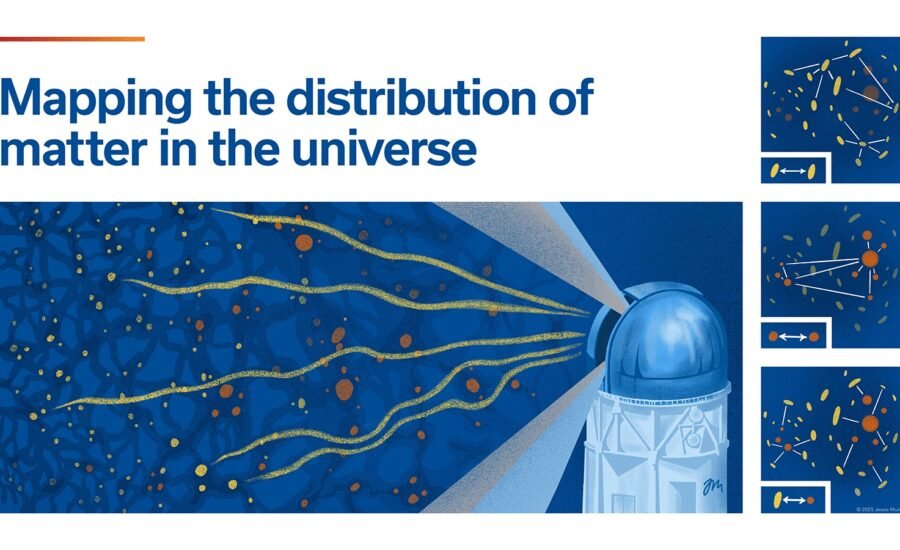
The correlations used by DES scientists to map the distribution of matter in the universe. The DES analysis uses shape measurements of source galaxies, shown in yellow, and the positions of lens galaxies, shown in red. Image credit: Jessie Muir/Dark Energy Survey.
As a key partner in this global DES collaboration, the U.S. Department of Energy’s (DOE) Argonne National Laboratory transformed the survey’s enormous imaging data set into scientific insight.
Argonne developed software systems that process massive amounts of data and leveraged high performance computing, applying sophisticated cosmological modeling to measure how matter clusters and how cosmic structures evolve.
“Argonne is delivering essential advances in theoretical modeling and simulation that connect the galaxies we observe to the underlying dark matter shaping the universe,” said Matthew Becker, an Argonne physicist and DES collaborator. “If we want to understand how galaxies and larger structures formed, we must understand dark energy.”
The DES collaboration spans more than 400 astrophysicists from 35 institutions in seven countries.
Led by DOE’s Fermi National Accelerator Laboratory (Fermilab), the collaboration also includes scientists from U.S. universities, the U.S. National Science Foundation’s (NSF) National Optical-Infrared Astronomy Research Laboratory, and DOE’s Lawrence Berkeley National Laboratory and SLAC National Accelerator Laboratory.
A Unified Stream of Images Powers the DES
The DES collaboration converges on a single, unifying resource: the data.
Every cosmological result — from galaxy clustering to weak gravitational lensing — traces back to the millions of images collected by DECam, a wide‑field astronomical camera built specifically for the DES.
While Fermilab was primarily responsible for designing, engineering and assembling DECam, Argonne contributed roughly 20% of the mechanical engineering and design of the camera, including the camera control systems.
The shutter uses an Argonne‑built control system. The lab also designed the cooling system that stabilizes the charge-couple devices (CCDs), the camera’s core imaging sensors.
The CCDs allow DECam to capture faint, distant galaxies with the sharp, stable images required for weak gravitational-lensing science. This type of science, also known as weak lensing, measures how gravity from invisible matter slightly bends light from distant galaxies, distorting their shapes.
Argonne performed detailed CCD characterization at its Advanced Photon Source (APS), the world’s brightest synchrotron X-ray light source, to test for the uniformity of the CCDs. The APS is a DOE Office of Science user facility at Argonne.
DECam was installed on the Víctor M. Blanco 4-meter Telescope at the NSF Cerro Tololo Inter-American Observatory in Chile in 2012 and surveyed about one-eighth of the sky in five colors over six years.
What Dark Energy Is and Why It Matters
Although scientists now know dark energy makes up most of the universe — roughly 70% — they didn’t identify dark energy until the late 1990s, when astronomers discovered that the expansion of the universe is accelerating.
Until then, scientists believed the expansion was gradually slowing under the pull of gravity. Because it is impossible to image this mysterious force, scientists called this acceleration “dark energy.”
“We detect dark energy only through its impact on the universe’s expansion and on how cosmic structures grow,” Becker said. “Its accelerated expansion acts like a brake on structure formation, making gravitational collapse less efficient.”

Example of a field in the constellation Lepus showing stars (small colored dots) and galaxies (larger fuzzy objects) about 300 million light-years away. This is just a tiny part of one DECam image. DES analysis measures the faintest galaxies visible in this picture. Image credit: Erin Sheldon/Dark Energy Survey.
To build a national strategy for studying this phenomenon, DOE, NSF and NASA formed the Dark Energy Task Force about 20 years ago, issuing its recommendations in 2006.
The task force recommended four key observational probes: sound waves from the early universe (baryon acoustic oscillations); exploding stars that serve as cosmic distance markers (type 1a — read as “type one-A” — supernovas); galaxy clusters — the largest structures in the universe; and weak lensing.
Each probe measures a different aspect of how the universe expands and how cosmic structure grows. DES is the first survey to use all four probes in a single coordinated program.
Argonne led the DES weak lensing analysis, which measures the tiny stretching of galaxy shapes caused by light traveling through the cosmic web — the vast network of matter that stretches across the universe. Because this signal is far weaker than distortions introduced by the telescope or atmosphere, weak lensing is among the most challenging measurements in cosmology.
In a major advancement, Becker co-developed a new method called metadetection that measures how galaxy shapes are subtly stretched by gravity, which fundamentally sharpened the survey’s weak lensing results.
“Metadetection uses the actual survey data to simulate what the universe would look like if the weak-lensing shear signal in the image changed,” Becker said. “From these simulations, we are then able to estimate the true shear signal in the data.”
By measuring how galaxy shapes change in these alternate, data-driven scenarios, metadetection removes long-standing instrumental biases, yielding the most precise weak-lensing measurements DES has produced.
Tracing the Accelerating Expansion of the Universe
The DES results demonstrate the power of combining multiple cosmological probes within a single survey, setting a methodological benchmark for next‑generation experiments.
By uniting four probes with advanced data processing, precise measurements of light and sophisticated modeling, DES narrowed the range of possible behaviors for dark energy more tightly than almost any previous experiment.
The results show that dark energy behaves like a steady, unchanging force — what physicists call a “cosmological constant” — and that the universe’s expansion history matches the standard cosmological model, in which the universe is roughly 70% dark energy, 25% dark matter and 5% ordinary matter.
Dark matter is the invisible mass that outweighs normal matter and acts like invisible scaffolding that holds galaxies together. Ordinary matter is the atomic material that makes up stars, planets, gas, dust and everything we can directly observe.
Guiding the Next Generation of Dark Energy Research
Results from the DES are now guiding the decade-long Legacy Survey of Space and Time (LSST), conducted by the NSF–DOE Vera C. Rubin Observatory in Chile, which will record millions of images of the Southern Hemisphere sky over 10 years. The observatory is funded by the NSF and DOE’s Office of Science.
Argonne scientists are key contributors to the Dark Energy Science Collaboration, the international team that will analyze data from the LSST, which began full operations in June.
“Our team is helping to build the systems and analysis tools that turn sky images into the measurements needed to study dark energy while advancing the theoretical modeling that links the galaxies we observe to the underlying dark matter,” Becker said.
Combined with Argonne’s state‑of‑the‑art cosmological simulations — made possible through the use of supercomputers at the Argonne Leadership Computing Facility, a DOE Office of Science user facility — these advances will be essential for ensuring robust dark‑energy studies with the LSST and extracting the most information from its data.
Together, this work is ensuring Argonne’s leadership role in the next generation of dark energy research.
The DES is jointly supported by the DOE Office of Science and the NSF.
Source: Beth Burmahl, Argonne National Laboratory