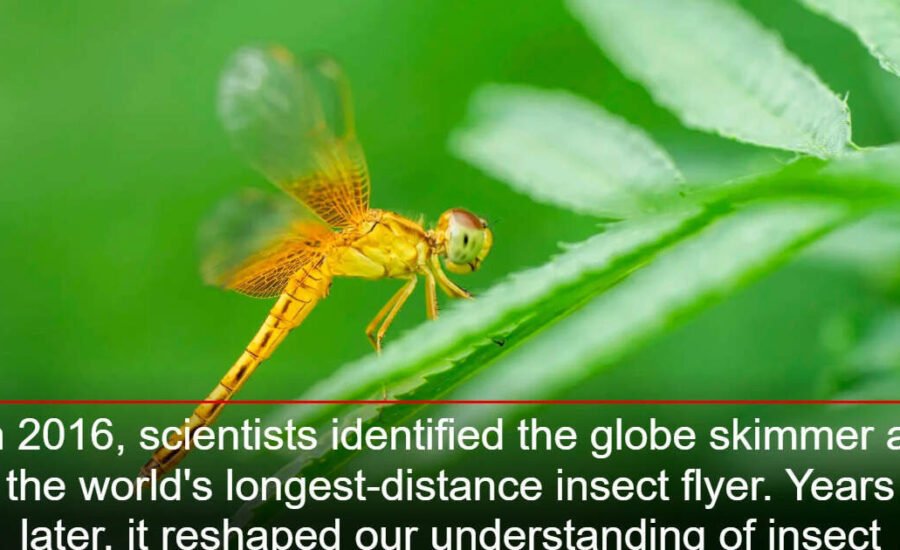
The spotlight is now on the globe skimmer dragonfly, Pantala flavescens. Barely an inch and a half long, this dragonfly appears to undertake migrations stretching thousands of miles, crossing oceans and connecting populations from different parts of the world.
 ANI
ANIThe globe skimmer as the world’s longest-distance insect flyer.(ANI Photo)
What made scientists rethink insect migration?
The breakthrough came through genetics rather than direct observation. Researchers examined dragonflies collected from locations including Texas, eastern Canada, Japan, Korea, India, and South America. Despite the enormous distances separating these populations, their genetic makeup was strikingly similar.
According to the researchers, there was only one realistic explanation. These dragonflies were not remaining within isolated regional populations. Instead, they were traveling across vast geographic areas, breeding with one another and maintaining what amounts to a single worldwide gene pool.

“This is the first time anyone has looked at genes to see how far these insects have traveled,” said Jessica Ware, assistant professor of biology at Rutgers University-Newark’s College of Arts and Sciences and senior author of the study.
“If North American Pantala only bred with North American Pantala, and Japanese Pantala only bred with Japanese Pantala,” Ware says, “we would expect to see that in genetic results that differed from each other. Because we don’t see that, it suggests the mixing of genes across vast geographic expanses.”The findings challenged long-held assumptions about how far insects of this size could travel.
How can such a tiny dragonfly cross oceans?
Unlike birds or marine mammals, dragonflies do not possess powerful bodies built for marathon journeys. Yet Pantala flavescens appears to have evolved in a way that allows it to travel remarkable distances while conserving energy.
According to Ware, their wings have a larger surface area, enabling them to ride weather systems rather than constantly relying on active flight.
“These dragonflies have adaptations such as increased surface areas on their wings that enable them to use the wind to carry them. They stroke, stroke, stroke and then glide for long periods, expending minimal amounts of energy as they do so.”
Researchers say the insects have already been observed crossing the Indian Ocean between Asia and Africa.
“They are following the weather,” explained Daniel Troast, who analyzed the DNA samples while completing his master’s degree in biology at Rutgers.
“They’re going from India where it’s dry season to Africa where it’s moist season, and apparently they do it once a year.”
Their ability to take advantage of favorable winds may explain how such a small insect manages journeys estimated at around 4,400 miles or more, surpassing every other known migrating insect.
Why is this journey essential for survival?
For the globe skimmer, migration is not simply about exploring new places. According to the Rutgers researchers, it is closely tied to reproduction.
Pantala dragonflies need fresh water to mate and lay their eggs. As seasons change and dry conditions spread, the insects follow shifting weather patterns in search of wetter environments where breeding remains possible.
Ware describes the migration as a “kind of suicide mission.”
Many dragonflies are unlikely to survive the entire journey. Even so, the species continues because enough individuals reach suitable breeding sites and produce the next generation.
Researchers believe not every dragonfly completes these long-distance flights in the same way. Some may remain airborne for astonishing stretches, using strong weather currents or even hurricane winds to glide across oceans with very little energy.
Others may travel in stages. If a dragonfly spots a temporary freshwater pool created by rainfall, even on a remote island, it is thought to land, mate, and lay eggs there. Within only a few weeks, the young mature into adults and continue the migration from the very place where their parents paused.
The result is an intercontinental journey carried forward over multiple generations rather than by a single insect.
What do scientists still hope to discover?
Although the genetic evidence strongly supports worldwide mixing between populations, many questions remain unanswered. Exactly which migration routes these dragonflies follow is still uncertain. Ware and Troast emphasize that much more research will be needed to understand the insects’ remarkable travel patterns.
Tracking them presents an obvious challenge. Devices used to monitor birds and larger animals are simply too heavy for an insect this small.
Now that the research has demonstrated a globally connected population, the scientists hope future studies will focus on mapping these migration routes in greater detail using new and creative methods.
Their findings have already rewritten the record books.
Before this work, monarch butterflies were considered the longest-distance migrating insects, traveling roughly 2,500 miles during their seasonal migrations across North America.
“Monarch butterflies migrating back and forth across North America were thought to be the longest migrating insects,” traveling about 2,500 miles each way, says Troast, “but Pantala completely destroys any migrating record they would have,” with its estimated range of 4,400 miles or more.
The globe skimmer’s journey even exceeds Charles Lindbergh’s famous solo flight from New York to Paris by several hundred miles.
Why is this dragonfly so different from its relatives?
One of the most surprising discoveries is that not all dragonflies share the same appetite for travel. While the globe skimmer and its close relative, the Green Darner (Anax junius), have evolved into exceptional long-distance migrants, many other dragonfly species spend almost their entire lives close to where they hatch.
Ware notes that some dragonflies “don’t ever leave the pond on which they’re born – traveling barely 36 feet away their entire lives.”
That dramatic contrast highlights just how unusual Pantala flavescens is. Despite its tiny size, it has evolved into one of nature’s greatest travelers, using weather systems, efficient flight, and carefully timed breeding to connect populations spread across multiple continents.
The Rutgers University-Newark study, published in PLOS ONE, has transformed scientists’ understanding of insect migration. Rather than existing as isolated regional populations, globe skimmers appear to form a worldwide network linked by extraordinary journeys across oceans. Genetic evidence has revealed that one of the smallest travelers in the animal kingdom may also be one of its most accomplished, proving that distance alone is no barrier when evolution provides the right adaptations.
FAQs
Which insect holds the longest migration record?
The globe skimmer dragonfly (Pantala flavescens), according to the Rutgers-led research.
How did scientists reach this conclusion?
They compared genetic samples from dragonflies collected across multiple continents.