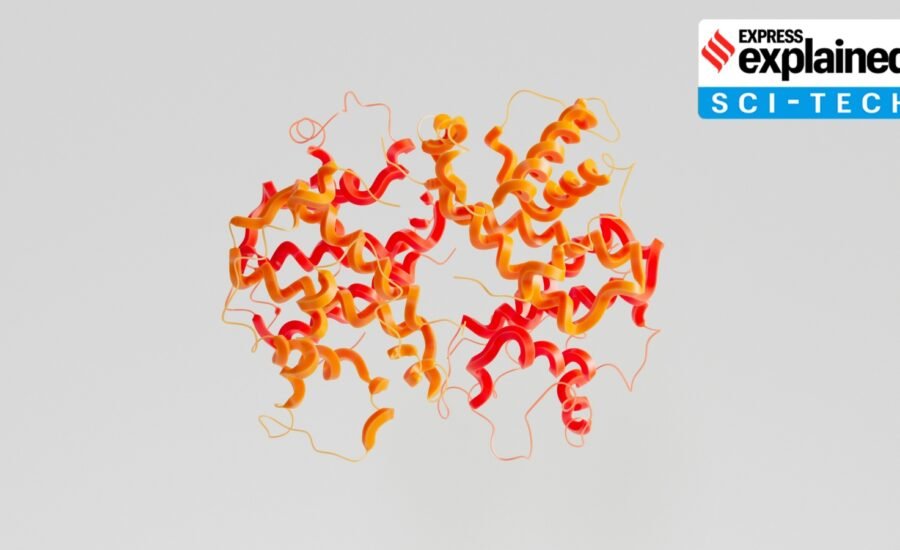
From Gulliver’s Travels to Honey, I Shrunk the Kids, we have long been fascinated by the idea of shrinking ourselves or growing to giant size. Scientists at Duke University, North Carolina, have now given a version of that power to proteins. The team has come up with an artificial intelligence (AI) system termed Raygun which can miniaturise, enlarge and extensively rewrite proteins. Their work was published in the journal Nature on July 29. Rohit Singh, an alumnus of IIT Kanpur and co-author of the study, explains their work and its significance.
Proteins are already minuscule, typically a few nanometres across. Shrinking them sounds like a strange goal until you consider that, much as with a compact car in a crowded city, a smaller version can go places the larger one cannot.
Gene therapy is a clear case. The aim is to deliver a working copy of a gene into a patient’s cells to compensate for a faulty one, and delivery is the hard part, since a gene cannot simply be swallowed and has to be packed into a molecular vehicle, typically the hollowed-out shell of a harmless virus. Those shells have a strict capacity limit, and many therapeutically valuable genes are too large to fit.
That constraint has consequences well beyond the laboratory. Gene therapies built on these viral shells are among the most expensive medicines, such as Hemgenix for haemophilia ($3.5 million), Casgevy for sickle cell disease ($2.2 million), and Zolgensma ($2.1 million) for spinal muscular atrophy. Often in India, families have had to turn to crowdfunding to pay for a single dose. Design tools that shrink a therapeutic protein without breaking it widen what can be delivered by cheaper, better-characterised vehicles.
Basic research hits the same wall. Biologists routinely attach a reporter to a protein they want to track, most famously the green fluorescent protein first isolated from a jellyfish, which glows green under the microscope when lit with blue light, revealing where the tagged protein goes. A bulky reporter can distort the very thing it is meant to observe.
Proteins as sentences
Proteins are polymers, long chains assembled from a small set of repeating units, in their case 20 amino acids. The order of those units determines the shape the chain folds into, and the shape determines the job: motor, scaffold, transporter, switch. Genes, which encode proteins, are polymers too, written in an alphabet of four nucleotides.
Story continues below this ad
The comparison to language is a natural one. A protein can be read as a sentence in a 20-letter alphabet, a gene as a sentence in a four-letter one.
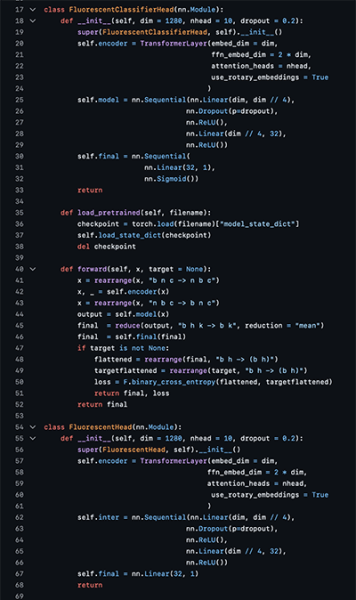 Raygun, a computer program, improves proteins by adding or deleting amino acids, essentially “shrinking” or “enlarging” them. Duke University
Evolution encodes the language that governs how a protein’s amino acid sequence gives rise to its shape and function, but scientists don’t fully understand that language. Protein language models act as a kind of translator, learning patterns from millions of protein sequences and linking those patterns to biological structure and function.
Large language models such as ChatGPT can summarise or expand a passage because vast exposure to writing teaches them two things: grammar, meaning what a valid sentence looks like, and gist, meaning what a passage is actually saying, so that it can be rewritten in different words. Evolution has handed biology a comparable corpus. Haemoglobin, the oxygen carrier in our blood, turns up in thousands of species, from whales to earthworms, always recognisable but never quite identical. Comparing enough of those variants shows which parts are untouchable and which tolerate change. Train a protein language model on hundreds of millions of such sequences and it learns a grammar that generalises across proteins.
What Raygun actually does
Protein language models supply the grammar. Raygun supplies the second half: how to take the gist of a protein and re-express it, sometimes in considerably fewer words.
Story continues below this ad
Doing that turns out to be harder than it sounds. A language model describes each amino acid with a long list of numbers capturing its chemistry and its context, so a 100-residue protein arrives as 100 such lists and a 2,500-residue protein as 2,500. Two proteins of different lengths are therefore described in formats that cannot be lined up against each other, let alone converted into one another, which is precisely what changing a protein’s length would demand.
Raygun’s answer is to summarise every protein at a fixed resolution. Dr. Kapil Devkota, postdoctoral research and lead computational author of the study, thought of dividing each sequence into the same number of blocks whatever its length, so a short protein gets a few residues per block and a long one gets many, then averages within each block. Every protein then carries a summary of identical size, a little like insisting that every book, whether novella or epic, be reduced to the same number of chapter notes. Much of Raygun’s machine learning goes into working out how to pack enough information into those notes that the protein can be written back out from them.
The second move is what makes generation possible. Raygun can treat a protein not as one fixed summary but as a probability distribution, a cloud of plausible variants rather than a single point. Drawing a sample at a chosen target length yields a complete sequence of that size in a single shot, in about 0.3 seconds on one graphics processor and roughly 100 times faster than diffusion-based methods, which build sequences through many rounds of refinement.
The user steers all of this with two dials: how far to stray from the original, and how long the result should be.
What came out of the lab
Story continues below this ad
Our team tested Raygun across a 17-fold size range, from haemoglobin at 147 amino acids to mTOR at 2,549, which could be shortened by more than 500 amino acids with its predicted structure largely intact.
The centrepiece was fluorescent proteins. Raygun generated 70,000 candidates each from two templates, jellyfish-derived eGFP and coral-derived mCherry. Computational filters narrowed these to eight, which were made in human cells; six glowed. The smallest working variants ran to 199 and 206 amino acids, shorter than 96% of the proteins catalogued in a standard database of fluorescent proteins.
The more consequential finding is how much editing the proteins tolerated. Some working variants carried more than 40 coordinated insertions, deletions and substitutions relative to their template. In contrast, when the edits are not carefully coordinated, the molecule loses its fluorescence after just 4-5 edits.
What it cannot do yet
The designed fluorescent proteins glow, but dimly, and reaching the brightness of laboratory workhorses will take further rounds of directed evolution. A deeper limitation follows from where the model gets its knowledge: Raygun learns the gist of a protein from evolution, so it protects what evolution selected for, and it has no particular reason to protect what human engineers later added on top.
Story continues below this ad
Which properties of an engineered protein survive an AI edit, and which do not, is an open question that we and other researchers are now actively tackling.
There is also the question of the ethics of such tools, and we are signatories to the Responsible AI for Biodesign principles. The value of computational design runs in both directions: a model that can propose a new protein can equally be pointed at a design of unknown provenance and asked whether it resembles something dangerous.
Rohit Singh is Assistant Professor of Biostatistics & Bioinformatics and Cell Biology at Duke University, North Carolina, USA.