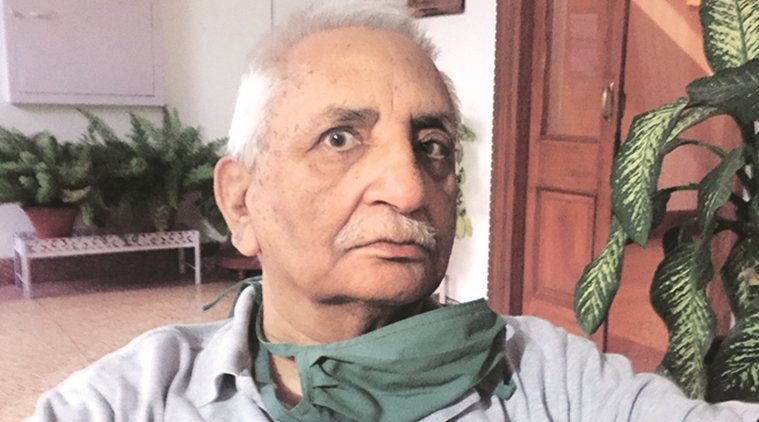
In its report submitted to the Centre on June 30, 2009, the Justice Liberhan Commission of Inquiry concluded that the 1992 Babri Masjid demolition was “neither spontaneous nor unplanned” but the result of a carefully orchestrated conspiracy. It was a conclusion that Justice Manmohan Singh Liberhan, who headed one of independent India’s longest-running commissions of inquiry, never wavered from until his last breath.
Born on November 11, 1938, in a village that later became part of Chandigarh, Liberhan was the son of eminent lawyer Chaudhary Bakhtawar Singh. He enrolled as an advocate in 1962 and began his legal practice in the district courts of Ambala before moving to the Punjab and Haryana High Court in 1964.

Over the years, he served as a member and later secretary of the Bar Council, Additional Advocate General, and Advocate General of Haryana. He was elevated as a judge of the Punjab and Haryana High Court on February 11, 1987. In July 1997, he became Chief Justice of the Madras High Court and, in December 1998, took over as Chief Justice of the Andhra Pradesh High Court, from where he retired.
Liberhan’s place in public memory, however, was secured by the inquiry that bore his name. Ten days after the demolition of the Babri Masjid on December 6, 1992, the P V Narasimha Rao government appointed the sitting judge to head a one-man Commission of Inquiry.
What was intended to conclude within three months stretched over 17 years, receiving 48 extensions and holding hundreds of sittings.
In its report submitted on June 30, 2009, the panel alleged cadres and leaders of the RSS, VHP, Bajrang Dal, BJP, and Shiv Sena had either actively or passively supported the demolition.
The Commission had also alleged the involvement of senior RSS and BJP leaders, including L K Advani, Murli Manohar Joshi, and Uma Bharti, as well as the role of the then Uttar Pradesh government.
Story continues below this ad
He never retreated from those findings. Even after a special CBI court acquitted all the accused in the demolition case in 2020, Liberhan remained firm.
“I found it was a civil conspiracy, I still believe in it,” he told The Indian Express then. “From all the evidence produced before me, it was clear that the Babri Masjid demolition was meticulously planned… I remember Uma Bharti categorically took responsibility for it. It was not an unseen force that demolished the mosque, human beings did it.”
In 2009, when parts of the report were published before it was tabled in Parliament, Liberhan was furious. “Don’t challenge my character… get lost,” he told reporters at his Chandigarh residence, insisting he was not “a characterless person who will hand it [the document] over to the media”.
Additional Solicitor General Satya Pal Jain, who represented LK Advani and other senior leaders before Justice Liberhan for almost 15 years, described him as a “great man with a deep knowledge of the law and unimpeachable integrity”. “It is perhaps the only commission before which all the leading lights of public life, from Prime Ministers to Chief Ministers, appeared. He was unfailingly polite, yet firm while questioning these leaders.”
Story continues below this ad
Jain also remembers Liberhan for his sense of humour. “I remember that once the wife of a retired judge took a lift with him to Chandigarh, and their car met with an accident near Panipat. Liberhan told me that when the news flashed on the radio, his wife was more curious about his travelling companion than the consequences of the accident.”
‘Fiercely independent, private man’
Peers remember him as fiercely independent. Dr Balram Gupta, professor emeritus of law and former director of the National Judicial Academy, Indore, recalled appearing before him in the Punjab and Haryana High Court.
“I still remember him remarking in the open court that while he was a judge because of Chaudhry Bansi Lal, a brother judge owed his elevation to Giani Zail Singh. He would say this in the open court. But never could anyone accuse him of leaning towards any political party or leader. He went strictly by the law. There was no bias or political colour in his rulings,” Gupta said.
Liberhan also offered glimpses of the discipline that shaped his judicial life. “As a judge, I never had any time for social outings. There’s so much to read, so much to deliberate upon. Justice leaves you with no time for yourself,” he remarked.
Story continues below this ad
Asked what makes a good lawyer, he replied: “It is very important that he should enjoy reading. That is very essential if you want to learn law. It’s almost impossible to master it, though.”
After retirement, Liberhan lived quietly in Chandigarh, occasionally speaking about the findings of the commission. He maintained that the evidence presented before him left little room for doubt. The Commission examined around 100 witnesses before submitting its report in 2009.
Justice Liberhan was a private man, shy and retiring. He did not really enjoy the limelight. But long after he is gone, he will be remembered for heading the inquiry into one of independent India’s most contentious episodes.