
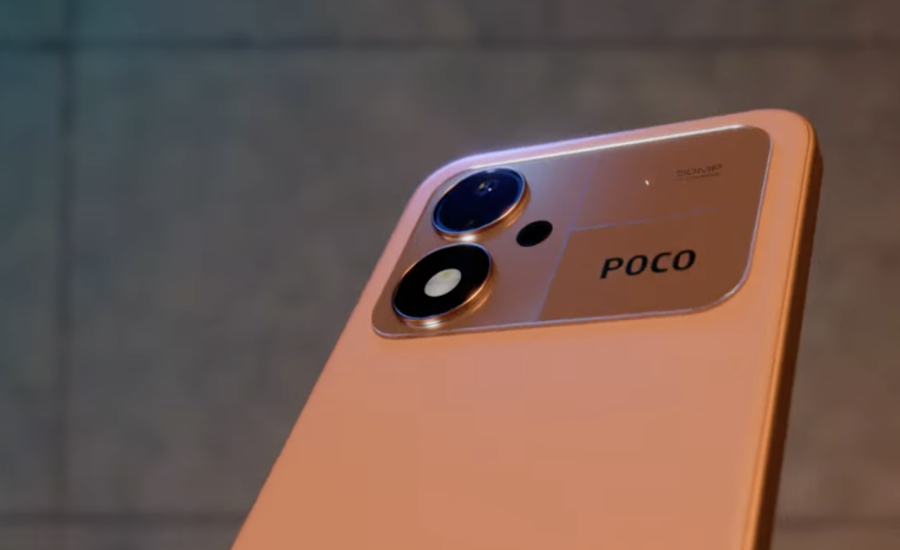
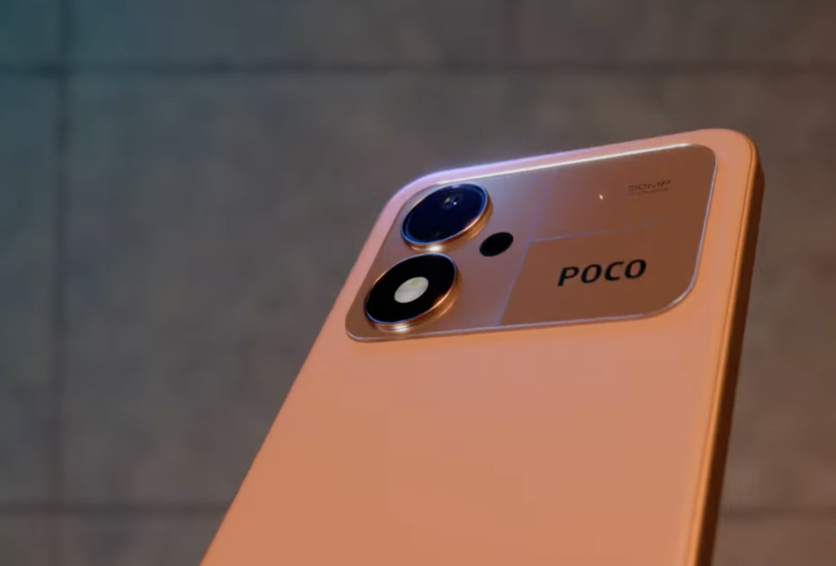
POCO officially launched the M8 Power in India on August 4, kicking off sales August 7 exclusively through Flipkart at ₹24,999 (approximately $262) for the 6GB/128GB configuration and ₹27,999 (approximately $294) for the 8GB/128GB model. Bank card offers of up to ₹3,000 effectively bring the entry price to around ₹21,999 (approximately $231) for eligible buyers. For anyone who has been watching this device since POCO’s July 20 Flipkart teaser, the confirmed at ₹24,999 base price lands about 25% above the ~₹20,000 estimate that observers had been working with — a meaningful gap worth knowing before August 7.
The headline specification is an 8,000mAh silicon-carbon cell in a phone that measures 8.4mm (0.33 inches) thick and weighs 225 grams (7.9 ounces). Those two numbers together tell the real engineering story: silicon-carbon battery chemistry has now reached the Indian budget tier. Until recently, this anode technology was exclusive to Chinese flagship and upper-mid-range devices costing $400 or more. Apple has not deployed it at any price point. Samsung began offering it in its 2026 foldable lineup. An Indian buyer spending $262 on a POCO in August 2026 is receiving anode chemistry that a $1,000 Samsung Galaxy customer was only just beginning to see this year.
What Makes an 8,000mAh Cell Fit in an 8.4mm Frame
A conventional lithium-ion battery uses graphite as its anode material. Graphite can hold approximately graphite stores 372 mAh per gram of anode material. Silicon can hold roughly ten times that — up to 4,200 mAh per gram in theory — which is why phones using silicon-carbon anodes can fit dramatically more capacity into the same physical volume and achieve the capacity advantage over graphite anodes that engineers have been pursuing for years.
The engineering challenge is that silicon expands 300 percent during charging when it absorbs lithium ions. Left unaddressed, that volumetric swing fractures the electrode and kills the cell within weeks. The solution — embedding silicon particles in a carbon matrix — uses carbon’s structural rigidity to buffer the expansion while still capturing most of silicon’s storage advantage. The result in commercial cells is typically a 20–50% energy density improvement over an equivalent graphite-anode cell. For the M8 Power’s geometry, that improvement is what makes 8,000mAh possible without a chassis that looks like a power bank.
POCO rates the battery at 1,600 rated charge cycles before dropping to 80% of its original capacity — a longevity figure that reflects the controlled 45W charging speed. Faster charging generates more heat per cycle, which accelerates silicon degradation. The 45W ceiling is not a cost-cutting oversight; it is the tradeoff Xiaomi made to reach that rated cycle life. A buyer comparing the M8 Power against competitors offering 66W or 80W charging at similar battery capacities is comparing across a genuine engineering tradeoff: faster top-up now, or longer battery health across years.
The battery carries a TÜV certification and, per POCO’s own marketing claims, delivers approximately 8 hours of additional use from 10 minutes of charging. The company’s stated endurance figure is approximately three days of typical use — consistent with the Redmi Note 17’s Chinese marketing claim of ~2.33 days, though independent testing of the India variant has not yet been conducted.
What POCO Traded to Hit ₹24,999
The silicon-carbon cell and the 6.9-inch Samsung E4 AMOLED display (120Hz, 1,800 nits peak) are the two specifications where the M8 Power reaches beyond what its price tag would typically justify. The platform underneath is deliberately chosen for efficiency rather than raw performance.
The Qualcomm Snapdragon 4 Gen 4 is built on a 4nm process node — the same manufacturing generation as Qualcomm’s current flagship silicon — but paired with an entry-level core configuration: two Cortex-A78 performance cores at 2.3GHz and six Cortex-A55 efficiency cores at 2.0GHz, as confirmed by Snapdragon 4 Gen 4 benchmark scores. The 4nm process is the key to the battery equation: a chip built this efficiently draws relatively little power during light tasks and standby, which is when the 8,000mAh cell accumulates its runtime advantage. POCO cites an AnTuTu score above 630,000 in its own marketing; independent measurements place the chip around 593,000–600,000 points — adequate for everyday tasks and sufficient for casual gaming.
The GPU is where the performance ceiling becomes clear. The Adreno 613 is an entry-level graphics unit, and buyers interested in graphically demanding 3D titles at high settings will reach its limits. Streaming, social media, maps, and productivity apps will run without issue; demanding mobile titles will require lowered settings.
Memory and storage follow the same efficient-but-not-premium logic: 6GB or 8GB of LPDDR4X RAM and 128GB of UFS 2.2 storage in both configurations. No 256GB option is available in India. LPDDR4X and UFS 2.2 are one generation behind what upper-mid-range competitors offer — including the Realme P4 Power uses UFS 3.1 storage standard. In daily use the difference is modest for typical tasks, but buyers doing heavy multitasking will notice the margin.
Thermal management is handled by a graphite cooling system spanning 10,416mm² (roughly 16.1 square inches). Connectivity includes dual-band Wi-Fi, Bluetooth 5.1, 5G, USB Type-C, and an IR blaster for controlling external devices.
Display and Build
The 6.9-inch FHD+ AMOLED panel is sourced from the Samsung E4 AMOLED display source — an established display platform known for color accuracy and power efficiency. The 120Hz refresh rate and 1,800 nits peak brightness are competitive for the segment. POCO adds 960Hz PWM dimming combined with DC dimming, a pairing specifically intended to reduce the low-brightness flicker that can cause eye fatigue during extended nighttime viewing. The display covers the full DCI-P3 color gamut.
Front-panel protection is Gorilla Glass 7i. The body carries an IP65 rating — dust-tight and protected against low-pressure water jets from all directions, sufficient for rain and splashes but not submersion. The polycarbonate back features a wide horizontal camera bar and is available in Blaze Orange (an India-exclusive colorway), Black, and Silver.
Cameras and Software
Imaging is not the M8 Power’s primary value proposition. The rear setup consists of a 50MP primary sensor (f/1.8, 5P lens) with 2x in-sensor zoom and a secondary camera. The front-facing camera is an 8MP unit. Both systems top out at 1080p video at 30fps. For buyers whose priorities run in a different order — social-media photography first, battery second — the Realme P4 Power camera and specs offer 50MP with OIS and an ultrawide camera at ₹25,999 (approximately $273) for the 8GB/128GB configuration.
Software is Android 16-based HyperOS 3. POCO commits to four years of major Android OS updates and six years of security patches — a support window that compares favorably with most competitors in this segment. For context, the Samsung Galaxy M47 5G support at ₹22,999 goes further on OS upgrades, offering six years of Android OS updates alongside six years of security patches; the M8 Power’s six-year security patch commitment is competitive, though its four-year OS upgrade window is shorter than Samsung’s commitment at that price. AI features include Circle to Search, Google Gemini integration, and POCO’s own suite of HyperOS tools including AI Sky and AI Eraser.
The M8 Power is a rebranded Redmi Note 17, confirmed through HyperOS firmware model number mapping: 26021PC18I maps directly to the Redmi Note 17’s Chinese code 26021RN18C, where “PC” denotes POCO branding and “I” indicates India. This dual-branding model across M-series generations is consistent with POCO’s established India playbook; the M6 Plus followed the same pattern as a rebranded Redmi model.
What the Competitors Offer Right Now
The sub-₹30,000 Indian endurance segment is genuinely competitive, and the M8 Power does not have the battery category to itself.
The Realme P4 Power launched earlier this year with a 10,001mAh battery — 25% larger than the M8 Power’s cell — a 6.8-inch 1.5K AMOLED at 144Hz, UFS 3.1 storage, and a 50MP OIS main camera, starting at ₹25,999 (approximately $273) for the 8GB/128GB configuration, as shown in its Realme P4 Power India launch specs. Its platform, the MediaTek Dimensity 7400 Ultra, represents a meaningful step up in GPU performance from the Snapdragon 4 Gen 4. The P4 Power is a Realme — a Chinese brand subject to China’s national intelligence and data-sharing legal framework, like POCO — but its hardware envelope is broader.
Samsung’s Galaxy F-series offers a different tradeoff axis: a brand not subject to Chinese intelligence law, longer software support track records across the range, and a presence in physical retail India-wide. Buyers for whom the data-sovereignty dimension matters will weigh Samsung against POCO on that axis before comparing AnTuTu scores.
What Xiaomi’s Chinese Legal Framework Means for M8 Power Buyers
POCO operates as a wholly-owned Xiaomi business unit. Xiaomi is incorporated and headquartered in Beijing. That corporate structure means the M8 Power is subject to China’s national intelligence legal framework regardless of how the device is branded, where its servers are located, or what its privacy policy states.
Three Chinese laws create the operative conditions:
China’s National Intelligence Law 2017, in its Article 7, requires all organizations and citizens to support, assist, and cooperate with government intelligence work. The Article 7 intelligence cooperation requirement leaves no carve-out for privately operated corporations. The Data Security Law (2021), covered in the China’s Data Security Law 2021 article, governs data creation, storage, and transfer within China and provides a government-access framework. The Cybersecurity Law (2017, amended January 2026) requires data localization in designated sectors and mandates government review of data exports.
Together, these laws mean a Chinese government agency presenting a valid intelligence or security request to Xiaomi can legally compel the company to produce user data. Xiaomi states it does not provide backdoors or direct government access. What Xiaomi cannot state is that it would refuse a legally valid Chinese government intelligence demand.
Data categories on the M8 Power that could be subject to such a demand include location history, usage patterns, call metadata, app data, and any content processed through HyperOS’s built-in features. Lithuania’s National Cyber Security Centre Lithuania documented Xiaomi censorship capability in 2021, finding that a Xiaomi device contained a built-in capability to filter politically sensitive search terms; Taiwan’s communications regulator found similar capabilities the following year.
Buyers can reduce — but not eliminate — their exposure: keep the device on a separate Wi-Fi network from primary devices, use a third-party browser rather than the built-in Xiaomi browser, minimize permissions granted to HyperOS system apps, and disable cloud sync for categories of data not requiring backup. None of these steps remove the structural legal obligation Xiaomi operates under.
For buyers whose primary consideration is battery endurance and screen size at a budget price, and whose data profile does not include sensitive professional or personal information, the M8 Power’s hardware case is strong. For buyers who handle sensitive data or work in contexts where state-level data exposure would be consequential, that risk assessment belongs before the AnTuTu score comparison.
All currency conversions in this article are approximate, based on exchange rates as of August 4, 2026, and are subject to change.
Frequently Asked Questions
What makes silicon-carbon battery technology different from a conventional smartphone battery, and why does it matter at ₹24,999?
A conventional lithium-ion battery uses graphite as its anode material, which can store about 372 milliamp-hours of charge per gram. Silicon stores roughly ten times more — which is why silicon-carbon cells can fit meaningfully more capacity into the same physical volume without making the phone thicker. In the M8 Power’s case, this is how an 8,000mAh cell fits inside an 8.4mm (0.33-inch) frame. Until 2025–2026, silicon-carbon anodes were largely confined to Chinese flagship and upper-mid-range devices priced at $400 or more. Apple has not deployed this chemistry at any price tier; Samsung only began offering it in its 2026 premium foldables. A buyer at ₹24,999 ($262) is now receiving anode chemistry that outpaces what Western flagship buyers were getting just a year ago.
Is the POCO M8 Power the same phone as the Redmi Note 17?
In all material respects, yes. The HyperOS firmware model number 26021PC18I maps directly to the Redmi Note 17’s Chinese code 26021RN18C — “PC” for POCO, “RN” for Redmi, “I” for India. The India variant carries confirmed differences: the Blaze Orange colorway is exclusive to India and not available on the Chinese model, and the software stack is confirmed as Android 16/HyperOS 3 throughout. Hardware specifications are consistent with the Redmi Note 17 as launched in China on July 14. POCO has employed this dual-branding model across multiple M-series generations in India.
What privacy and data risks come with using a POCO or Xiaomi phone in India?
POCO is a wholly-owned Xiaomi business unit, and Xiaomi is legally incorporated in Beijing. China’s National Intelligence Law (2017) requires all companies and citizens under Chinese law to cooperate with government intelligence requests — an obligation that applies regardless of where the company’s servers are located or how the device is branded. Two additional laws, the Data Security Law (2021) and the Cybersecurity Law (2017), create a framework under which a Chinese government agency presenting a valid security request can legally compel Xiaomi to produce user data. Lithuania and Taiwan have both previously documented security concerns with Xiaomi devices. Buyers can reduce exposure through network segmentation, third-party browser use, and permission management, but no mitigation eliminates the underlying legal framework.
How does the Snapdragon 4 Gen 4 perform, and is it good enough for gaming?
For everyday tasks — streaming, social media, calls, productivity apps — the Snapdragon 4 Gen 4 is fully capable. Its 4nm process node keeps power draw low, which is precisely what makes the three-day battery estimate possible. For gaming, the picture is more nuanced: the Adreno 613 GPU handles casual titles without issue, but graphically demanding 3D games at high settings will require lowered quality settings. Independent AnTuTu measurements place the chip around 593,000–600,000 points overall, somewhat below POCO’s stated marketing figure of above 630,000. Buyers prioritizing heavy mobile gaming in this price range would find better GPU performance from the Dimensity 7400 Ultra in the Realme P4 Power, though at the tradeoff of a higher entry price.