Saturn’s two-toned moon Iapetus passes through superior conjunction, sitting just south of the ringed world this morning.
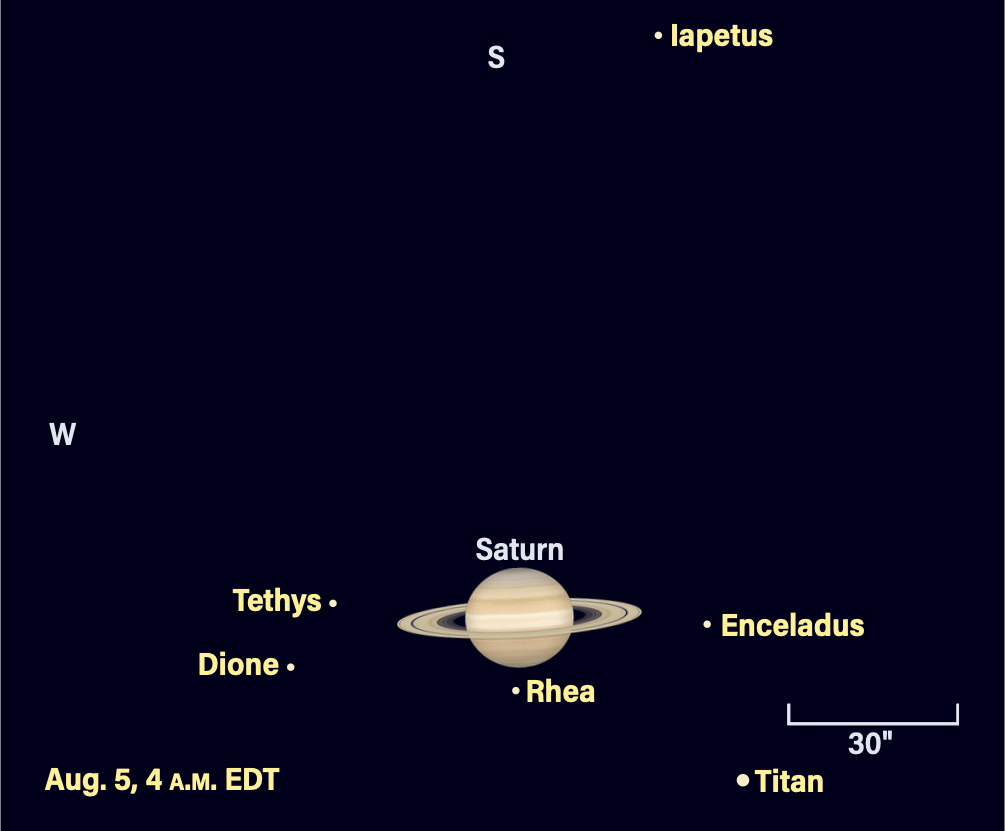
Iapetus is south of Saturn on Aug. 5, at its brightest (11th magnitude) for the month. Note that only moons brighter than 12th magnitude are shown. Credit: Astronomy: Roen Kelly
Looking for a sky event this week? Check out our full Sky This Week column.
August 4: Asteroid Bamberga on the move
Titan has now moved in closer to its parent planet, Saturn, while the elusive moon Iapetus passes through superior conjunction and also sits close to the ringed world. It’s a great opportunity to view the latter, whose brightness can vary by some two magnitudes, depending on which portion of its surface is turned earthward.
Saturn rises just before 11 P.M. local daylight time and is best viewed in the early morning, around 4 A.M. At that time, turn south and look for the brightest object in this region, about 50° high — that’s the ringed planet. Through a telescope, you’ll spot several moons, starting with mid-8th-magnitude Titan just northeast of Saturn. Tenth-magnitude Rhea, Tethys, and Dione are closer to the planet; their relative positions change quickly, so they may not appear in exactly the same locations as on the chart above. You may or may not see Enceladus, which is roughly 12th magnitude, so don’t be concerned if you can’t find it, even with the chart.
The crowning achievement is Iapetus, which now sits just under 2’ south of Saturn, glowing at magnitude 11. By the time it reaches eastern elongation later this month, it will be over 9’ from Saturn and have dropped by a magnitude to roughly the same brightness as Enceladus, making it a real challenge to spot.
Sunrise: 6:02 A.M.
Sunset: 8:09 P.M.
Moonrise: 11:30 P.M.
Moonset: 1:30 P.M.
Moon Phase: Last Quarter
*Times for sunrise, sunset, moonrise, and moonset are given in local time from 40° N 90° W. The Moon’s illumination is given at 10 P.M. local time from the same location.
Last Quarter Moon occurs at 10:21 P.M. EDT on the 5th, shortly before Mercury passes 8° south of the star Pollux in Gemini at midnight EDT. As Gemini rises shortly before the Sun on the morning of the 6th, the planet Mercury is just over 7° due south of the constellation’s beta star, Pollux. An hour before sunrise, nearly all of Gemini has cleared the eastern horizon, and Mercury shines at magnitude –0.3 nearly 5° high. You’ll spot it to the lower right of Pollux, which is the brightest star in the Twins and sits closer to the horizon than Castor (Alpha [α] Geminorum), which is a tad fainter and stands about 4.5° directly above Pollux as the constellation rises.
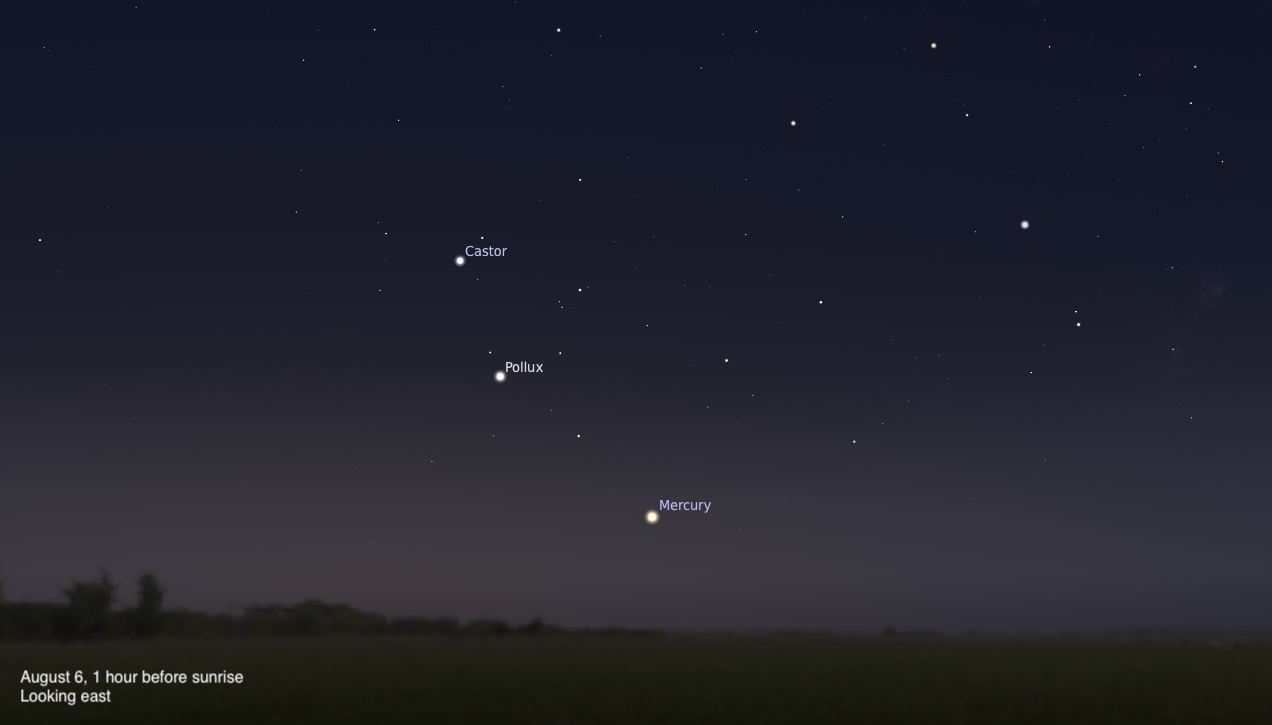
If you’ve got a telescope, you’ll note that Mercury has changed in appearance from earlier this week. Its disk now spans 7” but is more than half lit, showing off a 54%-illuminated gibbous phase. Again, you’ll need steady seeing to clearly make out the phase, but you may get lucky if you spend some time with it as the sky slowly lightens. As always, make sure to put away optics several minutes before sunrise from your location to protect your eyes.
Alison Klesman is senior editor of Astronomy magazine. She holds a Ph.D. in astronomy and has studied a variety of topics, from minor planets to supermassive black holes.