
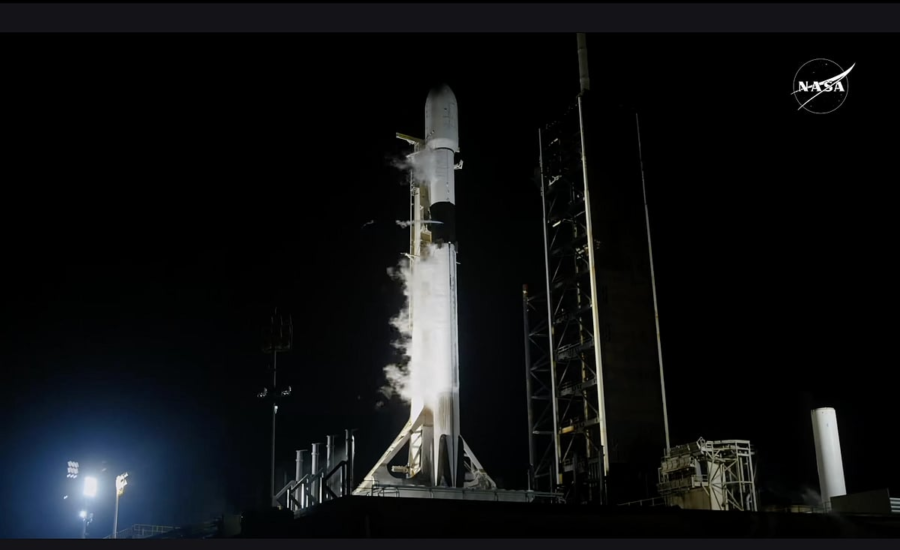
NASA will attempt to observe a discarded SpaceX rocket stage as it crashes into the Moon on August 5, 2026 in an unplanned collision that poses no danger to Earth but could offer scientists useful lunar data, .
The used Falcon 9 upper section, also known as “stage”, is expected to hit the lunar surface near the Einstein and Bell craters, according to NASA. The impact could create a crater about 60 feet wide and 12 ft deep, throwing dust and rock outwards as ejecta, NASA said.
The rocket stage was launched on January 15, 2025, when SpaceX’s Falcon 9 successfully deployed Firefly Aerospace’s lunar lander under NASA’s initiative, NASA said. Solar activity and gravitational forces later pushed the spent stage on an unplanned path back towards the Moon.
Independent astronomers first identified the trajectory using publicly available data, before NASA’s Center for Near Earth Object Studies at the Jet Propulsion Laboratory confirmed that the stage had a 100 per cent chance of impacting the Moon.
The object, described as roughly the size of a school bus and weighing about four tonnes, is expected to strike the Moon at about 5,400 miles per hour, according to . The collision is expected at around 06.35 GMT, or about 1 pm Indian Standard Time, according to a report.
Impact offers science opportunity, revives space junk debate
The impact will not be visible to the naked eye from Earth, but NASA said it would attempt to observe it in real time using ground-based telescopes. Weather and lighting conditions could make observations difficult, NASA said.
NASA’s Lunar Reconnaissance Orbiter and the ShadowCam instrument aboard South Korea’s Korea Pathfinder Lunar Orbiter will also look for opportunities to image the impact site before and after the collision, NASA said. The availability of images will depend on lighting, orbital timing and spacecraft position, and it could take several days to receive them.
Scientists say the event could help them study how material is thrown up by lunar impacts and improve models used for future exploration missions, NASA said. Because the Moon has no atmosphere to slow incoming objects, it is struck by meteoroids daily.
Human-made impacts are less common, but they have happened before. A Chinese rocket stage struck the far side of the Moon in 2022, while NASA intentionally crashed a rocket stage into the Moon in 2009 to study the plume of lunar material it created, The Guardian reported.
NASA said disposing of upper stages on the lunar surface is considered a technically accepted and safe option in some mission profiles, particularly where controlled impact provides a predictable end-of-life outcome.
But astronomers said the collision also highlighted concerns about space debris. Bill Gray, an astronomer who published a report on the stage’s impact, said the event was of “probably minor” scientific interest but also pointed to “carelessness” in how leftover space hardware is disposed of, The Guardian report stated.
NASA said it remains committed to debris mitigation and responsible disposal practices to safeguard Earth, its orbital environment and other planetary bodies.