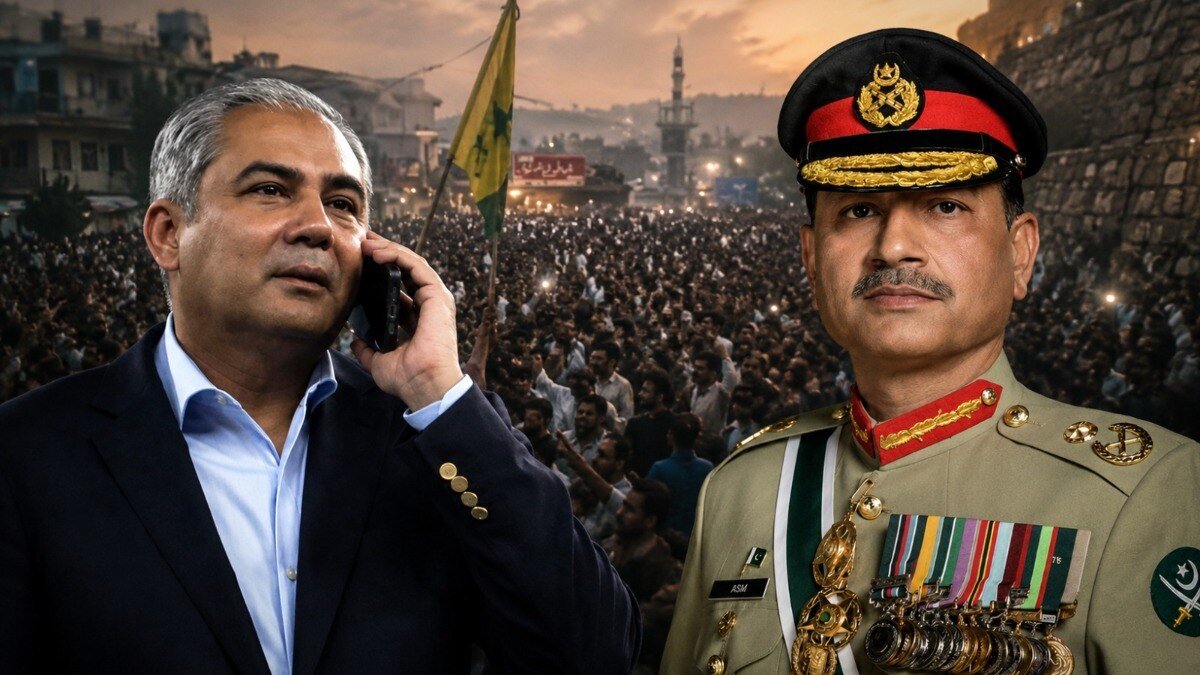
He’s working to control the population in Pakistan. He’s also reviewing the Islamic Republic’s monsoon preparedness. Pakistan’s strategic nuclear command is under his watch. He’s also the de facto chief of all three armed services. He’s Field Marshal Asim Munir, Pakistan’s de facto ruler. If he’s doing it all anyway, why not rule Pakistan outright?
The chief of Pakistan’s hybrid regime and the country’s most powerful man has acquired responsibilities at an unprecedented pace. He’s now looking for more. There’s just one responsibility now left for his shoulders. If recent remarks by Pakistan’s Interior Minister (equivalent to Home Minister in India) Mohsin Naqvi are any indication, the arrangement of the hybrid regime is creaking under the weight of one man, Asim Munir. Pakistan watchers believe a coup (or martial law) might be imminent.
Pakistan’s civilian government has looked toothless over the past year. While Shehbaz Sharif sits at the Prime Minister’s Office in Islamabad, major decisions on diplomacy, internal security and even administrative matters come from neighbouring Rawalpindi. Asim Munir is the ringmaster running the show with the Sharif administration as a garb. The concentration of power by Munir comes even as Pakistan faces simultaneous crises. Its economy is collapsing. Then, there’s insurgency raging in Balochistan and Khyber Pakhtunkhwa. POK is up in arms over instability and worsening governance. And to cover up the establishment’s bloody crackdown, there’s a gag on the international press.
As has been the norm in Pakistan — the land of coups and convenient coincidences — the military chief is becoming the undisputed power centre of the Islamic Republic. With Asim Munir now overseeing almost every domain, and his closest aide Mohsin Naqvi saying that Pakistan’s governance system has “collapsed”, is another coup loading?
Pakistan has seen four military takeovers since 1947. Three elected civilian governments have been overthrown in coups in 1958, 1977 and 1999. In 1969, Yahya Khan replaced fellow military ruler Ayub Khan.
Former Pakistan Army dissident-turned-YouTuber Adil Raja claimed that the military had finalised a plan to replace the current political order. In a YouTube video, he added that Munir could become the President and Naqvi would be the Prime Minister while retaining a “democratic facade”.
Reacting to the developments, Pakistani political scientist and author Ayesha Siddiqa said Munir should either “head home and take the army into the barracks” or “step into the field once and face the nation” by imposing martial law instead of exercising power from behind the scenes. She argued that Pakistan’s governance crisis cannot be resolved through informal military control.
Now, back to why we’re discussing this. The signs have been there ever since former PM Imran Khan was ousted and jailed. They became stronger after Operation Sindoor, when Asim Munir self-promoted himself to the rank of Field Marshal and further tightened his grip. But Munir’s trusted lieutenant, Mohsin Naqvi, declaring Pakistan’s governance system has “collapsed” has added fresh fuel to speculation of an imminent military takeover. Yes, the same Naqvi who still has India’s Asia Cup trophy — which he eloped with — in his possession.
MOHSIN NAQVI’S BOMBSHELL ON GOVT COLLAPSE, AND WHY IT MATTERS
Once a CNN journalist, Pakistan’s Interior Minister Mohsin Naqvi is widely regarded as one of Munir’s closest confidants. The man, with no political experience but considerable clout as a power broker, wasn’t even in politics when he was air-dropped into Shehbaz Sharif’s cabinet through the Senate route (akin to India’s Rajya Sabha). So, he’s no ordinary cabinet minister. He’s the King’s Man. Naqvi also heads the Pakistan Cricket Board (PCB), probably the country’s most powerful office after Munir’s and Sharif’s.
Speaking at an event, Naqvi admitted that Pakistan’s governance system had effectively “collapsed” and argued that the country could no longer continue with business as usual. Though he stopped short of explicitly calling for military rule, his remarks immediately fuelled speculation because of who he is and whom he represents.
Taking a swipe at Interior Minister Mohsin Naqvi, JUI-F chief Maulana Fazlur Rehman remarked, “Naqvi sahab hamare barkhurdaar hain, lekin waqt se pehle baalig ho gaye hain” (Naqvi is like a son to us, but he has grown up before his time). The jibe came weeks after Naqvi had warned the establishment to “take off the uniform and enter politics.”
Incidentally, Naqvi’s political rise coincided with Munir’s consolidation of authority in Pakistan. That is why his remarks drew the attention.
Reacting to Naqvi’s “collapse” remarks, Pakistani author and a Dawn columnist, Yousuf Nazar, argued that “The media and politicians have understandably focussed on Mr Mohsin Naqvi. But the interior minister speaks for the establishment, more precisely for Field Marshal Asim Munir.”
From Nazar’s assessment, Naqvi’s remarks should be read as inseparable from Munir’s growing dominance over Pakistan’s power structure. “By assuming so much power, directly or indirectly, the field marshal has assumed a huge historic responsibility… If the system has collapsed, it is impossible for the Field Marshal to detach himself from it,” he added in the post.
Nazar also asked if Pakistan’s military leadership had diagnosed the country’s real problems. “I was not impressed by Mr Naqvi’s speech. I don’t think he demonstrated any depth of understanding of what ails the country,” he added. Nazar also said that Pakistan suffered from a deeper structural malaise. That, he said, included elite capture, institutional arrogance and a political culture where powerful individuals treat public office like personal property.
Now, a quick rewind through Pakistan’s history of coups, and why we and many others see Munir’s rise as the next one.
PAKISTAN’S COUPS HAVE COME IN TWO FLAVOURS
Pakistan has witnessed multiple military takeovers since independence. They have broadly followed two models. The first is the classic coup. Here, in a coup d’etat, military Generals and Field Marshals overthrow civilian governments, suspend or rewrite the Constitution and impose martial law. Ayub Khan did it in 1958. Yahya Khan followed in 1969. Zia-ul-Haq ousted Zulfikar Ali Bhutto in 1977, General Pervez Musharraf removed Nawaz Sharif in 1999.
In Pakistan, martial law is the suspension of civilian governance and the Constitution. The military assumes direct control of the state. The name “martial” is derived from Mars, the Roman god of war, denoting the rule by the armed forces.
The second model isn’t loud. That’s a soft coup. It’s to rule without formally ruling. Here, the Constitution remains intact. Elections are held. Parliament functions. Prime ministers come and go. But main decisions are taken elsewhere. Foreign policy, nuclear command, internal security and domestic politics remain under the military establishment.
As we have seen, and what Pakistan watchers have argued for years, Pakistan has been operating under this hybrid arrangement for a while now. It has been a gradual process. Since Imran Khan’s fallout with the military in 2022, Munir has steadily expanded his authority. The crackdown on PTI, military trials of civilians, the sidelining of the party ahead of the 2024 elections, the birth of a coalition of convenience (by rivals PML(N) and the PPP), and Munir’s consolidation of power, have all reinforced the perception that Rawalpindi has regained complete control over Pakistan.
Unlike Musharraf, Munir has so far avoided wearing both uniform and civilian office. But he is exercising similar authority without declaring martial law. So, Munir might have been gradually into coup mode, but the question is if a hard coup, or coup d’etat, is on the cards.
Now 58, Asim Munir has no fixed retirement age as the Field Marshal. The recently amended Pakistani laws say the federal government would decide when — or even whether — he steps down. So, he’s here to stay.
IS MUNIR PREPARING THE GROUND FOR A COUP?
Whether Munir is actually taking Pakistan towards another coup is impossible to say with certainty. But several experts and Pakistani observers believe recent developments deserve attention as they might culminate in direct military rule.
Indian Army veteran Major General CM Seth (Retired) interpreted Naqvi’s remarks as an indication that larger political changes could be approaching. Taking to X, retired Indian Army officer Major General Seth said Naqvi’s remarks were an “indication of events to unfold in Pakistan” and that it was “likely that Munir will take over the country and declare martial law.” He, however, added that it was his assessment.
Now, perhaps the more pressing question is whether a coup is imminent.
Pakistani Army dissident Adil Raja claimed, citing two unnamed sources allegedly present at a seven-hour ISI meeting, that Pakistan’s top military leadership had concluded the country’s existing system had “collapsed” and was preparing a new political order.
Raja further claimed Naqvi was tasked with securing political backing for the plan and that constitutional changes would be pushed through “by force if necessary.” He even said that Pakistan President Asif Ali Zardari and his son, PPP chief Bilawal Bhutto Zardari, were “offered a safe exit from Pakistan”.
Only time will tell if Munir eventually chooses to formalise his authority through martial law. From what Adil Raja said, it seems he might continue ruling through a compliant civilian setup. Perhaps more than that is in power now. As Dawn columnist Yousuf Nazar said, by assuming so much authority, Munir has also assumed ownership of Pakistan’s mounting crises. If the system succeeds, the credit will flow towards Rawalpindi.
But if the experiment fails, there would be far fewer civilian leaders left to blame.
– Ends