Antarctica’s Blood Falls may be more than a rusty-looking stream spilling from Taylor Glacier. A study published on August 3, 2026, found molecular evidence of an active community of marine-derived microscopic life in the red mud and sediment around the glacier’s edge.
The discovery suggests this isolated polar desert still carries a biological record of an older connection to the sea. Not just ancient debris. Something is still active there.

That does not mean scientists uncovered a perfectly preserved ancient ocean beneath the ice. The more careful conclusion is that marine lineages appear to have survived and adapted long after seawater was cut off by the advancing glacier.
Blood Falls may be less like a frozen time capsule and more like a living archive. Strange, but real.
A marine fingerprint in red mud
Lead author Angela Zoumplis, now at Yale University, put the central result plainly. “We are not simply seeing genetic leftovers.”
Senior author Andrew E. Allen, based at Scripps Institution of Oceanography and the J. Craig Venter Institute, worked with a team that compared 167 samples. These came from the glacier terminus, nearby freshwater habitats, wind collectors, and McMurdo Sound.
The goal was simple. Where did the organisms come from? And were they actually active?
Earlier 2009 research had identified an active bacterial community in Blood Falls brine. The new work extends that story to eukaryotes, organisms whose cells contain a nucleus.
That group includes diatoms. These single-celled algae live inside glasslike silica shells.
Marine-associated diatoms made up more than 60 percent of the community in red material. In some mud and sediment samples, the proportion was close to four out of five sequences.
That is a strong marine signal.
Why Blood Falls runs red
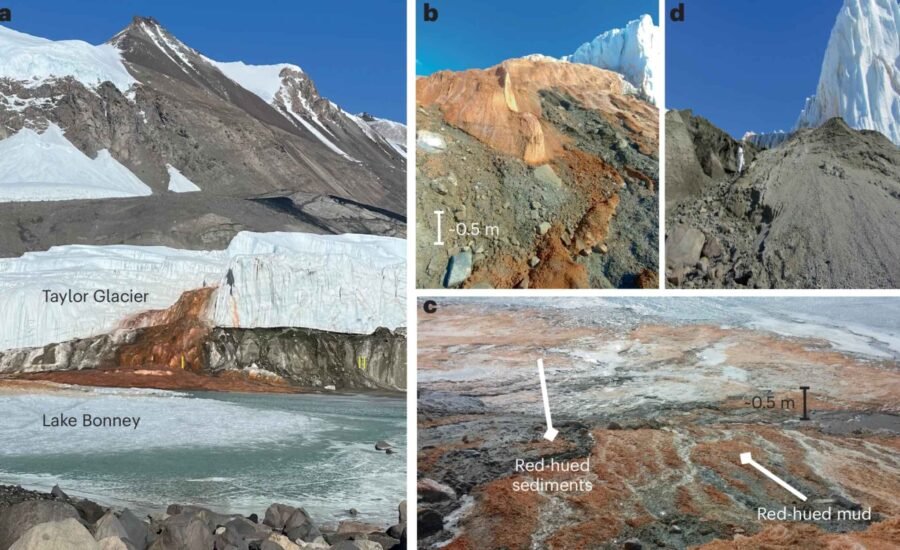
Blood Falls is a short red outflow at the end of Taylor Glacier in the McMurdo Dry Valleys, one of the coldest and driest deserts on Earth.
Its color comes from iron-rich brine, meaning extremely salty water, that periodically escapes from the glacier. When the iron reaches the surface and reacts with oxygen, it stains the ice.
Think of rust spreading across white metal. Only here, the white surface is a glacier.
A 2017 study mapped a brine system inside Taylor Glacier. It showed how salty liquid can move through ice that otherwise remains frozen.
Chemical and isotope evidence points to an ancient seawater source. Researchers believe seawater entered Taylor Valley during warmer periods before advancing ice sealed it away.
Summer meltwater now mixes with that brine near the surface. The result is a rough place to live, with conditions switching between fresher and saltier water.
Not exactly comfortable.
To separate living residents from old biological remains, the researchers used DNA sequencing alongside metatranscriptomics, a technique that examines RNA.
DNA can remain after a cell dies. It is a bit like finding an old footprint.
RNA is more fragile. Because it breaks down relatively quickly, it can provide a more recent snapshot of which genes cells were using when the samples were collected.
The RNA results showed light-using eukaryotes carrying out photosynthesis, respiration, salt control, and cellular repair.
Diatoms and dinoflagellates generated more than 70 percent of the signal from organisms using light for energy. That suggests they were not simply dead passengers delivered to the site.
They were responding to their surroundings. Picture tiny solar panels that can also patch themselves up.
Wind cannot explain it all
Marine diatoms have been found in inland Antarctic deposits before. Scientists have argued for years about how they got there.
One possibility is a past marine incursion, when seawater entered the valley. Another is that strong Antarctic winds carried microscopic material inland.
Earlier research on airborne diatoms found that wind connects habitats in the region. But most of that movement appears to be local rather than spread freely across the entire landscape.
In the new study, modern wind collectors contained very few marine signatures. The red mud and sediment near Blood Falls contained many.
Genetic networks also showed that some marine diatom lineages at the glacier terminus differed from their modern relatives in McMurdo Sound. That pattern fits with isolation over time.
Could wind still have played a role? Yes.
It may have contributed, especially in the distant past. But it does not appear to explain the whole community.
Survival by slowing down
Life at the glacier terminus faces repeated freezing, thawing, salt shocks, iron exposure, and long dry spells.
Compared with modern marine relatives, the diatoms showed greater investment in ion transport, protein maintenance, and DNA repair.
In everyday terms, these cells spend a lot of energy checking the pipes and patching cracks after every storm. Survival may depend as much on repair and flexibility as on growth.
Several groups detected in the study can also form spores, cysts, or resting cells when conditions get worse.
Separate research on the marine diatom Chaetoceros socialis found that its resting spores remained viable for at least nine months.
It is biology’s pause button.
Still, that does not mean the organisms can remain dormant forever. The study offers evidence of survival strategies, not immortality.
What the study does not prove
The researchers did not detect eukaryotes in the deep brine itself.
Their evidence came from red-stained ice, mud, and sediment at the Taylor Glacier terminus. This is the area where brine meets surface conditions and glacier meltwater.
That distinction matters. “Near Blood Falls” is not the same as “living deep beneath the glacier.”
The genetic marker used in the study was also too limited to prove that the lineages are new species. It could not show exactly how long they had been isolated either.
About half of the mapped RNA reads could not be linked to a known group. Limited sample quantities and preservation problems also prevented a full visual examination under a microscope.
So, some branches of the family tree remain blank.
The evidence is strong. But the story is not finished.
A living archive of Antarctic change
Why does all this matter beyond a red stain on some very remote ice?
Diatoms are highly sensitive to salt, water chemistry, and habitat conditions. Their communities can work like environmental witnesses, preserving clues about what an area used to be like.
A marine-derived group surviving in an inland polar desert could help researchers reconstruct how Taylor Valley, the nearby ocean, and the East Antarctic Ice Sheet interacted during earlier climate shifts.
The finding also shows that life can persist in cold, salty, isolated environments without remaining unchanged.
Blood Falls appears to preserve history through survival, adaptation, and occasional dormancy. Not by freezing biology perfectly in place.
It is a living record. And a complicated one.
The full study was published in Nature Geoscience.
—–
Like what you read? Subscribe to our newsletter for engaging articles, exclusive content, and the latest updates.
Check us out on EarthSnap, a free app brought to you by Eric Ralls and Earth.com.
—–