
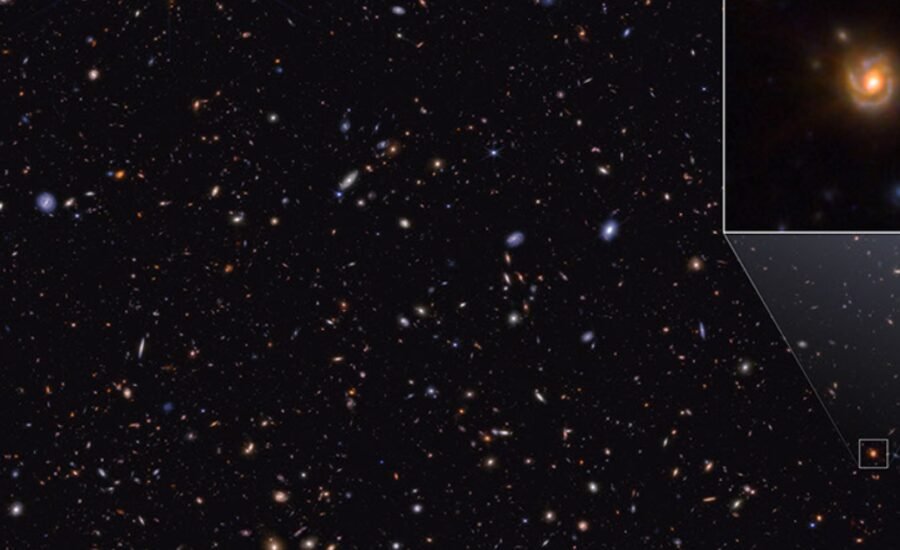
Ever since Webb discovered these compact, glowing red objects in the early universe, astronomers have struggled to explain them. Their light signatures, dense gas clouds and unusual chemical composition refused to fit existing theories. Some scientists suggested they were rapidly growing black holes, while others proposed exotic objects that had never been observed before.
Now, a team led by Devesh Nandal believes they have found a single explanation. Their model suggests that these supermassive stars experienced violent pulsations that repeatedly blasted enormous shells of gas into space, creating a dense cocoon around each star. This cocoon would make the objects appear exactly as Webb sees them—tiny, brilliant and wrapped in thick clouds of hydrogen, helium and nitrogen.
The theory also solves another long-standing cosmic mystery. These gigantic stars would have lived fast and died young, collapsing directly into massive black holes without exploding as supernovae. That process would create “heavy seed” black holes tens of thousands of times the Sun’s mass, giving them a huge head start in becoming the supermassive black holes that already existed less than a billion years after the Big Bang.
If future James Webb observations confirm the theory, the enigmatic little red dots could turn out to be the missing link between the universe’s very first stars and the giant black holes that power the earliest galaxies.