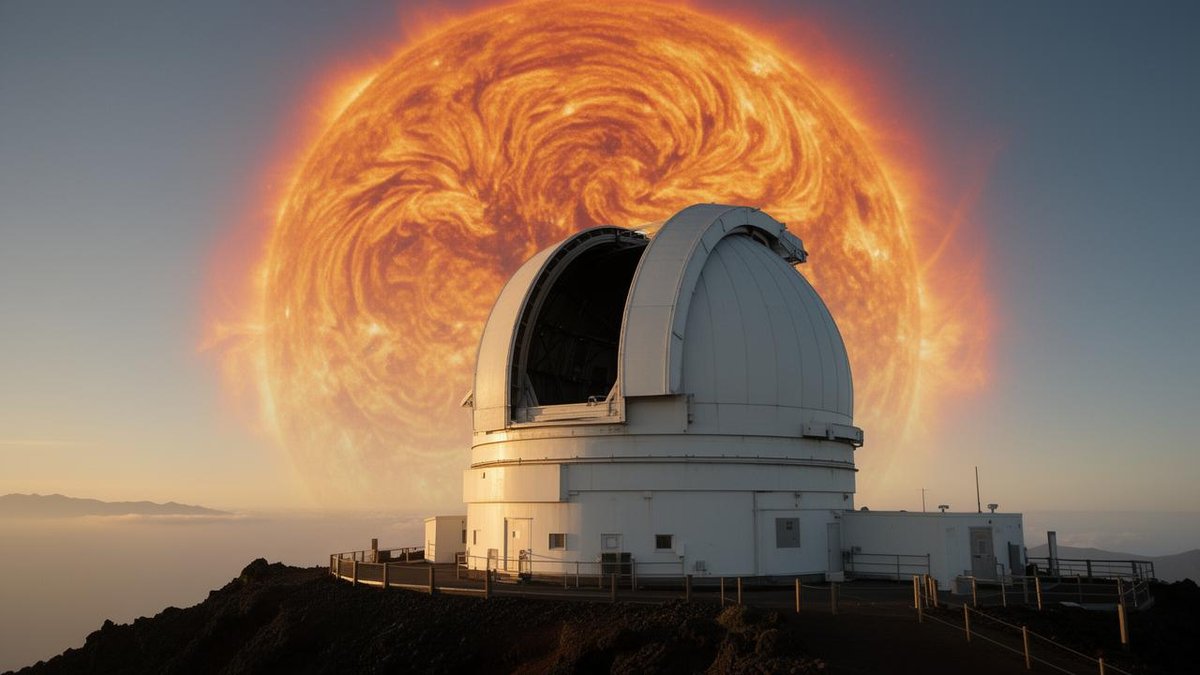
The Daniel K. Inouye Solar Telescope, the world’s largest solar telescope located atop Haleakalā on the island of Maui, Hawaii, has achieved its highest resolution yet in observing the sun’s surface. It has successfully captured, for the first time, vortex phenomena known as “Kelvin-Helmholtz instabilities,” which had been theoretically predicted for many years. This discovery is expected to provide crucial clues to understanding the mechanisms of explosive events like solar flares and coronal mass ejections (CMEs), as well as the long-standing mystery of why the solar corona is heated to ultra-high temperatures exceeding one million degrees. The research findings were published in the international scientific journal Nature on August 5, 2026.
An international research team comprising the U.S. National Science Foundation’s (NSF) National Solar Observatory (NSO), the High Altitude Observatory (HAO) of the U.S. National Center for Atmospheric Research (NCAR), and Germany’s Max Planck Institute for Solar System Research (MPS) used the 4-meter aperture Inouye Solar Telescope to photograph the sun’s photosphere. Along the edges of an active region near a sunspot where magnetic fields are concentrated, they discovered countless small, vortex-like structures resembling waves breaking on an ocean shore.
These vortex patterns perfectly match the characteristics of “Kelvin-Helmholtz instability,” a phenomenon where turbulence grows at the interface between two fluids moving at different speeds, forming wavy or spiral vortices. This classical physical phenomenon, formulated around 1870, has been observed on Earth as patterns on lake surfaces on windy days or in cloud formations, and also in the atmospheres of gas giant planets like Jupiter and Saturn. While it had been theoretically predicted to occur on the sun’s surface, the scale of the vortices was too fine to be resolved by previous telescopes.
To verify the reliability of the observational data, the research team conducted high-resolution magnetohydrodynamic simulations using the MURaM code. The results showed that, consistent with the observational data, vortices were generated along magnetic field boundaries in the simulations. The average spacing between vortices (the wavelength of the instability) showed an extremely high degree of agreement between observations and simulations, both measuring 50 to 65 kilometers. This strongly supports the conclusion that these are real plasma phenomena, not artifacts (artificial noise) from the observation instrument.
David KuriZe, a solar physicist at the NSO and the paper’s lead author, commented, “We were truly amazed by the incredibly fine details and dynamic activity revealed in the high-resolution images. What really surprised us was finding so many Kelvin-Helmholtz instability events. We never expected them to be so ubiquitous throughout the magnetized region.”
The significance of this discovery lies particularly in its potential to elucidate the fundamental “engine” driving the sun’s explosive phenomena. Solar flares and CMEs are thought to occur when magnetic field lines twist together, and the stored magnetic energy is released all at once through magnetic reconnection. However, the driving force that initiates the twisting of magnetic field lines was previously unknown. The countless vortices discovered are believed to occur constantly anywhere on the sun’s surface where strong magnetic fields and shear flows exist, raising the possibility that they function as a “steady driving source” that routinely twists magnetic field lines.
Furthermore, vortices from Kelvin-Helmholtz instability efficiently mix magnetized and non-magnetized plasma. The research team’s analysis indicates that these mini-vortices accelerate the process of diffusing magnetic flux outward from the edges of granules. This suggests they could serve as a previously missing “additional source of magnetic diffusion” for models related to the solar dynamo and the roughly 11-year solar activity cycle.
Friedrich Wöger, a senior scientist at the NSO and co-author of the paper, commented on the application to protecting social infrastructure, stating, “Modern society relies on technologies susceptible to space weather. To better understand and ultimately predict the sun’s most disruptive behavior, we must first understand the fine-scale physical processes that cause it. This discovery reveals one of those processes for the first time at an unprecedented level of detail.”
Solar flares and CMEs are the primary causes of “space weather” that can cause severe disruptions to modern critical infrastructure, including power grids, satellites, GPS, and global communications. The research team plans to introduce automated pattern recognition programs to automatically detect signs of Kelvin-Helmholtz instability from the large datasets acquired by the Inouye telescope. Through long-term, high-frequency observations, they aim to quantify the amount of energy these vortices transport to the sun’s upper atmosphere and their impact on magnetic field diffusion over time, which is expected to improve the accuracy of space weather models predicting flares and CMEs.