
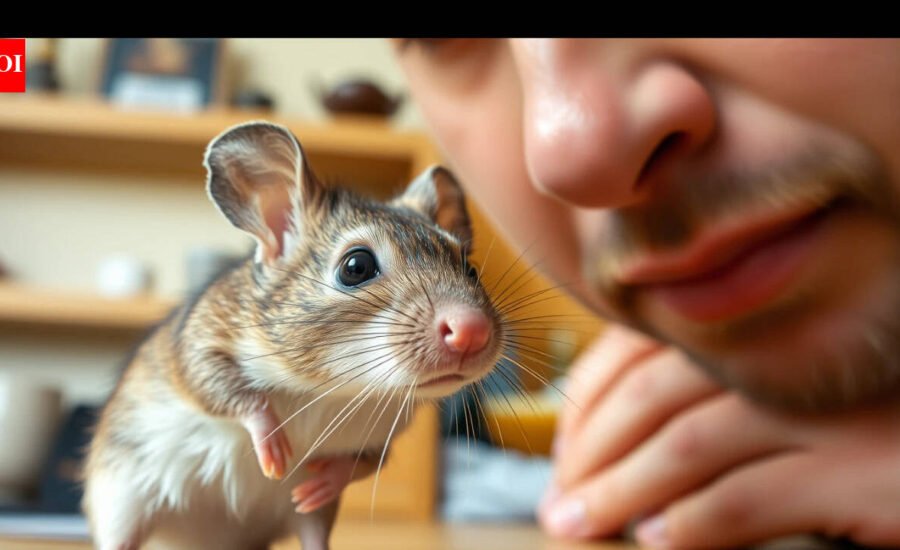
A mouse hunting for food might sniff several times a second. A person checking whether a cantaloupe is ripe usually leans in for a single, unhurried breath. On the surface, these look like completely different behaviours. Two complementary studies from Northwestern University, published together in the journal Science Advances, suggest the brain may treat them in strikingly similar ways. One study found that mice, despite their reputation for rapid-fire sniffing, are capable of a single, deliberate sniff of their own. The other found that a single human inhalation triggers the same brain wave rhythm rodents rely on during their rapid sniffing, hinting at an ancient, shared neural system for smell that has persisted across millions of years of mammalian evolution.
Why rapid rodent sniffing and slow human breathing raised a puzzle
According to Northwestern University, smell is not a passive sense; animals actively control when and how they inhale, shaping the flow of odour molecules into the nose and the information ultimately sent to the brain. Rodents are especially known for their rapid sniffing, while humans breathe considerably more slowly, raising a long-standing puzzle for researchers: how can both species identify and process odours with comparable speed and precision when their actual sampling rates differ so dramatically?The two Northwestern teams approached this puzzle from opposite directions. One group, working in the laboratory of Gordon Shepherd, studied how mice coordinate breathing and hand and head movement while examining food. The other, working in Christina Zelano’s laboratory, recorded activity directly from the human olfactory bulb, the brain structure that receives the earliest neural signals arriving from the nose.
How researchers discovered mice take a deliberate single sniff
According to the study published in Science Advances titled Dexterous single sniffs for ethological active olfaction, researchers in the Shepherd lab, working with collaborators at the University of Pennsylvania and the University of Florida College of Medicine, noticed that mice handling food sometimes paused mid-bite, lifting the food toward their noses before continuing to eat, a brief pause easy to overlook amid their usual rapid sniffing. Led by postdoctoral scholar Mang Gao and research assistant professor John Barrett, the team built a robotic multi-camera system to track freely moving mice as they foraged and ate, recording breathing alongside precise head and forepaw movements.The recordings showed the mice timing a single sniff to the exact moment food reached the nose, with breathing, head position and hand movement all coordinating as one deliberate action, distinct from the repetitive sniffing mice use while actively searching for food. Mice sniffed more strongly when handling less appealing food, but odour alone did not appear to trigger the behaviour. When researchers disrupted the animals’ sense of smell entirely, the single food sniff continued regardless, only stopping once the team silenced the motor cortex, the brain region governing voluntary movement, indicating the behaviour was a deliberate motor choice rather than a reflex. Barrett said the true similarity lies in this single sniff, noting that mice even move their hands while sniffing, which shows the behaviour is volitional, something they are doing on purpose.
How a single human breath matches a rodent’s sniffing rhythm
The second study, led by postdoctoral scholar Andrew Sheriff in Zelano’s lab working alongside Dr Bruce Tan of Northwestern’s Department of Otolaryngology, examined the same underlying question from the opposite direction: how humans manage to identify odours about as quickly as rodents despite sniffing more than ten times slower. According to the second study published in Science Advances titled Theta oscillations are an organisational unit of odour processing in the olfactory bulb, the team used a minimally invasive, high-precision recording method developed in the Zelano lab to measure activity directly within the olfactory bulbs of healthy human volunteers as they took a single intentional breath.That single inhalation triggered low-frequency brain waves known as theta oscillations, in the 2 to 8 hertz range, matching precisely the frequency at which rodents physically sniff. Because human breathing is naturally so much slower than a rodent’s, researchers were able to observe something not easily visible in rodents: that this theta rhythm can continue independently of the physical breath itself, rather than being tightly locked to it as it appears to be in mice.
Why a single human sniff can do the work of several mouse sniffs
According to Northwestern, this finding suggests the human brain does not need a separate breath for each theta cycle. Instead, one slow inhalation can activate several internal processing cycles in sequence, allowing odour information to be divided up and organised rapidly within the span of a single sniff, with the theta rhythm also structuring the faster bursts of neural activity involved in actually analysing the smell itself. Study co-author Qiaohan Yang explained that in rodents, sniffing and theta rhythm are so tightly fused that the two are nearly indistinguishable, whereas the slower human sniff rate pulls them apart, revealing theta oscillation as a distinct, independently generated rhythm that a single deliberate inhalation is sufficient to engage.
Why this shared system could matter for understanding disease
Beyond the basic neuroscience, researchers say the findings carry potential relevance for human health. Changes in sniffing behaviour have already been associated with conditions including autism, Alzheimer’s disease and Parkinson’s disease, meaning a clearer picture of how healthy smell processing circuits normally operate could help researchers better recognise when those systems begin to break down. Sheriff said that understanding this evolutionarily conserved set of mechanisms helps researchers understand how mammalian brains work generally, which could ultimately help explain how they fail in disease, framing the research as a foundation for understanding how to eventually fix these systems when they stop functioning properly.
What the findings suggest about the evolution of smell
Together, the two studies point toward a shared conclusion rather than two separate discoveries. A sniff, whether rapid and repeated in a mouse or slow and singular in a human, is not simply air passing through the nose; its timing can be coordinated with movement, attention and decision making in both species. Mice appear to actively choose when to perform a focused smell check, while the human brain compresses similar underlying neural timing into a single, slower inhalation.Rather than evolving an entirely new olfactory system for humans, the research suggests evolution largely retained the same core mammalian design, adapting how that shared system operates within very different breathing patterns and behaviours, whether that means a mouse deciding whether a crumb is worth eating or a person judging whether a piece of fruit is finally ripe.