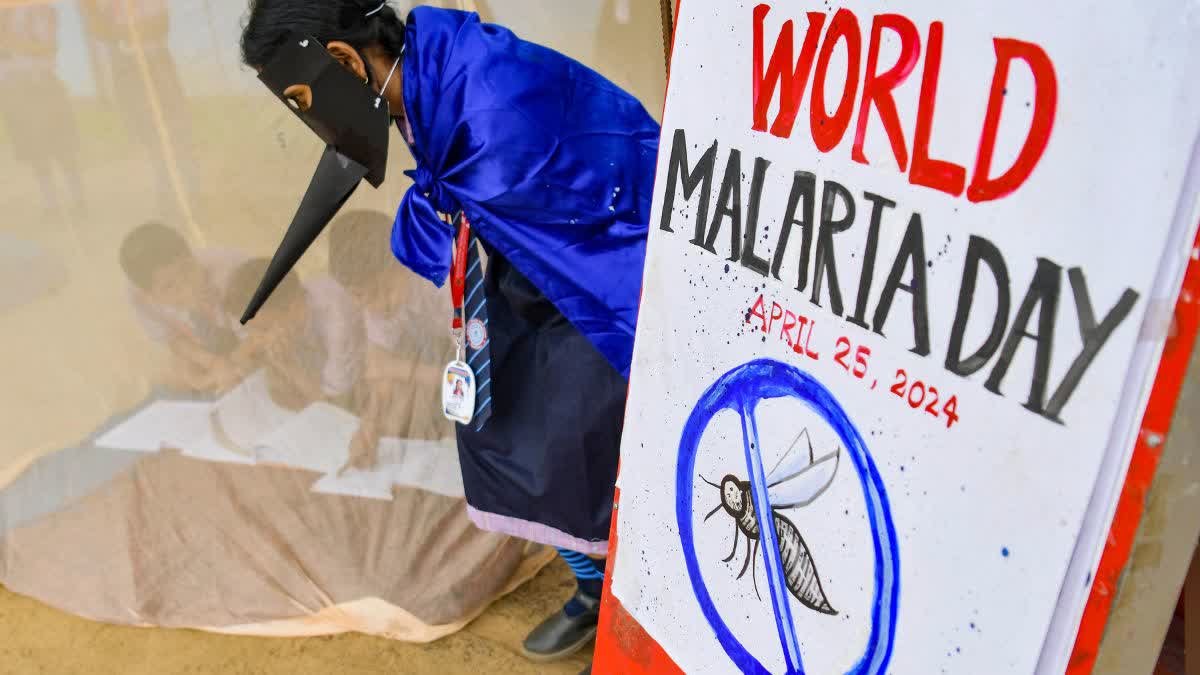
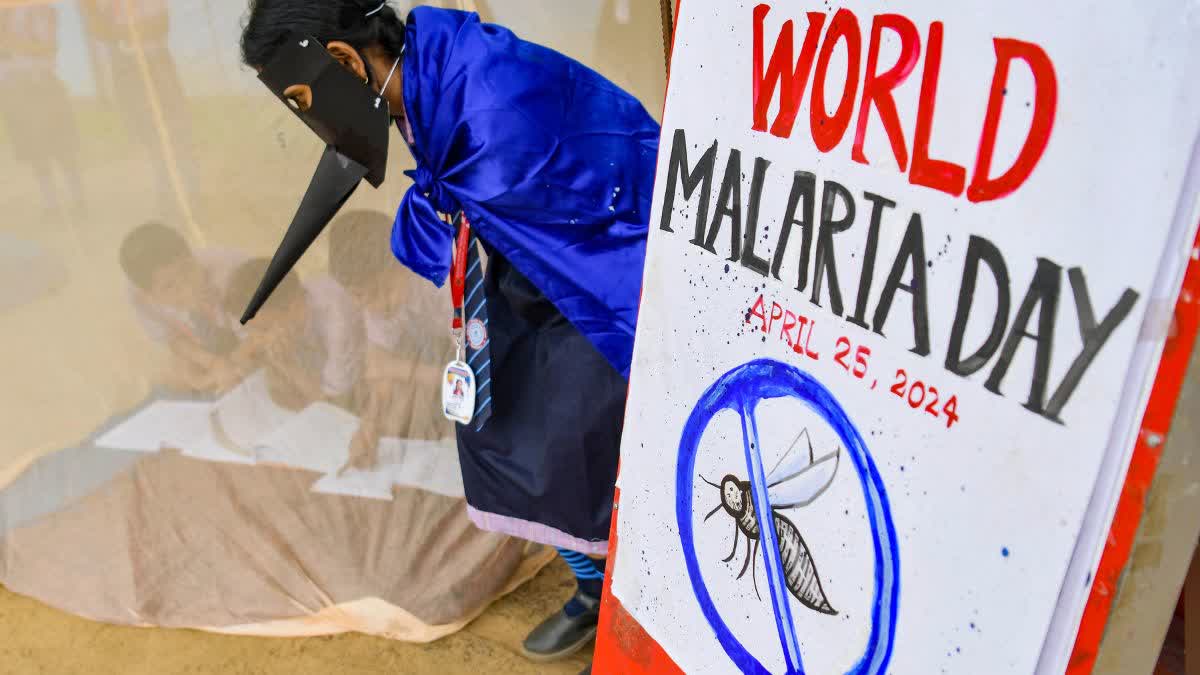
Students in Agartala depict how mosquito nets stop mosquitoes on World Malaria Day (IANS)
New Delhi: Every monsoon, millions of Indians face a familiar but growing threat—not just from floods, but from the mosquitoes that thrive in their aftermath. Diseases such as malaria, dengue, chikungunya, Japanese encephalitis and lymphatic filariasis continue to pose a major public health challenge, particularly in densely populated urban areas, tribal regions and flood-prone states.
Because these diseases spread rapidly and place enormous pressure on healthcare systems, the Health Ministry believes ensuring a steady supply of life-saving drugs is essential to India’s disease-control strategy.
According to government data in possession of ETV Bharat, West Bengal, Odisha, Jharkhand, Chhattisgarh and Tripura emerged as the five states with the highest malaria burden in India during the last three years, while Lakshadweep, Sikkim, Ladakh, Manipur and Puducherry remained among the least affected.
Infographics for Malaria deaths in India (ETV Bharat)
The data further stated that among the worst-affected states, West Bengal remained the country’s leading malaria hotspot, reporting 23,428 cases in 2023, 19,497 in 2024 and 18,872 in 2025. Cases climbed steadily during the monsoon, peaking at 6,094 in September 2023, 5,510 in September 2024 and 4,020 in August 2025, before decreasing towards December, the government data in response to an ETV Bharat RTI query under Right To Information Act stated.
The vector borne disease also accounted for 142 total deaths across the country in the last three years with Maharashtra leading the list of states with 56 casualties followed by Mizoram (17), Odisha (14), Kerala (10), and Chhattisgarh (9) deaths.
Odisha continued to report one of the highest caseloads, recording 32,064 cases in 2023, 56,330 in 2024 and 37,665 in 2025. The state witnessed its highest monthly burden in August 2023 (8,016 cases), July 2024 (14,293) and June 2025 (11,916), indicating an early onset of seasonal transmission.
Jharkhand remained another major endemic state with 29,014 cases in 2023, 32,533 in 2024 and 31,035 in 2025. Monthly infections peaked in June 2023 (11,405 cases), September 2024 (5,264) and August 2025 (4,804).
Chhattisgarh reported 19,461 cases in 2023, 24,887 in 2024 and 18,497 in 2025. Its highest monthly caseload was recorded in July 2023 (4,047 cases), July 2024 (5,525) and June 2025 (4,374).
Infographics for Malaria deaths in India (ETV Bharat)
Tripura also featured among the five most affected states, recording 18,048 cases in 2023, 6,924 in 2024 and 4,552 in 2025. The state’s transmission peaked in July 2023 (4,837 cases), June 2024 (2,741) and June 2025 (1,913) before steadily declining through the remainder of the year.
On the other hand, Lakshadweep reported no malaria cases during the three-year period. Sikkim registered only 6 cases in 2023, 5 in 2024 and 12 in 2025. Ladakh recorded 5, 7 and 7 cases, respectively, while Manipur reported 25 cases in 2023, 26 in 2024 and 67 in 2025. Puducherry also remained a low-burden region with just 4 cases in 2023, 9 in 2024 and 15 in 2025.
Nationally, India recorded 181,785 malaria cases and 56 deaths in 2023, 207,855 cases and 45 deaths in 2024, and 168,414 cases with 41 deaths in 2025. The month-wise trend shows malaria transmission consistently intensifying during the southwest monsoon, with most endemic states recording their highest caseloads between July and September, before declining from October onward.
The sharp contrast between the highest- and lowest-burden states underscores that malaria in India is increasingly concentrated in a limited number of endemic districts, highlighting the need for targeted surveillance, vector control and early diagnosis in high-transmission regions while sustaining elimination gains elsewhere.
Talking to ETV Bharat, Additional Director General in the Health Ministry Dr Sanjay Roy said the Central government keeps monitoring the malaria situation across the country. “We keep sending advisories to states and UTs from time to time. Recently, we have sent an advisory to all states and UTs, promoting malaria elimination activities,” Dr Roy said.
In a latest communication with states and UTs over mitigating vector borne diseases, the Health Ministry has informed about decentralising the procurement of three key anti-malaria drugs under the National Centre for Vector Borne Disease Control (NCVBDC), from FY2026-27.
According to the communication, which is in ETV Bharat’s possession, the procurement of Artemisinin-based Combination Therapy with Sulfadoxine-Pyrimethamine (ACT-SP), Artemisinin-based Combination Therapy with Artemether-Lumefantrine (ACT-AL) for all age groups, and Injection Artesunate will now be undertaken by states, instead of through a Centralised mechanism.
The Ministry has asked states to carefully assess their requirements and procure the medicines in accordance with the prescribed technical specifications available on the NCVBDC website. States have also been directed to regularly update stock details on the Drugs and Vaccines Distribution Management System (DVDMS) portal to ensure near real-time monitoring of availability.
The advisory stresses close monitoring of stocks and expiry dates, directing states to redistribute surplus medicines to other health facilities, districts or states to prevent wastage. It further states that procurement must follow the General Financial Rules (GFR), Procurement Manual and guidelines issued by the Department of Expenditure from time to time.
“Funds for procurement of these medicines will be provided under the Programme Implementation Plan (PIP) of the National Health Mission (NHM),” the letter signed by Dr Pranab Jyoti Bhuyan, additional director, NCVBDC stated.
Also Read: