The total solar eclipse on August 12, 2026 will also serve as a scientific laboratory. NASA-funded teams will follow the Moon’s shadow with an aircraft flying at high altitude, and students will launch 80 balloons to measure the atmosphere’s reactions before, during and after the phenomenon.
A total eclipse occurs when the Moon completely masks the solar disk from a narrow band of the Earth. The corona, the Sun’s outer atmosphere, then becomes visible. Its light is usually drowned out by the much stronger glow of the solar surface.

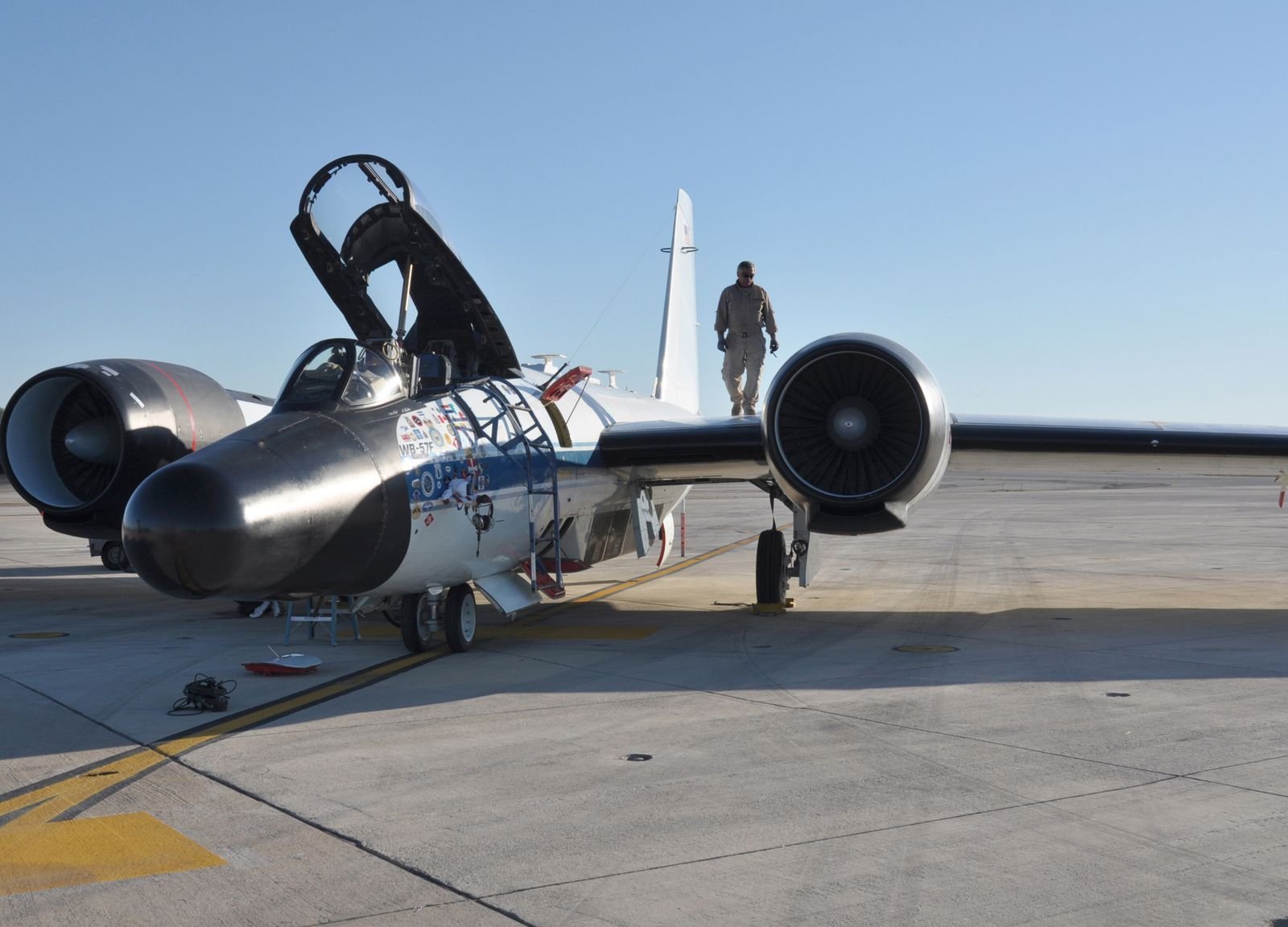
WB-57F belonging to NASA.
Image Wikimedia
The path of totality will notably cross northern Russia, Greenland, Iceland, the Atlantic, a small part of Portugal and Spain. A partial eclipse will be visible over a large part of Europe. In Paris, about 92% of the solar disk will be obscured at maximum.
A NASA WB-57 aircraft will observe the Sun from about 15,000 m altitude. This position reduces some of the disturbances caused by Earth’s atmosphere. The movement of the aircraft will also make it possible to extend the observation time in the Moon’s shadow.
The instruments will track the movements and structures of the corona. The scientists particularly want to study the dynamics of the plasma, a very hot gas made up of charged particles. These measurements can be compared with images taken from the ground and with data from space observatories.
In Iceland and Spain, university teams will launch scientific balloons. In Iceland, 80 launches are scheduled between 18 hours before the eclipse and eight hours after: the sensors will measure temperature, pressure, humidity and air movements near the surface.
The rapid darkening temporarily cools the ground and the lower layers of the atmosphere. The researchers will be able to follow the speed of this reaction and the return to normal conditions. They will also examine the atmospheric waves generated by the rapid passage of the lunar shadow.
The results will be compared with those collected during the North American eclipse of April 8, 2024. The comparison will make it possible to test the same instruments under a different geography; the teams will thus have two campaigns to improve their models of the Sun and of Earth’s atmosphere.