
-
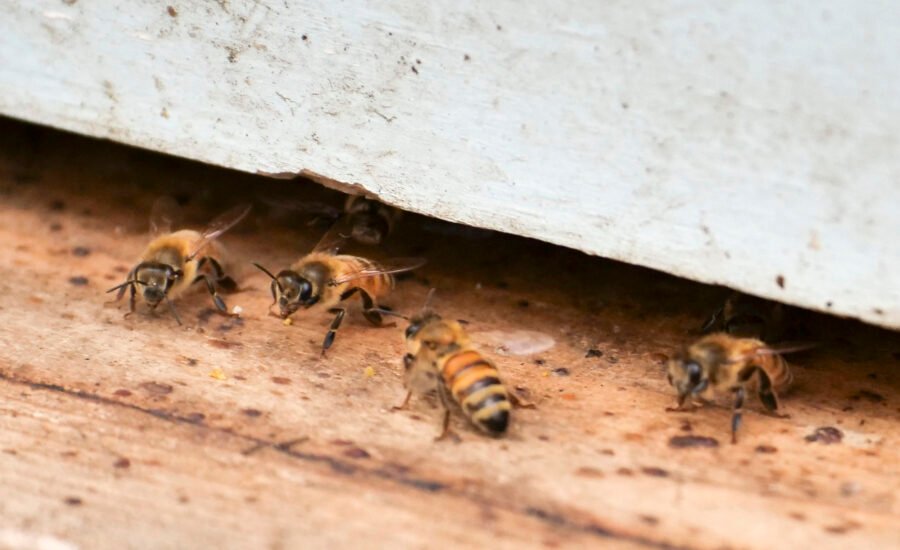
Researchers developed a honeybee-inspired mathematical model to examine whether centralized or decentralized control works best.
-
They found that decentralized control, like honeybees have, may have an edge over systems where one boss calls the shots.
-
The findings have implications for businesses and countries and could inform development of neural networks and multi-agent systems, like drone swarms.
Newswise — August 5, 2026—Do organizations perform better under a single leader or when individuals organize themselves? A new honeybee-inspired study published in the journal PNAS suggests that while both approaches can succeed, decentralized groups may have an edge when communication is strong and there’s just the right mix of risk-takers and cautious followers.
“We found that decentralized strategies of decision making are at least as good as centrally coordinated ones and, in many ways, may be more robust and resilient,” said corresponding author Zachary Kilpatrick, a professor of applied mathematics who studies how animals make decisions.
A honeybee colony contains tens of thousands of individuals performing different jobs to support the hive. Some explore surrounding meadows, foraging and scouting for information. Others stay back, cleaning the hive and feeding the larvae. While the queen lays eggs and chemically signals her presence, she doesn’t determine who does what.
Like honeybees, ants and termites function without a central authority, while animals such as elephants and wolves rely on more hierarchical social structures.
To explore how leaderless societies accomplish complex tasks, Kilpatrick and colleagues Hyunjoong Kim of the University of Cincinnati and Krešimir Josić of the University of Houston developed a mathematical model simulating a bee colony under different decision-making strategies. They found little difference between centralized and decentralized approaches in overall performance.
The model also suggested decentralized groups were more resilient.
“If one individual is making the decisions for an entire group, and that individual dies, gets removed or can’t communicate with the group it leaves it really vulnerable,” Kilpatrick said. “In a decentralized group if you knock out one communication pathway, there are others.”
The researchers also explored how many risk-takers, or scouts, should leave the hive to forage while others remain behind.
The study found that the larger the group, the smaller the proportion of risk-takers it required. This makes sense, because each bee that leaves the hive contributes proportionally less new information to the colony upon return, said Kilpatrick.
“If you send too many foragers out of the hive, you’re going to waste a bunch of energy for little additional benefit,” he said. “The same scaling logic may hold for human groups, where a small team may need half its members exploring while a large field needs only a handful.”
As organizations grow, humans often adopt centralized hierarchies. But the researchers note that many of society’s biggest advances—from scientific discoveries to startups and exploration—begin when individuals break free of these hierarchies and pursue new ideas before others follow.
As new, more complex challenges arise, humans might want to take a cue from the bees, said Kilpatrick.
“Our research suggests that there can be a real benefit to having decentralized, individuated exploration that ultimately gets shared back with the community.”
###
Contact:
CU Boulder Media Relations
[email protected]
Find more media resources | Find more story ideas at CU Boulder Today