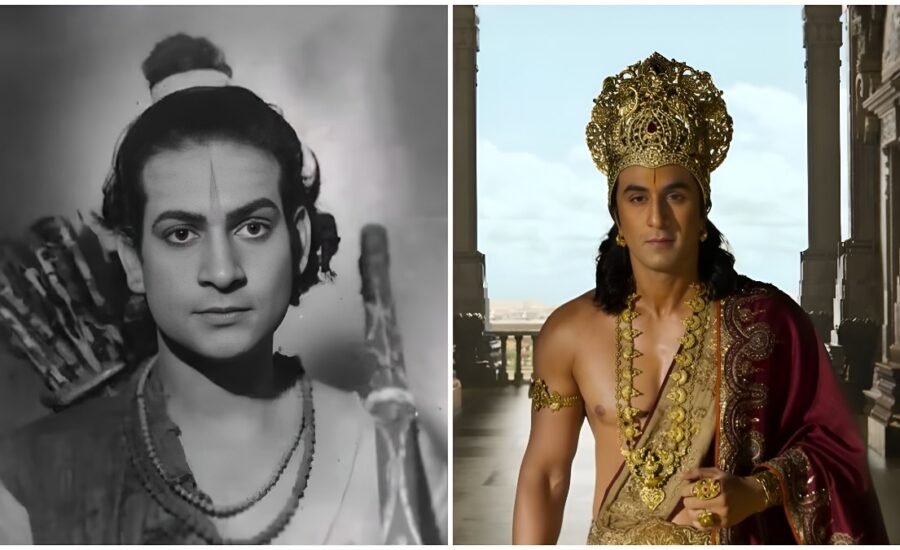
Long before actor Ranbir Kapoor stepped into the role for director Nitesh Tiwari’s upcoming Ramayana films (2026–2027), and even before actor Arun Govil became the definitive face of Maryada Purushottam for millions through Ramayan (1987), one actor had already made the role his own. Prem Adib played Lord Ram in nine films, embodying the character so completely that audiences struggled to see him as anyone else. He transformed the silver screen into a space of quiet devotion.
His journey as Ram began in 1942 with Vijay Bhatt’s Bharat Milap. The film struck such a deep chord that Bhatt immediately cast him again the next year in Ram Rajya. That film carried a rare distinction: it remains the only film Mahatma Gandhi is known to have watched. What followed felt almost inevitable.
Audiences kept asking for more of that serene, measured presence. Prem Adib returned as Ram in Rambaan, then Ram Vivaah (which he produced and directed himself), Ram Navami, Ram Hanuman Yuddh, Ram Lakshman, Ram Bhakt Vibhishan, and the 1954 Ramayan – actually a combination of sequences from Bhatt’s earlier three films. Nine times in all. No one before him – not actors Trilok Kapoor, Mahipal or Shahu Modak – left so deep a mark.
Among these, Ram Vivaah stands apart. The film was produced by Prem Adib, directed by Prem Adib, starring Prem Adib as Lord Ram. It was a rare instance of an actor taking complete ownership of the story that had defined him. From 1943 to the early 1950s, the Adib – Shobhana Samarth pairing as Ram and Sita became so popular that their images appeared in religious publications and calendars hung in homes and even temples.
Before that extraordinary run, Prem Adib’s own story was quieter but no less determined. Born Shiv Prasad Adib in 1917 into a Kashmiri Pandit family, he carried history in his name. In the nineteenth century, his grandfather had received the title “Adib” — meaning a culturally refined person – from the last Nawab of Awadh, Wajid Ali Shah. The family had moved from Kashmir to Uttar Pradesh generations earlier.
Young Shiv Prasad grew up with a quiet obsession for cinema. By college, the pull became irresistible. Without telling his family, he left for Bombay and began the long struggle that so many actors of that time knew. His first break came in 1936 when director Mohan Sinha cast him in Romantic India and changed his name to Prem Adib.
There was a time when the same man who could play stylish, contemporary characters in other films somehow disappeared completely into the grace and restraint the role of Ram demanded. That disappearance was so complete that later generations forgot he had ever looked any other way.
Not every story has a perfect ending. On Christmas Day in 1959, Prem Adib suffered a brain haemorrhage and died at the age of forty-two.
As a new wave of epic storytelling returns to screens – bigger budgets, global ambitions, fresh faces — it feels right to pause and remember the actor who, without the machinery of modern publicity, simply became Ram for an entire generation. In an industry that constantly reinvents its gods, Prem Adib’s quiet, repeated act of becoming still stands as a record no one has quite matched.
As the story of Lord Ram continues to find new voices, audiences will soon return to the epic on the big screen with the two-part Ramayana set to arrive around Diwali in 2026 and 2027.
Around the same time, SS Rajamouli’s Varanasi will also bring its own ambitious, mystical vision to theatres in 2027, weaving elements of the Ramayana into a larger, time-bending canvas.
In that moment of fresh retelling, it feels right to remember Prem Adib — the actor who, long before the machinery of modern spectacle, simply became Ram nine times over and left behind a quiet standard of grace that still holds.
– Ends