
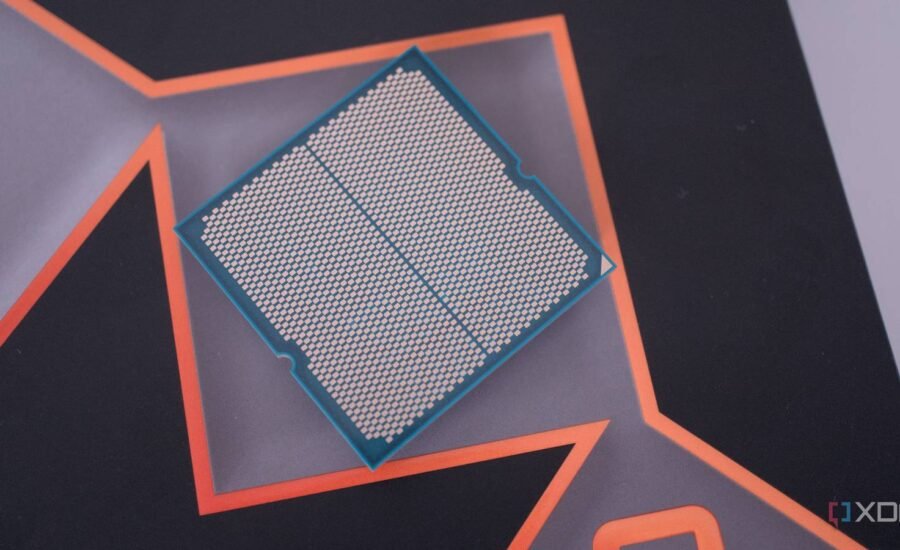
Binning has always been a foundational part of the silicon manufacturing industry. Because no two fabricated chips ever come off the wafer fully identical to one another, the ones that hit the highest clocks with the best power and thermal characteristics get binned as premium SKUs, while the weaker dies from the same design are sold as budget chips.
Sometimes, though, “weaker” used to be a strategic decision rather than relating to a physical defect, and, to fill out product stacks and market segmentation, manufacturers would take perfectly good chips and switch off working cores. A budget quad-core CPU you bought may have started out as a flagship chip, with either cores or cache disabled to hit a price. For a brief window on AMD’s platform, the switch off wasn’t a permanent change. With the right motherboard and a bit of luck, users could flip the dormant cores back and pick up a free upgrade.
AMD used to build entire desktop CPU lineups from one die
The segmentation was for economic reasons

AMD’s K10 architecture, introduced back in 2007, was rather unique. Unlike modern processors where physical laser fuses permanently lock a chip’s capabilities, the K10’s factory-level configuration could often be bypassed by motherboard overrides, which would turn a budget PC into one with flagship potential.
Anyone who knows anything about the silicon industry and fabbing in particular, knows that it’s an expensive affair that demands huge R&D budgets. As such, it was far more cost-effective in manufacturing to design a single, top-tier slab of silicon and then strategically disable cores for lower-end markets, which is a process known as down-binning.
This practice was perhaps most prevalent in the Deneb die, AMD’s 45-nanometer quad-core processor microarchitecture that formed the basis for the Phenom II and some early Athlon II X4 processors. The Deneb die was a native quad-core processor featuring 6MB of L3 cache. A flawless wafer became the flagship Phenom II X4. From there, AMD worked down the stack. If a core failed validation, it was disabled at the factory and the chip was sold as a triple-core Phenom II X3.
However, plenty of X3s were not defective at all, and budget demand routinely outran the supply of faulty dies, so AMD would sometimes take fully functional quad-cores and switch off a core purely to fill the cheaper shelves. The same practice produced the dual-core Phenom II X2, with two cores disabled. Even some early iterations of the budget Athlon II X4s were cut from this larger 258mm2 die with the L3 cache disabled, rather than from the dedicated L3-less Propus die that came a little later.
You could “unlock” the disabled cores
And many enthusiasts successfully gained enormous value out of it

The tool that made unlocking cores possible on these chips happened to be a BIOS feature that AMD themselves introduced on the 790GX chipsets. Advanced Clock Calibration, or ACC, originally launched on AMD’s SB710 and SB750 Southbridges, which were the motherboard chips that handled basic component connections as a way to improve clock stability and advanced timing control.
Enthusiasts, however, soon discovered a wild side effect. If one were to venture into the system BIOS and set ACC’s firmware option to “Auto”, it inadvertently bypassed AMD’s factory locks, which would sometimes lead to a dual-core Phenom II booting up as a quad-core processor. There are many known and documented examples of this behavior as well. TechPowerUp, in an October 2009 review of the single-core AMD Sempron 140, mentioned that pairing the chip with an SB710 or SB750 Southbridge and running the ACC function in BIOS could very well unlock the second core, effectively turning it into an Athlon II X2 processor.
Of course, the silicon lottery still had a role to play in it. If a core was disabled just to meet the budget market’s demand, it ran flawlessly. However, if it had failed factory testing, waking it up meant running into random crashes at times. Despite those risks, manufacturers leaned in hard, and brands like ASRock and ASUS even introduced a simpler, one-click “Unlock CPU Core” (UCC) toggle in their SKUs.
The trick died with modern chiplets, and it won’t come back
Permanent fuses, tiny chiplets, and signed firmware ended it for good
As tantalizing as it may seem to head into your system BIOS, change a few toggles, and turn your Ryzen 5 into a Ryzen 7 processor, the trick no longer applies to modern CPUs. Most of the reason behind it has to do with how modern CPUs are manufactured.
In the K10 era, a disabled core was more often than not just a configuration setting, and a motherboard BIOS toggle could override it. Modern chips, on the other hand, use eFuses, which are on-die fuses blown during the binning process to sever a core or cache block for good. Naturally, no toggle can reverse a physical process.
The die size has shrunk considerably, too. AMD no longer uses monolithic dies like Deneb to fill the range and instead relies on small, standardized Core Complex Dies (CCDs). A processor like my own Ryzen 5 7600X runs a single CCD with two cores fused off. Because these chiplets are small, yields are high, so, there is very little need to disable good silicon to hit budget prices as well.
Modern CPUs now also feature a cryptographic verification and hardware root-of-trust (for example, platform security processors and secure boot chains) when they power on, so if one were to inject a rogue signal to re-enable dormant silicon, the security processor will reject the mismatch and refuse to boot. Previously, Intel sold feature unlocks this way on Xeon platforms, although the scheme has since wound down.
You could really get more CPU than you paid for, back in the day
The era of core unlocking feels unfathomable right now, but it was very real, and quite popular amongst enthusiasts and overclockers back in the day. You’d have to look no further than user forums on overclocking going back to 2008 and 2009 to see what an impact it had on the enthusiast community. Although modern CPUs don’t allow for it, it would certainly be fun to “unlock” my Ryzen 5 all the way up to a Ryzen 7, especially in this hardware economy.