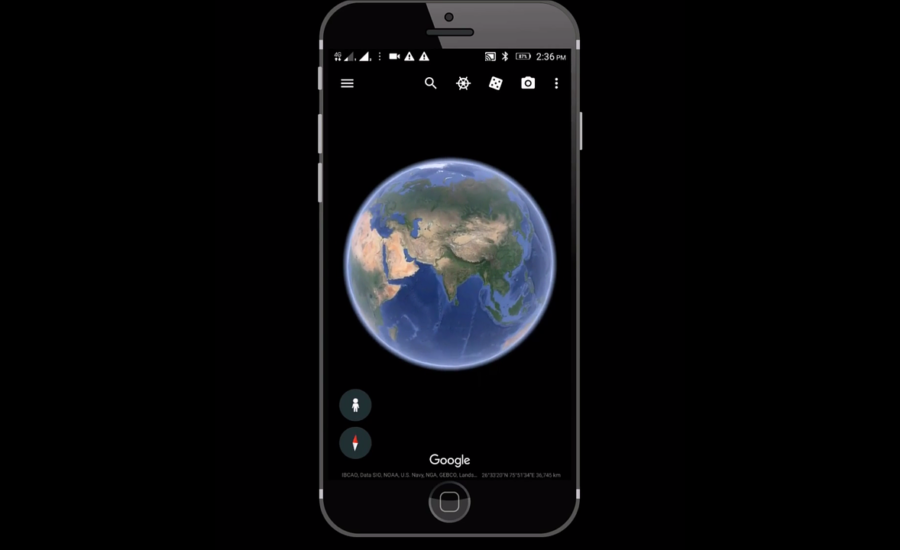
Google has rolled back the image generation feature it introduced in Google Earth less than 48 hours after launch. The company said it had seen users sharing AI-generated images that “appear to violate” its policies and that it is working on implementing stronger guardrails.
In an update to its announcement, Google said: “We know that people uniquely trust Google Earth for a reliable view of the world. We’ve seen geospatial professionals using this feature for a range of useful purposes, however we’ve also seen people sharing screenshots of generated imagery that appear to violate our policies. So we’re rolling back this feature in Google Earth while we work on implementing stronger guardrails. It’s important to note that generated images didn’t appear in the main Google Earth experience for others to see and were watermarked as AI generated.”
What the feature offered: Google Earth launched the AI feature on July 30. It integrated the Nano Banana 2 image generation model into Google Earth. Users could generate AI images using Google Earth’s satellite, aerial and 3D imagery as a base. They only needed to enter text prompts. Google promoted the feature for recreating historical sites, generating educational infographics, visualising real estate projects and imagining future cityscapes.
Fabricated scenes raise concerns: Researchers and experts warned that people could misuse the feature to create convincing fake satellite images. They said users could combine AI-generated content with Google Earth’s real satellite and aerial imagery. BBC Verify tested the tool and generated false images. These included the Eiffel Tower collapsed, a giant sinkhole swallowing the Great Pyramid of Giza, and Russian tanks in Kyiv.
AI and misinformation researcher Henk van Ess also demonstrated the risks. He created images of a fake nuclear power plant in Iran, a refugee camp on the US-Mexico border and a hospital in Gaza with a bomb crater nearby. “The forgery does not have to look convincing on its own. It inherits the credibility of the map it was born on,” he said.
Researchers and geospatial experts warned that attaching AI-generated content to Google’s trusted mapping interface could make false images appear credible. Nathaniel Raymond, executive director of the Humanitarian Research Lab at Yale’s School of Public Health, wrote: “@HRL_YaleSPH deals with attempted disinformation related to overhead imagery and open source info on a near daily basis. Nano Banana opens floodgates to sum of all fears level spoofing of sat data that will hurt vulnerable people.”
Google points to safeguards: Responding to criticism before the rollback, Google said: “We take misinformation seriously, every image created with Nano Banana in Google Earth includes the SynthID digital watermark, so if someone is unsure about an image, they can ask the Gemini app or use Lens in Search to see if the image was AI-generated. In addition, we prevent image creation on harmful topics and are continually updating our protections.”
Despite those safeguards, users and researchers bypassed some content restrictions by modifying prompts. They also shared screenshots of generated images outside Google Earth.
The company has not said when the feature will return. It said it is working on stronger safeguards before restoring image generation in Google Earth.
Read more