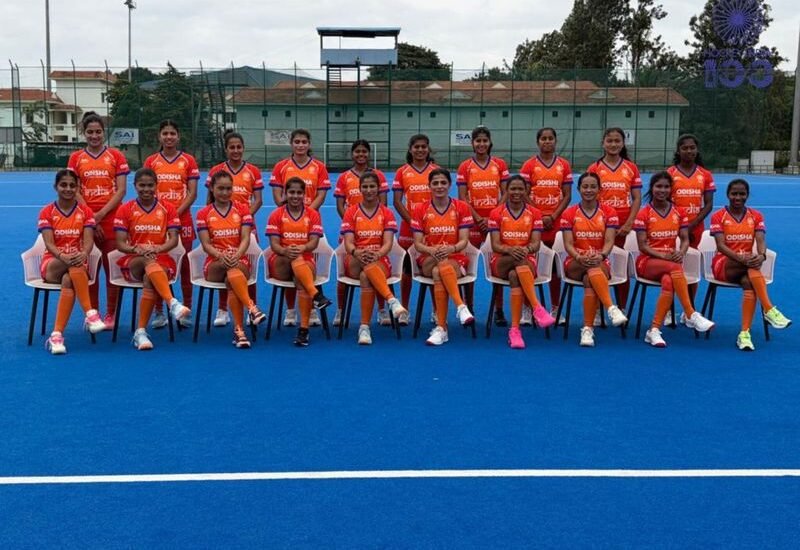
Within the RSS-BJP playbook, saffron denotes Hindu nationalism, civilisational pride, and the core identity of Hindutva. It functions as a master symbol representing cultural resurgence, political dominance, and collective unity.
Hockey India (HI)’s procedurally incorrect announcement to replace the traditional blue jersey with saffron, weeks ahead of the FIH Hockey World Cup in the Netherlands and Belgium, cannot be viewed as a routine administrative or technically-driven decision with the endorsement of unnamed current and former players, and coaches.
Instead, the move should be contextualised within the framework of the broader ‘saffronisation and cultural rebranding agenda’ being pursued by the Union government, state governments run by the Bharatiya Janata Party (BJP) and the party itself, along with cohorts.
Before examining deeper questions, there is a need to recapitulate the least political issue or question – ‘were due processes mandated in running the sports body followed before taking the decision’? The answer is undeniably ‘no’, given the statement of HI president and former player captain, Dilip Tirkey of having no prior knowledge of the decision.
In contrast, HI secretary, Bhola Nath Singh affirmed that “all officials” were aware of the change, an assertion made without identifying any official.
Quite clearly, HI is not being run in the stipulated manner, wherein the executive board is in the loop about important issues – and certainly, a change of jersey colour from one that is just six years short of a century, is a crucial enough matter.
Since 2014 when the Bharatiya Janata Party (BJP) formed a majority government, numerous allegations with due evidence backing these, abound, regarding institutions not being administered as per standard and laid out protocols.
None of these, from lofty constitutional bodies like the Election Commission of India (ECI), Comptroller and Auditor General (CAG) of India, judiciary and the collegium system and numerous others, besides universities, colleges and institutions are run in the manner they should be.
Instead, they are increasingly appearing to be extension arms of the political executive. HI is the latest institution to be added to this list.
The wider issue, previously mentioned, that of today’s political dispensation constantly realigning national symbols with ideological markers, has a deeper role in reformatting the Republic.
One day, this is to make insults to Vande Mataram, the national song, a punishable offence and placing it at par with national flag, the constitution of India, and the national anthem. On another day, it is to change the hockey team’s jersey.
All these efforts are aimed at embedding Hindutva worldview, aesthetics, and symbols into public and institutional life.
Efforts to erase India’s diversities in every field
For more than a decade we have been witness to graded ideological alignment of India’s academic, cultural and sports institutions and even constitutional institutions like parliament, with the Rashtriya Swayamsevak Sangh-BJP (RSS-BJP) ecosystem which reflects a systematic strategy of projecting ‘cultural nationalism’ (Sanskritik Rashtravad), the ideological credo of the Sangh Parivar, as the sole framework to view the Indian nation and our nationhood.
The effort is to erase India’s diversities in every field and replace these with one single monochromatic ideological-cum-cultural brand. HI is merely the latest body to fall to this strategy.
There was a time, at least in private conversations, when BJP leaders were extremely critical of the long-running practise of political leaders, mainly from the ruling party, taking over various sports federations.
Yet, name a sports federation now, beginning with the richest in the country – cricket, and it will possibly be, only a rare sports body that is not run by a person or clique, with direct or indirect linkages to the BJP.
HI secretary, Singh’s colours are revealed by his close association with Brij Bhushan Sharan Singh after having served as vice president of Wrestling Federation of India (WFI) under the latter a few years earlier.
Sports federation office bearers with political links are cozying up with the government of the day, because they require political patronage. The ruling party and government play along because their political objective, of players, teams and administrations being appropriated, within the Hindutva ideological labyrinth is met.
The challenge for adversaries in such situations is to challenge the symbolic ownership, in this instance of the saffron colour, and not allow the tactic to succeed.
There is after all, little doubt that ceding saffron, or other ideas or motifs in other instances – like the Vande Mataram for instance, to a single political movement, is a self-defeating strategy.
In the present context, however much the RSS-BJP tries to depict that they have the proverbial ‘proprietorial rights’ over colour saffron, critics of the bandwagon, cannot but disagree with this formulation.
The challenge for them in this instance is to embrace saffron too, but not support the change of the hockey team’s jersey.
Appropriation of the saffron colour
Following the emergence of the Ram Janmabhoomi Movement in the mid-1980s, the claim of the saffron colour being a symbol of robust or even belligerent Hindutva (also projected as being synonymous to Hinduism), gained currency. From that point, critics of this ideological spectre have not consistently underlined saffron’s pluralistic roots.
They have not consistently projected the colour as being also the chosen colour of the Bhakti and Sufi traditions; saffron was the attire of medieval saint-poets like Kabir, Ravidas, and Tukaram, all of whom, importantly, preached egalitarianism, challenged caste hierarchies, and rejected religious orthodoxy. Furthermore, all of them had followers cutting across communities formed on the basis of religious and caste identities.
By maintaining sullen silence over appropriation of the saffron colour by the Sangh Parivar, its secular ideological adversaries have missed pointing out that saffron or ochre also holds sacred significance across multiple faiths, including Sikhism (Nishan Sahib), Buddhism (monastic robes), and Jainism, as well as in syncretised Sufi shrines.
Repeated attempts to appropriate saffron as the symbol of Hindutva and make it part of the institution, in this case the hockey team’s jersey, has to be also responded by recalling the words of former President S. Radhakrishnan.
Years before moving into the Rashtrapati Bhawan, when the Constituent Assembly unanimously adopted India’s national flag on July 22, 1947, Radhakrishnan explained that bhagwa or the saffron colour denotes sacrifice, renunciation or disinterestedness, and certainly not dominance, for those holding top official positions.
He added that the colour was a constant reminder to those in power and in public service, to remain selfless, be detached from worldly profits, and stay completely dedicated to the nation’s welfare.
In contrast, within the RSS-BJP playbook, saffron denotes Hindu nationalism, civilisational pride, and the core identity of Hindutva. It functions as a master symbol representing cultural resurgence, political dominance, and collective unity.
Critics of the HI’s move for saffronising hockey in India, must emphasise that their opposition is not to the colour per se, but must be rooted in the contention of former players and captains that ‘blue’ has been the historical identity of Indian sports, especially hockey. They must also point to the real ‘intention’ of the handful in HI who have ordered the switch to saffron jerseys.
It must be stated by them that “men (or women) in blue”, is not just a brand identity, but a frequently used way to describe Indian teams.
It has been reported that saffron was sought to be ‘imposed’ on the Indian men’s cricket team before the 2023 World Cup match against Pakistan. This blatantly ideologically-driven move was rejected with unanimity within the dressing room. The hockey team, in HI understanding, are lesser mortals and thereby, were not even consulted.
Hindutva’s adversaries however, must convey that wearing saffron is not a marker of adhering to a specific political agenda.
The objection to the HI decision must not be reduced to rejecting the colour. It must be emphasised that cultural heritage cannot be reduced to being a symbol for partisan hegemony.
Nilanjan Mukhopadhyay reported and wrote on the Ram temple agitation from the 1980s. He authored The Demolition: India At The Crossroads (1994) and The Demolition and the Verdict (2021), updated in 2024.
This article went live on August third, two thousand twenty six, at twenty minutes past eight in the evening.
The Wire is now on WhatsApp. Follow our channel for sharp analysis and opinions on the latest developments.