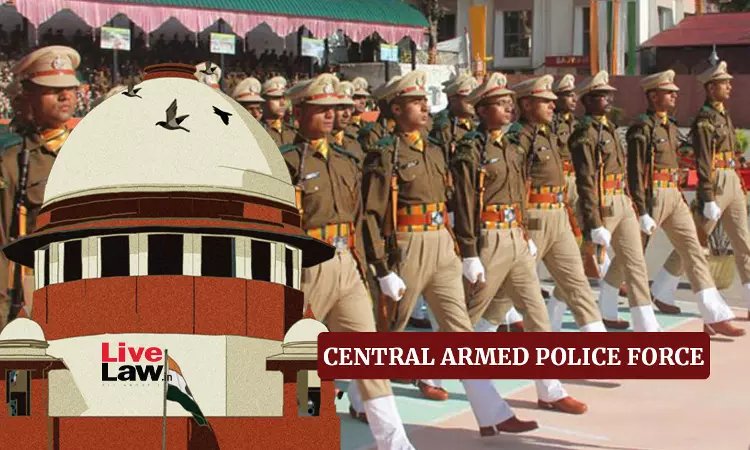
The Supreme Court on Tuesday issued notice to the Union Government on a writ petition challenging the constitutional validity of the Central Armed Police Forces (General Administration) Act, 2026, contending that it amounts to an impermissible legislative override of the Court’s earlier judgment barring the deputation of IPS officers in the Central Armed Police Force (CAPF).
A bench comprising Justice Manoj Misra and Justice Vijay Bishnoi was considering a petiton filed by 34 officers.
The plea seeks a declaration that the Act is unconstitutional on the ground that it violates Articles 14, 16 and 21 of the Constitution as well as the doctrine of separation of powers.
In Sanjay Prakash v. Union of India, decided on May 23, 2025, the Supreme Court (bench of Justice AS Oka and Justice Ujjal Bhuyan) had directed that posts earmarked for deputation in the cadres of the CAPFs up to the level of SAG(Senior Administrative Grade) should be progressively reduced within a period of time, such as two years. The Court also held the Central Armed Police Forces (CAPFs) must be treated as part of Organised Group-A Services (OGAS) not only for the purpose of granting Non-Functional Financial Upgradation (NFFU) but also for all cadre-related matters, including cadre review.


The effect of the judgment was that the deputation of IPS officers in senior CAPF posts must be reduced.
The CAPF Act, which was enacted by Parliament after the judgment, gives it an overriding effect over any judgment of the Court. Section 3 says that “notwithstanding any judgment, decree or order of any court”, the Central Government may, by notification, make rules to provide for the method, manner and mode of recruitment, including promotion and deputation and the conditions of service of officers in the Central Armed Police Force. The provision also specifies the manner in which the posts are to be filled up by IPS deputation. It states that in all CAPFs, 50% of the total posts in the rank of Inspector General, at least 67% posts in the rank of Additional Director General, and all posts in the rank of Special Director General and Director General must be filled by IPS officers on deputation.
The petitioners argue that the CAPF Act has negated the judgments in Sanjay Prakash and and Harananda v. Union of India ((2019) 14 SCC 126), without removing the legal basis of those decisions.
The plea argues that while the legislature is competent to amend the law retrospectively, it cannot simply nullify judicial pronouncements without curing the defects or altering the underlying legal basis on which the judgments were rendered.
It contends that the 2026 Act effectively seeks to negate the effect of the Supreme Court’s decisions through legislative fiat, thereby violating the constitutional principle of separation of powers.
Case : SANJAY PRAKASH AND ORS. v. UNION OF INDIA AND ORS.| Diary No. 29938-2026