Astronomers have captured the most detailed images ever taken of the sun’s visible surface, uncovering swirling, vortex-like patterns that evoke Vincent van Gogh’s “The Starry Night” and unlocking new clues about the fundamental physics driving our home star.
The observations, made with the National Science Foundation’s Daniel K. Inouye Solar Telescope in Hawaii, represent the first direct detection of a phenomenon called Kelvin-Helmholtz instability (KHI) on the surface of any star. Published Wednesday in the journal Nature, the findings provide a long-sought experimental confirmation of a process that theorists have predicted for decades but had never been able to observe on the sun until now.
The still images and time-lapse video reveal continuously growing whirls of hot plasma across a portion of the sun’s photosphere — a relatively thin layer about 60 miles (100 km) deep, compared to the overall solar diameter of roughly 865,000 miles (1.4 million km). The observed vortices range from about 12 miles (19 km) in diameter, the smallest scale the telescope can detect, up to roughly 100 miles (170 km).
“When I was sitting there with my colleagues and we looked at these images for the first time, we immediately recognized these Kelvin-Helmholtz patterns, and we were super excited right away,” Friedrich Wöger, a senior scientist at the National Solar Observatory and co-lead author of the study, told Gizmodo.
KHI, first described in the 19th century, is a dynamic process that unfolds when two parallel streams of fluids or gases slide past each other at different speeds. The interface between them can become unstable and develop wave-like vortices that grow until they break apart — similar to waves forming on a lake or ocean in windy conditions.
On Earth, KHI-driven swirling clouds are a well-known but rare meteorological occurrence, and they have also been spotted in the atmospheres of Jupiter and Saturn. But the solar version operates under far more extreme conditions.
“The difference from the waves and clouds we know here on Earth is that the two interacting fluids are hot plasma — about 6,000 degrees Kelvin and 10,000 degrees Fahrenheit (5,540 degrees Celsius) — moving within a magnetic field that helps create the conditions for the instability to develop,” Wöger said.
A Telescope Built for Discovery
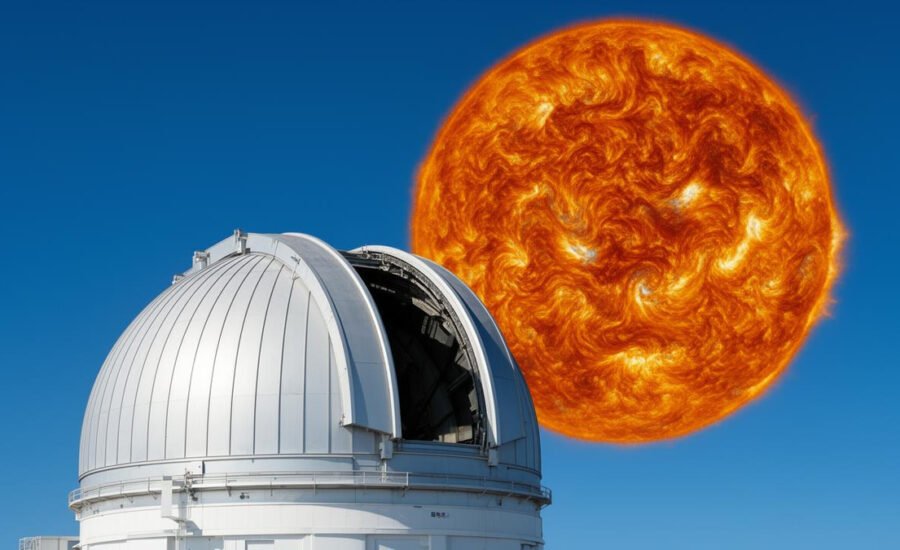
The observations were made possible by the Inouye Solar Telescope, which sits near the summit of the Haleakalā shield volcano on Maui. With a mirror 13 feet (4 meters) across, the telescope collects seven times more sunlight than any other solar instrument, producing exceptionally clear, detailed images of the photosphere.
David Kuridze, an astronomer at the National Solar Observatory and co-lead author of the study, was part of an international team that originally set out to find the best way to fully realize the telescope’s capabilities. Developing and testing different techniques to improve image quality ultimately led to the striking close-ups now published.
“It is very important to understand what is going on at the Sun at the microscopic level,” Kuridze told Gizmodo. “We need to understand those small-scale microscopic fields.”
Solving Solar Mysteries
The discovery could help scientists crack some of the most persistent puzzles in solar physics, including why the sun’s outer atmosphere becomes so staggeringly hot.
While the sun’s surface temperature measures around 10,000 degrees Fahrenheit (5,500 degrees Celsius), its outer atmosphere — the corona — reaches roughly 2 million degrees Fahrenheit, according to the Princeton Plasma Physics Laboratory. That is about 200 times hotter, a discrepancy that has long puzzled researchers because temperature should decrease with distance from the hot surface.
Scientists have hypothesized that KHI contributes to coronal heating, and the new observations provide a pathway to investigate this mechanism more thoroughly. The constant twisting motions generated by KHI can gradually build the energy required to trigger coronal mass ejections — huge bubbles of gas threaded with magnetic field lines that are expelled from the sun — and solar flares, gigantic explosions that propel light, energy and high-speed particles into space.
KHI could also help explain why the sun’s magnetic cycle is so short. The sun’s magnetic poles flip roughly every 11 years, an extremely rapid pace by cosmic standards. For this cycle to work, magnetic fields must dissipate and reorganize with great efficiency, but current models struggle to explain how that happens. KHI may be a missing piece because it is very effective at dissipating magnetic fields.
“The sun and sun-like stars are extremely dynamic systems, characterized by a whole spectrum of rapid, explosive events within their magnetic elements. How these explosions are triggered is one of the main frontiers in modern solar physics,” Kuridze said.
Wöger called the discovery “a true game-changer,” saying it opens up a new framework for understanding how the sun energizes its atmosphere.
Art Imitating Physics
Beyond its scientific significance, the team found the aesthetics of the images striking. The curling, circular patterns bear an uncanny resemblance to the swirling sky in Van Gogh’s 1889 painting “The Starry Night.”
“Interestingly, artists have long captured this fluid dynamic intuition in their work,” Kuridze said. “A similar parallel appears in Hokusai’s famous woodblock print, ‘The Great Wave off Kanagawa,’ where the curling crests of the wave echo the iconic shape of KHI billows. It shows how the fundamental geometry of nature deeply resonates with human art.”
Wöger added: “Maybe ‘magnificent’ comes closest to describing the aesthetics in the images for us.”
What Comes Next
Equipped with the high-resolution data from the Inouye Solar Telescope, the researchers now plan to use computer programs to automatically spot and study the swirling signatures of KHI. This will help them determine how prevalent the phenomenon is in the photosphere, how much energy KHIs can carry up into the sun’s corona, and the extent to which they affect the way magnetic fields spread through the sun’s lower atmosphere.
“This discovery opens up whole new avenues of how to tackle some of the biggest problems and mysteries we have in solar physics at this moment,” Kuridze said.
Understanding these processes carries practical implications on Earth as well. Eruptions from the solar surface can interfere with the operation of satellites, GPS navigation, power grids and global communications, making improved solar forecasting a priority for modern infrastructure.