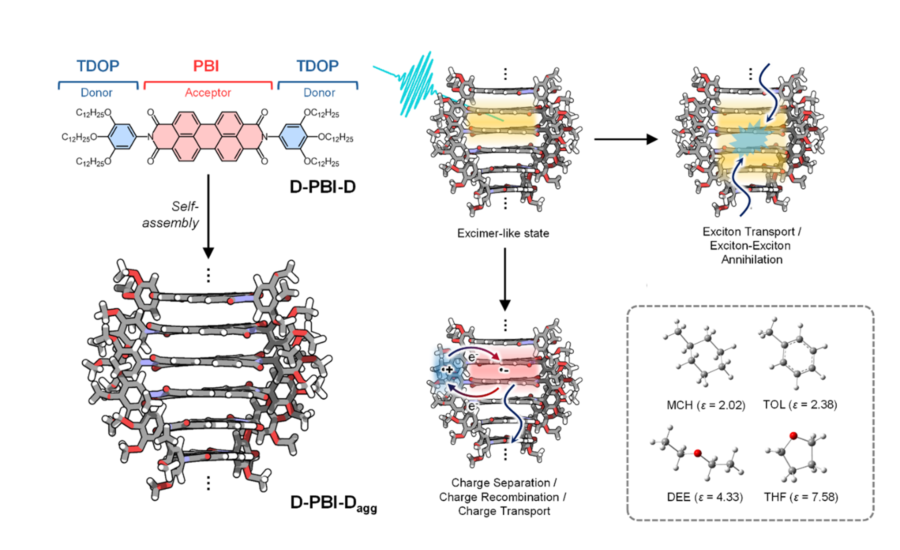
A research team led by Professor Taeyeon Kim of the Department of Chemistry at Sungkyunkwan University, in collaboration with a team from Yonsei University, has identified a new principle that controls charge separation, a phenomenon that plays a central role both in plants’ process of generating electrical energy (photosynthesis) and in next-generation molecular semiconductor devices. The findings were published online in Nature Communications, a leading international journal in the fields of nanoscience and chemistry, on July 17.
When plants absorb sunlight to generate energy, they rapidly separate and transfer charge within their internal structures. Inspired by this process, the scientific community has long sought to develop next-generation energy devices such as artificial photosynthesis systems and organic solar cells. Molecular aggregate structures formed by densely stacking “perylene bisimide (PBI),” an organic semiconductor molecule known for its excellent electron-accepting properties, have drawn particular attention as a subject of research. However, the complex environment created by tightly clustered molecules has made it difficult to precisely determine how the surrounding environment alone affects charge transfer.
To address this, the research team developed a proprietary PBI molecular aggregate platform that allows the polarity of the surrounding solvent (liquid) to be selectively varied while keeping the stacked nanostructure of the molecules unchanged. The team applied ultrafast laser spectroscopy, capable of capturing subtle changes in light at the femtosecond scale (one quadrillionth of a second), to this aggregate platform, and supported the results with quantum chemical computations.
The results revealed, for the first time in the world, a phenomenon in which the very mechanism of charge transfer completely switches depending on the properties of the surrounding solvent — a so-called “mechanism crossover.” In solvents with low polarity, such as oil, charge transfer was driven by quantum mechanical tunneling (a quasi-classical regime), in which molecules pass through energy barriers via subtle vibrations. In solvents with high polarity, such as water or alcohol, charge transfer was instead governed by the collective fluctuation of surrounding solvent molecules (a classical regime).
The team further demonstrated that under strong light exposure, the “exciton diffusion length” — the effective distance over which light energy travels — could be tuned from 35.9 nanometers (nm) up to 98.8 nanometers depending on the surrounding solvent environment. This opens a pathway for energy within organic semiconductors to be transferred more efficiently over longer distances without loss.
“This study is significant in that it isolated the influence of the dielectric environment alone, without structural distortion, within a complex molecular aggregate, thereby revealing the fundamental principle of charge transfer,” said Professor Kim of Sungkyunkwan University. “We expect this to provide holistic, integrated molecular design guidelines that can maximize the efficiency of eco-friendly future energy devices such as organic solar cells and artificial photosynthesis systems.”