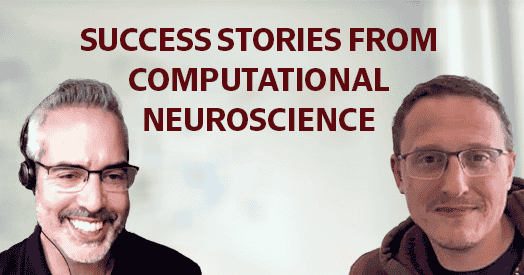
How do brains work? How do neural circuits in different parts of the brain perform the operations that the organism needs to get around in the world? In essence, these are the questions that the field of computational neuroscience sets out to answer. In this interview, I talk with Timothy Behrens about the field’s goals and approaches, its place as a bridge between brains and minds, and the notable progress being made across many fronts. Behrens is professor of computational neuroscience at the University of Oxford and a group leader at the Sainsbury Wellcome Centre for Neural Circuits and Behaviour at University College London.
Behrens has been a leader in the field for many years and has a particular interest in cognitive maps. I reached out to him after seeing his recent series of posts on Bluesky listing some systems in which he thought computational neuroscience had made real progress; these include the ring attractor in the central complex of flies that tracks heading, the grid cell circuit for path integration in rodents and the song learning circuit in zebrafinches, among others. I wanted to know what prompted him to write this list and what his criteria were for success.
In our conversation, which you can watch on this page, Behrens cites two main factors underlying progress in these specific systems. The first is that they operate over a fairly low-dimensional space—the problems these systems have to solve are just not that complex (not in isolation, at least). The second is that, because the ecological tasks carried out by these circuits are so basic and so essential, evolution may have hard-wired the solutions into the circuit design.
Both Behrens and I suspect that much more of the brain is like that than most people think. The current preoccupation with learning rules and algorithms and the successes of large language models can make it seem like “all you need is learning.” But this obscures the fact that brain circuits are highly diverse in their local architectures, with very specialized cells connected in very stereotyped ways. Hardware and software co-evolved in brain evolution—indeed, they cannot be separated in the way they are in digital computers.
As Behrens points out, even flexible, learned behaviors benefit from some innate representations, or at least an innately structured representational space. He describes how such structured circuitry, mapping things such as physical space and progress toward goals, can be combined to build representations of complex tasks.
M
uch of Behrens’ own work focuses on cognitive maps. These maps, as first conceived in 1948 by Edward Tolman, referred to an internal causal model that animals can use to navigate their surroundings and to predict what will happen if they take a particular action in the world. Thirty years later, John O’Keeffe and Lynn Nadel developed this idea specifically in the context of the hippocampus. As it happens, these structured cognitive spaces are often physically laid out in ways that really do look like maps across the brain.
This structure likely reflects a core principle of wiring efficiency: Because neurons tend to connect most often with other neurons that are nearest to them in space, specialized clusters will tend to arise as a result of learning. But the fact that the layout of such clusters tends to be quite consistent across individuals strongly suggests it is scaffolded by some innate structuring of neural circuits. The amazing thing is that these kinds of maps are evident not just for things such as categories of visual objects, but also for much more abstract semantic concepts.
Behrens’ work explores how hippocampal maps work and interact with the cortex. Growing evidence suggests a more abstract role for the hippocampus beyond simple mapping of memory and space. In Behrens’ view, this can account for the diverse functions of this structure in tracking movements in space, series of events, progress toward tasks, and many other cognitive parameters. We also touch on the crucial, but still mysterious, role of temporal oscillations in shaping communication between the hippocampus and cortex.
In closing, we discuss some of the exciting technological developments that are powering advances in computational neuroscience today. One of these is the growing ability to perform incredibly powerful experiments in animals—using techniques such as optogenetic holography, for example—to deduce detailed mechanisms underlying complicated cognitive tasks. Behrens is optimistic that these approaches will help fulfill the mission of computational neuroscience: to work out how animals learn about their world, how this knowledge is structured, and how those structures enable the processes of cognition to take place.
Watch our conversation and read the transcript.