
• Physics 19, 110
A tabletop method for producing cold radioactive molecules enables precise measurement of their properties and could uncover violations of fundamental symmetries.


Ella Maru Studio
On paper, molecules containing heavy radioactive nuclei could open a gateway to physics beyond the standard model of particle physics. However, experimental studies have been limited by the scarcity of the radionuclides and the difficulty of producing such unstable molecular species. Now a team led by Nick Hutzler at Caltech has demonstrated a tabletop experiment that can create radium-containing molecules, cool them to cryogenic temperatures, and measure their properties with high resolution. The technique can be extended to other exotic species, providing an accessible experimental tool for researchers to probe fundamental forces within the nucleus [1].
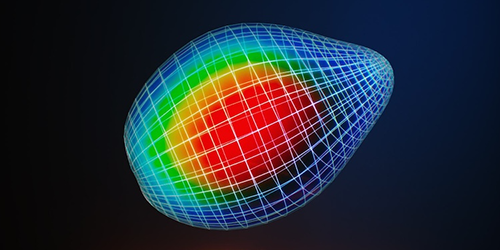
In 2010, theorists predicted that molecules of radium monofluoride (RaF) could be used to detect the extremely weak effects caused by violations of parity, a fundamental mirror-like symmetry [2]. Radium is particularly interesting because its pear-shaped nucleus and high atomic number can boost these effects by more than 3 orders of magnitude compared with spherical nuclei. Incorporating the nucleus in a molecule enhances the sensitivity because of the large internal electric fields. Consequently, these radioactive molecules should evince measurable shifts in energy levels that can be related to the complex interactions among protons and neutrons.
So far, radium-containing molecules have been produced only in trace quantities, typically using specialized accelerator facilities. In 2020, for example, an international research team used the ISOLDE facility at CERN to bombard uranium-containing material with protons, creating RaF molecules and providing the opportunity to study them for the first time [3]. More precise experiments in 2024 enabled the same team to map out the molecule’s internal energy structure with enough resolution to identify a scheme for laser cooling [4].
In this new work, Hutzler and colleagues sought to create radium-containing molecules in their own lab without resorting to a high-energy accelerator. Radium is usually extracted from uranium-bearing ores in the form of compounds such as radium chloride or radium nitrate. To convert tiny amounts of these radium-containing compounds into a usable number of molecules, Hutzler and colleagues first mixed the compounds with water and a natural sweetener called xylitol. Heating the mixture yielded a gel-like radioactive material that could be used as a target for producing the molecules.
The researchers installed a blob of radioactive gel inside a cryogenic chamber filled with helium gas, along with pellets of molecular reagents. Firing laser pulses at the targets released atomic and molecular precursors into the chamber, which were rapidly cooled to temperatures of around 4 K through collisions with the helium atoms. Laser light then drove chemical reactions to selectively produce RaF and both radium monohydroxide (RaOH) and monodeuteroxide (RaOD).
Molecules at these low temperatures occupy a relatively small number of quantum states, making it easier to measure specific energy transitions using laser-induced fluorescence. Even so, there are large uncertainties in the predicted energy levels of these heavy molecules. To locate their precise values, the researchers first used a broadband laser to scan for laser-induced fluorescence within the predicted range. Subsequent scans over increasingly narrow spectral regions eventually enabled individual energy transitions to be measured with high resolution. The measurements yielded molecular properties that largely match the predicted values, although one discrepancy indicates that the calculations do not yet fully capture the behavior of molecules in their excited state.
The researchers believe that the same tabletop technique could be extended to other radioactive molecules, paving the way for new experimental studies of these unexplored species. “This report impressively demonstrates that high-resolution spectroscopy on sufficiently long-lived radioactive molecules is feasible with cleverly designed tabletop setups at university laboratories,” says Robert Berger of the Philipps University of Marburg in Germany.
Hutzler and colleagues are now collaborating with scientists at MIT and Harvard University to extract the radioactive molecules into a beam, which is needed for other techniques such as laser cooling and trapping. “One of the reasons we are interested in RaF and RaOH is that they are predicted to be extremely laser coolable,” says Chandler Conn, a graduate student in Hutzler’s team and coauthor of the study. Laser cooling would yield radioactive molecules at temperatures close to absolute zero, which would dramatically increase the sensitivity of experiments that aim to measure the electric dipole moment of the electron, which some theories predict is larger than expected within the standard model.
–Susan Curtis
Susan Curtis is a freelance science writer based in Bristol, UK.
References
- C. J. Conn et al., “Production and spectroscopy of cold radioactive molecules,” Science 393, 319 (2026).
- T. A. Isaev et al., “Laser-cooled RaF as a promising candidate to measure molecular parity violation,” Phys. Rev. A 82, 052521 (2010).
- R. F. Garcia Ruiz et al., “Spectroscopy of short-lived radioactive molecules,” Nature 581, 396 (2020).
- S. M. Udrescu et al., “Precision spectroscopy and laser-cooling scheme of a radium-containing molecule,” Nat. Phys. 20, 202 (2024).