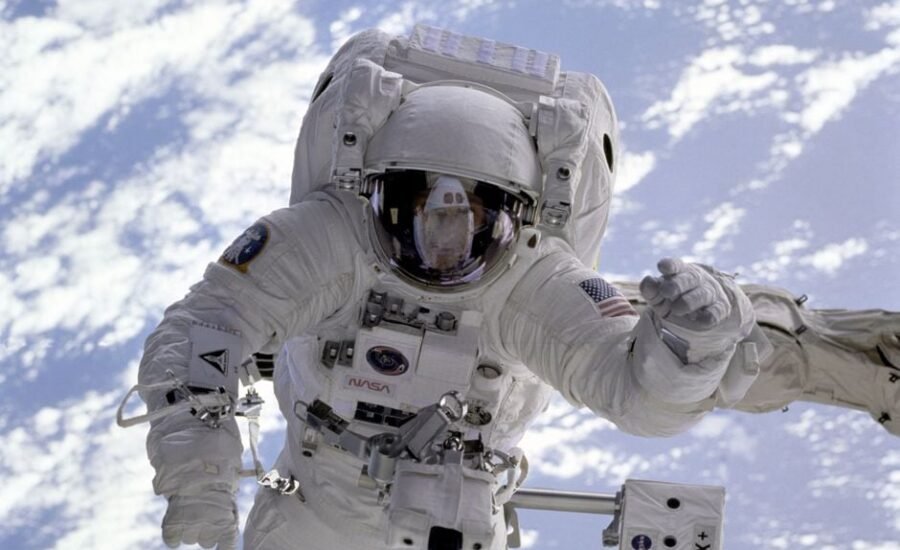
We tend to picture astronauts as peak physical specimens, and to get the job they are. The more interesting story is what happens to that body once it is up there. Months without gravity quietly remodel a human being in ways we are still working out, and not all of them reverse when they come home.
Space, it turns out, is hard on the very people best prepared for it.
I am a writer with a long interest in this beat, not a physician or a physiologist, so treat this as a careful reading of the research rather than expert testimony.
The body without gravity
The changes start the moment the weight comes off. Without gravity pulling blood and fluid towards the feet, roughly two litres of it shift upward into the chest and head, which is why astronauts arrive in orbit with puffy faces and strangely thin legs. The body reads the crowded upper half as too much fluid and sheds some, so blood volume drops in the first days.
Then the slower losses set in. Weight-bearing bones, no longer loaded, shed mineral at around 1 to 1.5 per cent a month, a rate that would take years to inflict on Earth. Muscles waste too, with one study finding the calf shrinking by about 15 per cent even with a demanding exercise routine. The heart, with less work to do pumping against gravity, becomes smaller and lazier. And with the spine no longer compressed, astronauts stretch out, gaining a few centimetres of height that they lose again within days of landing.
To fight all this, crews on the space station exercise around two hours a day, strapped to treadmills and resistance machines. It blunts the losses. It does not stop them.
The eyes are the real worry
The change that most concerns flight surgeons is one nobody predicted in the early days: the eyes. The same headward fluid shift raises pressure inside the skull and behind the eyeball, and over months it can swell the optic nerve and flatten the back of the eye, thickening the retinal nerve tissue measurably.
The result is a cluster of vision problems now grouped under the label spaceflight-associated neuro-ocular syndrome. Many astronauts return needing stronger glasses, and in some the structural changes do not fully settle afterwards. On a short station stay it is a manageable nuisance. On a multi-year trip to Mars, with no way to correct a serious problem in flight, it is one of the biggest open questions in the whole enterprise.
The study of two brothers
The most revealing look we have came from a coincidence: NASA had a pair of identical twins in the astronaut corps. When Scott Kelly spent nearly a year on the space station, his brother Mark stayed on the ground, giving researchers a rare matched comparison of the same genome in space and on Earth.
The NASA Twins Study, published in the journal Science in 2019 by Francine Garrett-Bakelman and a large team, turned up some surprises. Scott’s telomeres, the caps on the ends of chromosomes, unexpectedly lengthened in space, then snapped back and in places shortened once he landed. Around 7 per cent of his gene activity had still not returned to its normal pattern six months after his return. His cognitive speed and accuracy dipped in the period after landing, and there were changes to his arteries and gut bacteria.
It is essential to read that study for what it is. It is a rich, detailed portrait of a single pair of twins, one person in space and one on the ground, which makes it a superb case study and a poor population statistic. It tells us what can happen and where to look next, not what happens to everyone. The honest headline is that most of the changes reversed, and a stubborn minority did not, at least not quickly.
Why it matters, and what helps
The reassuring part is that the human body is resilient. For stays of the length the space station handles, the great majority of these effects recover on Earth, and exercise and careful nutrition keep them within bounds during the flight. Astronauts are not being permanently broken by orbit.
The worry is what happens when you stack the risks. A voyage to Mars would mean years rather than months, far more radiation once beyond Earth’s magnetic shield, and then arrival at a world with about a third of Earth’s gravity and no hospital. Nobody knows what long exposure to that combination does to a body, because nobody has tried it.
What to watch
The research that matters now is less about reaching further and more about keeping people intact when we do: better exercise and drug countermeasures, shielding against radiation, and serious study of whether spinning a craft to create artificial gravity is worth the engineering.
The romance of spaceflight is the launch and the view. The quieter truth is that the hardest part may be the slow work of keeping a human body, evolved entirely for one particular planet, functioning well anywhere else.
Standards
Space Daily articles are produced with AI assistance and reviewed by editorial staff before publication. See our editorial standards and masthead.