How has Mars lost its atmosphere over time? This is what a recent study published in Science Advances hopes to address as a team of scientists investigated a connection between the solar wind the Mars’ atmospheric loss. This study has the potential to help scientists better understand how Mars went from a potentially habitable world to the cold and dry planet today, along with gaining insight into other worlds.
For the study, the researchers analyzed a combination of data obtained from NASA’s Mars Atmosphere and Volatile Evolution (MAVEN) spacecraft and China’s Tianwen-1 mission. The primary motivation behind the study was to address a longstanding knowledge gap regarding the physical processes occurring when the solar wind strikes Mar’s atmosphere and how this results in atmospheric loss. While Tianwen-1 data was used to track the incoming solar wind, MAVEN data was used to observe how this incoming solar wind impacted atmospheric loss.
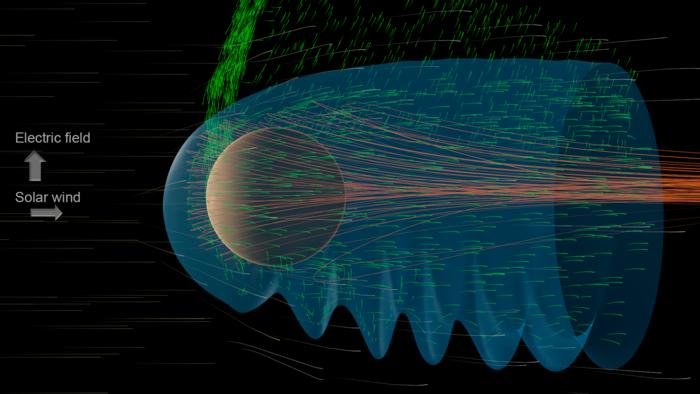
In the end, the researchers found a known phenomenon called Kelvin–Helmholtz (KH) waves that are produced as the incoming solar wind collides with Mars’ atmosphere. KH waves are produced when two fluids or gases of different speeds and densities slied past each other and can often be seen in Earth’s clouds. The researchers concluded that these KH waves are the reason behind the spikes in atmospheric ions being lost to space.
“We want to know when these waves are most likely to form, how they evolve, and how strongly they can drive atmospheric escape,” said Dr. Chuanfei Dong, who is an assistant professor in the Boston University College of Arts & Sciences and a co-author on the study. “This process could also occur on other planets that lack a strong magnetic field, including some exoplanets.”
What new insights into the solar wind and planetary atmospheric loss will researchers make in the coming years and decades? Only time will tell, and this is why we science!
As always, keep doing science & keep looking up!
Sources: Science Advances, EurekAlert!
Featured Image: Simulated image depicting what happens when the solar wind interacts with Mars’s atmosphere, producing Kelvin–Helmholtz (KH) waves (bottom). (Credit: Chi Zhang, Boston University)