A seventh round of United States-mediated talks has begun in the Italian capital with the aim of establishing new “pilot zones” in southern Lebanon from which Israeli forces will begin withdrawing, and the Lebanese army will assume control.
The three-day Israel-Lebanon diplomatic talks in Rome come as Israeli forces continue to strike southern Lebanon despite having agreed to a conditional ceasefire in early June.
Recommended Stories
list of 3 itemsend of list
Under a US-brokered, June 26 framework deal, Israeli forces had agreed to withdraw from large swaths of southern Lebanon they are still occupying, in exchange for the disarmament of the Iran-backed Hezbollah group. However, this has not happened yet.
Will the seventh round of talks finally deliver a lasting ceasefire and Israeli forces’ withdrawal?
Here’s what we know:
Who will be at the talks?
The seventh round of talks in Rome will be attended by high-level political and military officials from both sides.
A Lebanese official told Turkiye’s Anadolu news agency on Monday that the Lebanese political delegation would comprise former ambassador to the US, Simon Karam, and the incumbent, Nada Mouawad, with the military delegation led by Brigadier-General George Rizkallah.
The official added that legal adviser Antoine Sfeir and land-surveying expert Najib Massihi would also participate in the talks.
According to The Times of Israel, besides high-level Israeli officials, the country’s military representatives are also attending the talks.
What was agreed in the June 26 framework?
Israel and Hezbollah have been at war since March 2, when the Lebanese group fired rockets into northern Israel in retaliation for the US-Israeli strikes on Iran on February 28.
Since then, Israel has occupied nearly one-fifth of Lebanon from the south and has killed more than 4,000 people since fighting erupted in March. More than one million people have been displaced from their homes as Israel says it is targeting Hezbollah strongholds, mostly in the south of the country and in the suburbs of the capital, Beirut.
A previous bout of fighting over Israel’s genocidal war on Gaza ended in a ceasefire in November 2024, but Israeli forces have carried out near-daily attacks, claiming that Hezbollah has violated the ceasefire and refusing to end its occupation in breach of the deal.
The Israel-Lebanon framework outlined a “sequenced process” under which the Lebanese army would restore “effective sovereign authority over all Lebanese territory, pending the verified disarmament of non-state armed groups” – a clear reference to Hezbollah.
The deal did not directly mandate complete Israeli withdrawal from the 20 percent of Lebanese land it currently occupies. Instead, it noted that Israel should “progressively redeploy” out of Lebanon, offering two “pilot zones” in which the Lebanese military “will gradually assume full and effective security responsibility”.
The first Israeli withdrawal under the pilot zone programme took place in July. But Israel continues to occupy what it describes as a buffer zone – or “Yellow Line” – about 10km (6 miles) inside Lebanon, saying the zone is necessary to protect northern Israeli communities from Hezbollah attacks.
In June, after the framework agreement was signed, Israeli Prime Minister Benjamin Netanyahu issued a video statement shortly afterwards, stressing that it would allow the Israeli military to remain in the occupied Lebanese land.
“We will maintain [the buffer zone] until Hezbollah disarms and as long as there is a threat to the State of Israel,” Netanyahu said.

What’s on the agenda in talks this week?
During the sixth round of talks in Rome on July 14 and 15, a US official told reporters that Israel and Lebanon had “agreed on the structure and guidelines for the pilot zone process, to be finalised and implemented in the coming days”.
On Sunday, a Lebanese official told Anadolu that in the seventh round of talks, Lebanon will propose designating new pilot areas for an Israeli withdrawal, with the second phase covering either Bint Jbeil or Khiam, both south of the Litani River in southern Lebanon.
The military delegation will bring maps and documents detailing the Lebanese army’s deployment in the town of Zawtar al-Gharbiyeh, the first pilot area agreed upon during the sixth round, the official said, and added that it will also present plans for deployments in areas from which Israeli forces may agree to withdraw.
Before talks on Tuesday, Lebanese Agriculture Minister Nizar Hani told media the government is not happy about on-the-ground developments following the earlier framework agreement with Israel.
Hani said the current situation falls short of the expectations of President Joseph Aoun and the Lebanese government, according to the state-run National News Agency (NNA).
Israeli officials have said they will remain in southern Lebanon as long as Hezbollah remains armed, however.
What has happened at previous talks?
The US mediated the first round of Lebanon-Israel talks on April 14 in Washington, DC. US Secretary of State Marco Rubio attended those talks. However, the path to a breakthrough appeared narrow, as Hezbollah, which is not itself a party to negotiations, has urged the Lebanese government to pull out, calling the efforts “futile”.
The second round of talks was held on April 23 when US President Donald Trump chaired the talks.
A third round of direct talks between Israel and Lebanon kicked off in Washington, DC, on May 14, days before the expiration of a “truce” that failed to halt Israeli attacks and Hezbollah’s response to them. Again, there was no breakthrough.
The city hosted a fourth round of talks on June 2 and 3, when Israel and Lebanon agreed to implement a ceasefire that would require a “complete cessation” of fire by Hezbollah, according to a joint statement.
The two countries, which do not have formal diplomatic relations, also agreed to create “pilot zones”, where Lebanese forces would “take exclusive control of the territory to the exclusion of all non-state actors”. The development came despite continued cross-border attacks.
Rubio announced the framework deal following the fifth round of talks on June 23 and 26 in Washington, DC. Ongoing fighting in Lebanon, however, threatened to disrupt efforts to forge a ceasefire between Iran and the US.
The sixth round of Lebanon-Israel talks began in Washington, DC, on July 14. It concluded a day later with Israel and Lebanon agreeing to focus on a plan to establish the “pilot zones”, from where Israeli forces would begin withdrawing. However, a complete Israeli withdrawal from Lebanon is yet to take place.
Where has Israel struck in Lebanon most recently?
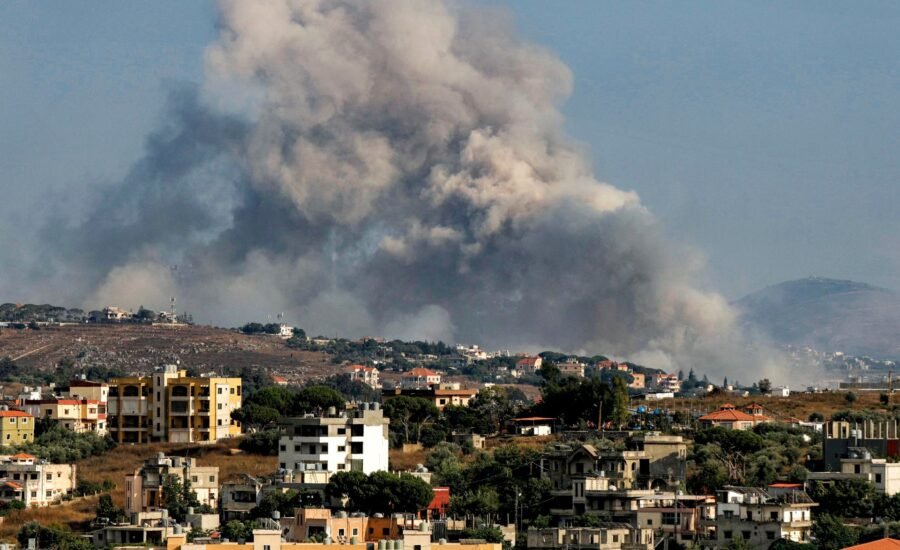
On Tuesday, NNA reported that Israeli forces dropped phosphorus bombs on olive and pine groves in the towns of Yaroun and Arnoun, as well as the city of Bint Jbeil in the Nabatieh governorate. The attacks caused large fires, it said.
The agency also reported two Israeli missile attacks on the Ali al-Taher hill near Nabatieh, and said an Israeli drone dropped a stun grenade in the town of Bayt al-Sayyad in Tyre.
On Friday, the Israeli army also carried out strikes close to the UNESCO-listed Beaufort Castle in southern Lebanon. President Aoun called it a “direct threat” to the framework deal. He noted that their timing “sends negative messages” before the talks.
What is Hezbollah’s stance on these talks?
Hezbollah is not a direct party to the talks despite being one of the parties technically at war.
Hezbollah’s secretary-general, Naim Qassem, has said Lebanon’s direct negotiations with Israel “bring Lebanon nothing other than shame, humiliation, disappointment and constant concessions”. However, he has voiced support for the deployment of the Lebanese army south of the Litani River.
On Tuesday, he denounced the talks in a televised speech marking the 40-day mourning period for Imam Hussein, the end of Ashura.
Qassem also criticised Aoun’s role, saying he “did not act as an arbiter and unifier, but instead became a source of division, and this is entirely inconsistent with both his role and Lebanon’s strength”.
At the same time, he emphasised that Israel had achieved political gains without any tangible results on the ground.
Qassem stated, “We are facing an Israeli-American aggression against us, Iran, Gaza, Yemen, and the entire region,” an aggression aimed at colonising the region and installing Israel as America’s proxy.
The secretary-general emphasised his belief in a “unified and indivisible Lebanon”, and stated that any aggression against the south is an aggression against all of Lebanon. He said: “The enemy’s only option is to withdraw, and it will withdraw.”
In response, Lebanon’s Prime Minister Nawaf Salam attacked Hezbollah, accusing it of dragging the country into “futile wars”.
What can we expect from the talks?
US Ambassador to Lebanon Michel Issa has said he is “encouraged” by ongoing talks in Rome and stressed that both sides “must agree” on a clear process.
In a statement on Sunday, Issa said there is still a lot of technical work to be done and that moving “too quickly” could jeopardise civilian safety.
“There is a meaningful difference between drafting an agreement on paper and implementing it responsibly – moving too quickly risks jeopardising the very civilians this process is meant to protect,” he said.
“We believe it is better to take the time needed to get this right the first time. Doing so will allow subsequent pilot zones to move forward more efficiently,” he added.
However, Heiko Wimmen, who oversees the Iraq, Syria, Lebanon project at the International Crisis Group, told Al Jazeera that there are contradictory signals around these talks.
“Washington seeks to widen the scope towards a full peace process, while Israel seems to prefer slow-rolling implementation of what has been agreed, and continues actions – like house demolition, burning of olive groves – that seem to point in the other direction,” he said.
“Hezbollah has again asserted its rejection of the process, and could obviously sabotage it at any point, though they seem to prefer to not get stuck with the blame,” he said.
“It remains unclear how much the extreme volatility of the US-Iran negotiations stands in the way of potential progress, but it appears likely that it does to some extent,” he added.