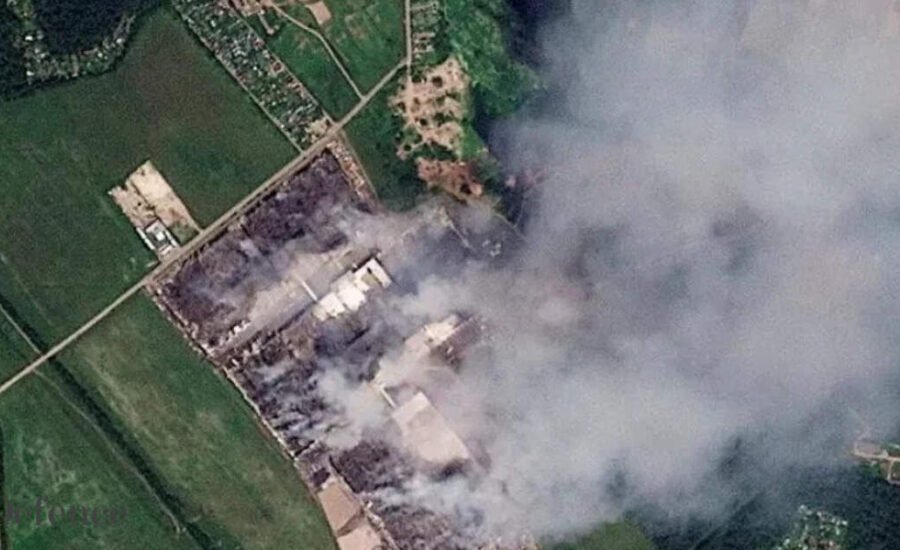
The attacks have prompted a debate over whether Ukraine is now deliberately targeting a pillar of everyday Russian life in an effort to make ordinary Russians feel the costs of a war that many have been able to keep at arm’s length. If that is indeed the strategy, then Wildberries is not just a logistics but a political target.
Also Read: Russia’s western oil exports to rise 4% in August on refinery disruptions
Wildberries: Russia’s Amazon
To understand why Wildberries has become a focus of Ukrainian strikes, it is important to understand what the company represents inside Russia. Wildberries is often described as Russia’s equivalent of Amazon, though in some respects it occupies an even more central position in daily life. It is the country’s largest online retailer, serving millions of customers across Russia’s vast geography. In many smaller cities and towns, Wildberries collection points have become a routine part of everyday commerce. The company links consumers to hundreds of thousands of sellers, warehouse workers, delivery drivers, and small entrepreneurs.
Over the past decade, Wildberries has grown into a critical piece of Russia’s consumer economy. Many small businesses depend on it as their primary sales platform. For countless households, it has become the default destination for online shopping. The company’s warehouses form a sprawling logistics network that connects producers, merchants, and consumers across the country.

That is what makes Wildberries different from a refinery or an airbase. Damage to a Wildberries warehouse is not just a disruption to a company. It has the potential to ripple through local economies, delay deliveries, affect merchants’ incomes, and remind ordinary Russians that the war is no longer confined to distant battlefields.
Ukraine’s official case
Ukraine has not presented the Wildberries campaign as an attack on civilian commerce. It argues that some Wildberries facilities play a role in supporting Russia’s war effort. Ukrainian officials, including President Volodymyr Zelensky, have alleged that the company has been involved in handling goods that ultimately support Russian military operations, particularly drone-related components and other dual-use items.The broader Ukrainian argument is that modern warfare depends not only on military bases and weapons factories but also on commercial logistics networks. From Kyiv’s perspective, infrastructure that helps move goods useful to the Russian military becomes a legitimate target.
Also Read: Indian refiners come to the rescue of Russia’s oil exporters
Ukrainian officials have also described the strikes as a form of long-range sanctions. Since Ukraine cannot impose the kind of economic pressure available to major Western powers, it is attempting to inflict costs directly through drone attacks on infrastructure that underpins Russia’s economy. But Ukraine has released little public evidence linking specific Wildberries warehouses to direct military supply operations. That gap has led many observers to look beyond the official explanation and examine the broader strategic logic of the campaign.
Russia and Wildberries reject Ukraine’s allegations. Wildberries founder Tatyana Kim, the richest woman in Russia, has insisted that the company is a civilian marketplace and not a military supplier. She has argued that many of the products cited by critics are widely available on global platforms such as Amazon and Alibaba. In her view, the presence of dual-use goods such as radios, drone components, or protective equipment does not transform an e-commerce company into a military logistics provider.
Russian officials have portrayed the attacks as strikes on civilian economic infrastructure. They argue that Wildberries warehouses are filled primarily with consumer goods and that the campaign amounts to an attempt to intimidate Russian civilians and damage normal economic activity.
The wider strategy
The scale and persistence of the attacks have encouraged a different interpretation. If the sole objective were to disrupt military procurement, Wildberries appears an unusual target. Large militaries typically obtain equipment through contractors, manufacturers, and government procurement systems. They do not normally rely on retail websites to purchase supplies in bulk. That does not mean Wildberries is irrelevant to the war. Volunteer groups, regional administrations, and individual military units have frequently used commercial marketplaces to acquire drones, radios, generators, and other equipment. Still, that alone does not fully explain more than a dozen attacks on a company whose primary function remains consumer commerce.
Also Read: India closely monitoring US bill targeting buyers of Russian oil, says MEA
What makes more sense to many analysts is the idea that Ukraine is expanding its campaign from military infrastructure to economic and psychological infrastructure. Wildberries occupies a place in Russian society that few companies can match. When a refinery burns, most Russians notice only indirectly through economic statistics or fuel prices. When Wildberries warehouses are repeatedly attacked, delayed deliveries, disrupted orders, and media coverage make the war visible in everyday life.
Since the start of the full-scale invasion, one of the Kremlin’s successes has been its ability to shield much of Russian society from the direct consequences of the conflict. Outside border regions and a handful of areas affected by drone attacks, many Russians have been able to continue their daily routines with relatively limited disruption. Economic adaptation, state spending, and the resilience of consumer services have helped preserve a sense of normality. The Wildberries campaign appears aimed at eroding that normality.
Repeated strikes on warehouses do more than destroy buildings. They create uncertainty. Consumers begin to wonder whether deliveries will arrive on time. Sellers worry about inventory. Workers fear further attacks. Local authorities are forced to address security concerns that previously seemed remote. The psychological effect is often larger than the physical damage. A single strike can be dismissed as an isolated incident. A sustained campaign suggests that no part of the country is entirely beyond the reach of the war. From this perspective, Wildberries becomes a vehicle through which Ukraine can project the conflict into the daily lives of millions of Russians.
Trying to force Putin to talks?
There is a view that attacks on Wildberries could eventually help push Vladimir Putin toward negotiations. The argument is not that destroying warehouses will directly force the Kremlin to change course. Rather, it is that persistent disruption to a company so deeply embedded in Russia’s economy can generate pressure that accumulates over time. Wildberries is connected to a vast network of merchants, suppliers, transport companies, insurers, and consumers. Every attack imposes costs. Every disruption affects businesses that are trying to operate in wartime conditions. Over time, those costs spread through a much wider economic ecosystem.
The theory is that if enough influential economic actors begin to view the war as a growing threat to their interests, pressure on the political leadership could increase. The objective is not necessarily public protest. It is the gradual erosion of the sense that the war can continue indefinitely without significant domestic consequences.
But Russian business elites today are far more dependent on the state than before the invasion. Many have little room to challenge Kremlin policy openly. For that reason, strikes on Wildberries alone are unlikely to force negotiations.
There is little evidence that attacks on commercial infrastructure by themselves can force a major power to alter its war aims. Governments often respond to such campaigns by tightening security, increasing propaganda, and portraying the attacks as proof of the enemy’s hostility.
At the same time, Ukraine does not need immediate political change for the strategy to have value. If repeated strikes make Russians feel less insulated from the conflict, if they create anxiety among businesses and consumers, and if they raise the economic costs of continuing the war, Ukraine may regard the campaign as successful.
That is what makes the Wildberries attacks significant. They are not simply another chapter in the drone war. They appear to reflect a shift in how Ukraine thinks about pressure. Instead of targeting only the machinery of war, it is increasingly targeting the systems that allow Russian society to live alongside the war without fully experiencing it.
Whether that pressure eventually reaches Putin in a meaningful way so that he is forced to negotiate with Ukraine remains an open question. But if the objective is to bring the war deeper into Russia’s everyday life, few targets are better suited to that mission than Wildberries.