Researchers have discovered self-destructing immune cells in planarian flatworms. The cells commit suicide within minutes to destroy pathogens, opening up the possibility of new treatments for infections, inflammation and cancer, reports a study.
Scientists discover immune cells that explode like tiny bombs
Scientists at Stanford University have uncovered an immune cell that kills off its surroundings like a suicide bomber, revealing a biological process that could lead to innovative treatments for infections and diseases such as cancers. Their work on the newly discovered cell type was published in the journal Cell.
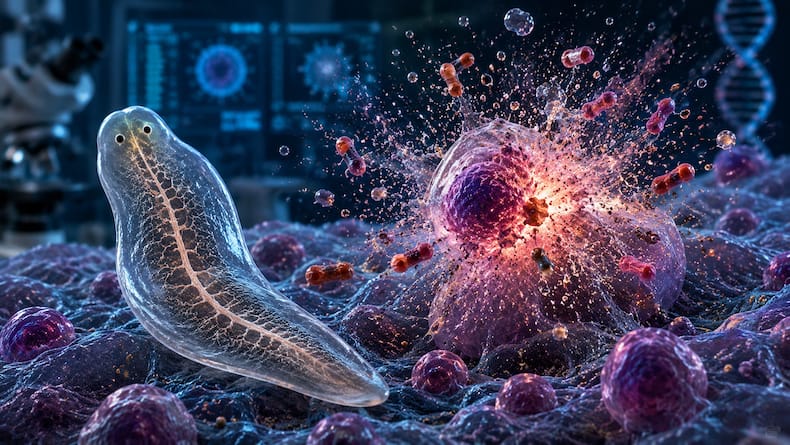
The study found that these strange cells, termed ruptoblasts, can kill nearby cells by essentially blowing themselves up within seconds or minutes of being activated. This process releases several toxins that can kill off nearby cells before ruptoblasts then disappear.
According to the researchers, a similar process to ruptosis has not been observed in other organisms, as most other forms of cell death usually take hours to occur. Senior author of the study, Professor Bo Wang, an associate professor of bioengineering at Stanford, noted that they would not have expected to find such a process.
“We never expected that a cell could just explode like a bomb and kill the cells surrounding it,” Wang said.
The new finding came about while scientists were trying to see if flatworms could tell the difference between their own tissues and those of another worm. To test this, postdoc Chew Chai cut each worm into two, then fused the half-worms together with tissue belonging to another, genetically distinct, worm. The results were surprising. Despite being marvels of regenerative medicine, the hybrid flatworms rejected foreign tissue strangely and fascinatingly.
The immune system of a worm is nothing like that of a man. The worms did not use standard immune cells to attack the foreign tissues, but instead launched an aggressive inflammatory response in which cells self-destructively ruptured.
“It’s this huge inflammatory response. Like there’s a fire and an alarm goes off, and the cells just blow up,” said Chai, who led the study.
Further tests showed that the reason behind it was increased levels of activin, a hormone responsible for promoting regeneration and reproduction in flatworms. As the level of activin rose, the inflammation did too, eventually killing the fused worms several days later.
The scientists proceeded to test this theory by injecting activin into healthy worms and observed an explosive response from their immune systems, identifying activin as the catalyst needed to unlock the ruptoblasts.
The scientists used a combination of live-cell imaging and flow cytometry to identify which cell type responded to activin. They found that a small subset of glandular cells had ruptured to release their toxic contents, killing nearby cells in the process and vanishing after five minutes or so.
While some mammalian cells can undergo a form of programmed cell death with massive pore formation in their membranes and bacteria can engage in explosive death events, in both cases the process takes several hours. Meanwhile, ruptosis takes place almost instantly, making the cell death with big pore formation one of the fastest forms of cell death discovered so far. Such rapid destruction makes cells called ruptoblasts powerful killers because they are able to destroy other cells in their vicinity with ease.
Researchers tested the ability of ruptoblasts to destroy other cells by injecting them with Escherichia coli bacteria, human kidney cells, and murine blood cells. In all cases, the experiment showed that ruptoblasts were able to kill all the test samples.
However, thanks to their localized effect only, these cell death “bombs” do not cause damage outside the affected area, thus being potentially useful in fighting pathogens without damaging the host cells.
Unlike the familiar T cells and neutrophils, which are types of white blood cells produced in the bone marrow, ruptoblasts are not cells derived from hematopoiesis. They are glandular cells that presumably maximize their endogenous secretory activity before executing their suicidal release of cytotoxic molecules upon activin receptor activation.
The scientists also revealed that release of calcium ions from the endoplasmic reticulum is one of the essential events leading to ruptosis.
The team also analyzed the distribution of Ruptoblasts across the animal kingdom. Their search only yielded invertebrates belonging to the group of basal bilaterals, otherwise known as flatworms. The researchers hypothesized that ruptoblasts are ancient immune cells that have been abandoned by vertebrates and other advanced animals, which lack regenerative abilities.
The researchers hypothesized that the reason why the explosive type of immunity was given up by vertebrates was due to the immensity of damage that it would cause to tissues and organs, which complex animals cannot swiftly regenerate. Meanwhile, the regeneration abilities of flatworms make them ideal candidates for utilizing such cytotoxic abilities.
The findings also demonstrate the value of studying unconventional organisms in order to understand biological processes that have not been observed in more common lab animals.
“Many animals live in environments containing various bacteria and viruses, yet have somehow evolved mechanisms to cope with these threats,” notes Wang. “By studying these processes, which have been poorly understood until now, we may find new biology with possible medical applications.”
While this research is clearly preliminary, the team suspects that isolating the mechanisms by which ruptoblasts launch their controlled attack may lead to the development of novel therapeutics to fight bacteria or tumors.
The application of such findings to human health remains some years away, however, since much more research is needed to understand this complex biological system.
The study provides an unprecedented look at an ancient part of the immune system.
Nevertheless, this research may provide insight into biological processes that have been poorly understood until now, and that may have medical applications in the future.
Disclaimer: This article summarizes a research study published in the scientific journal Cell. The study was conducted in planarian worms and does not suggest that human patients can be treated similarly. Additional research is needed before any new medical treatment can be tested in humans.