
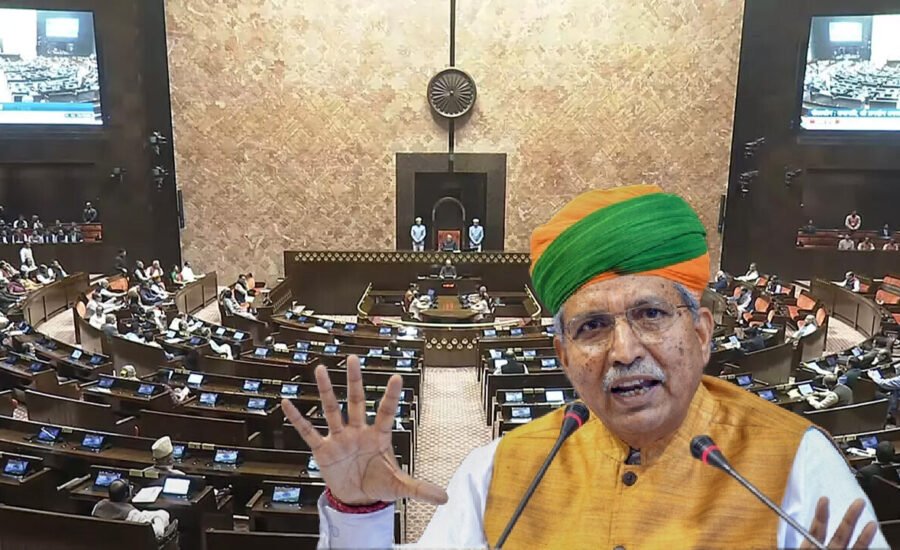
The Rajya Sabha on Wednesday considered and returned the Supreme Court (Number of Judges) Amendment Bill, 2026, with Union Law Minister Arjun Ram Meghwal disclosing that the proposal to increase the sanctioned strength of the Supreme Court was initiated after Chief Justice of India Surya Kant wrote to the Prime Minister seeking the enhancement.
The Bill seeks to increase the sanctioned strength of Supreme Court judges from 34 to 38, including the Chief Justice of India. Having been returned by the Rajya Sabha after debate, it now awaits Presidential assent to become law. The Lok Sabha had cleared the Bill on August 3.
Replying to the debate, Meghwal said the increase in judicial strength was not merely the need of the hour but also an important judicial reform aimed at facilitating the constitution of a permanent Constitution Bench and dedicated benches for disposal of pending cases.
The Law Minister revealed that CJI Surya Kant had written to the Prime Minister on May 11 requesting an increase in the Court’s sanctioned strength. According to Meghwal, the CJI pointed out that the growing inflow of cases required the Supreme Court to maintain a high daily disposal rate. However, the constitution of Constitution Benches inevitably affects that rate, as judges are diverted from regular hearing work. The CJI cited the recently constituted nine-judge Constitution Bench hearing the Sabarimala reference as an example. Therefore, the CJI proposed an increase in the strength of Judges. Following the CJI’s letter, the Ordinance was brought on May 17.


The debate on the Bill saw participation from around 33 members, beginning with Senior Advocate and Rajya Sabha MP Vivek Tankha. Tankha questioned the urgency behind promulgating the Ordinance just a few days before the Supreme Court commenced its partial vacation. He also expressed doubt over whether adding four judges would significantly impact the pendency of nearly 95,000 cases before the apex court.
Senior Advocate and MP from All India Trinamool Congress, Menaka Guruswamy, also spoke on similar lines. She stated that the real problem lies with the fact that the government doesn’t want to appoint women, people from minority communities, and from the LGBTQI community to the judiciary. She added that representation from these sections is less than 20% in the judiciary at present. She spoke regarding 30% vacancies in high courts across the country.
Advocate and MP Harrish Beeran remarked that this is merely a cosmetic change because real lies like in the institutional structure, such as the age of retirement. He stated that when judges retire when they are at the peak of their career and since their experience holds immense importance, the government should consider increasing the retirement age. He also suggested an increase in the salary of the judges and the need for transparency in the appointment of judges.
Senior Advocate and Rajya Sabha MP P. Wilson raised concerns over what he described as a “diversity deficit” in judicial appointments, contending that a majority of judges come from upper-class backgrounds. He advocated a constitutional amendment to address representation in appointments and also called for increasing the retirement age of judges of the Supreme Court and High Courts.
Bar Council of India Chairman and Rajya Sabha MP Manan Kumar Mishra, meanwhile, highlighted the large number of vacancies in the trial judiciary and stressed that strengthening the subordinate courts was equally important for reducing delays in the justice delivery system.
About the bill
The Bill was introduced in the ongoing monsoon session of Parliament by Union Minister of Law and Justice Arjun Ram Meghwal on July 20. On August 3, the Bill was moved by him in Lok Sabha. The Minister said that the Bill has been brought keeping in view the pendency of cases before the Supreme Court and to improve the efficiency of the Court.
It seeks to replace the ordinance promulgated by the President of India to increase the number of Supreme Court judges from 34 to 38, including the Chief Justice of India. The Supreme Court (Number of Judges) Amendment Ordinance 2026 was promulgated to amend Section 2 of the Supreme Court (Number of Judges) Act, 1956, to replace the word “33” therein with “37”.
As per Article 124 of the Constitution, the Supreme Court comprises the Chief Justice of India and the number of Judges which the Parliament prescribes by way of law. On May 5, the Union Cabinet cleared the proposal to increase the strength of Supreme Court Judges. The present working strength of the Supreme Court is 32 (including the CJI).
Pursuant to this, the Supreme Court will now have a sanctioned strength of 38 judges, including the CJI. The last time the number of Supreme Court Judges was increased was in 2019, when it was raised from 30 to 33 (excluding the CJI). The bill does not require an amendment to the Constitution and requires a simple majority for passage.
The Rajya Sabha proceedings can be viewed at this link.