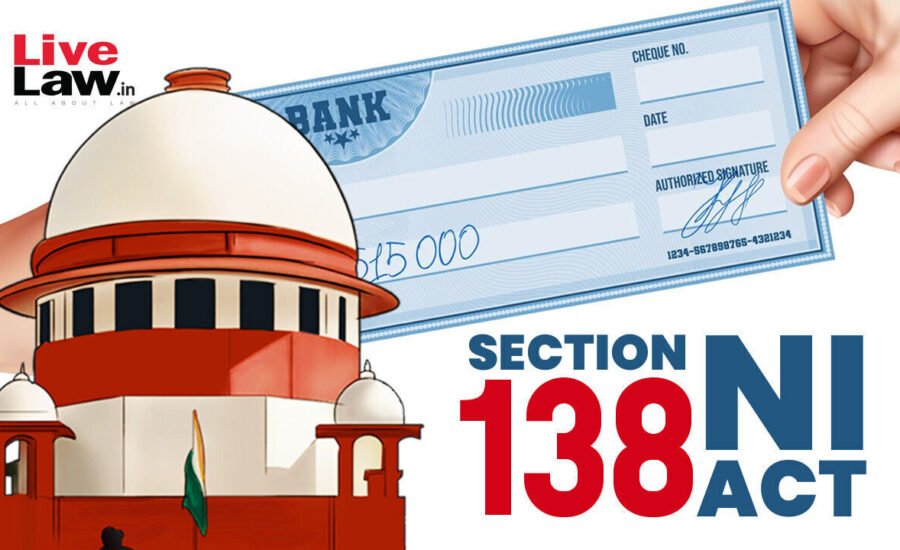
The Supreme Court has held that the failure to arraign a company as an accused in a cheque dishonour complaint under Section 138 of the Negotiable Instruments Act is a fatal defect that cannot be cured by subsequently summoning the company as an additional accused under Section 319 of the Code of Criminal Procedure during the trial.
A Bench of Justice Manoj Misra and Justice Vijay Bishnoi ruled that where a cheque is drawn on a company’s bank account, prosecution of the company is a mandatory precondition for fastening vicarious liability on its directors or authorised signatories under Section 141 of the Negotiable Instruments Act. Consequently, the High Court erred in directing the trial court to invoke Section 319 CrPC to implead the company after the trial had commenced.
The Court was hearing an appeal filed by Manjula Kapoor against an order of the Himachal Pradesh High Court. The complaint alleged that M/s Cine Prime Entertainment owed the complainant Rs. 5 lakh and had issued a cheque signed by Kapoor, its authorised signatory. After the cheque was dishonoured, the complainant initiated proceedings only against Kapoor without making the company an accused or issuing the statutory demand notice to it. The High Court however allowed the complainant to cure this defect by summoning the company as an additional accused under S.319 CrPC. Challenging this, the director approached the Supreme Court.


The Supreme Court set aside the Himachal Pradesh High Court’s decision, which directed the trial court to start a de novo trial, after issuing a notice under Section 319 Cr.P.C. to the Appellant-company to join the trial.
For maintaining prosecution of any director of the company, arraigning a company as an accused is mandatory, as held in Aneeta Hada v. Godfather Travels & Tours (P) Ltd., (2012) 5 SCC 661. Since the company was not arraigned as an accused, the complaint against the Appellant-director would not be maintainable; moreover, the defect of non-arraignment of the company cannot be cured by invoking Section 319 Cr.P.C., the Court said.
“…where the complaint suffers from so fundamental a defect that no cognizance can be taken thereupon, the Court cannot proceed and take recourse to the provisions of Section 319 to cure that defect. The reason is simple, if the complaint suffers from a fatal defect, there is no valid institution of a proceeding. In such circumstances, only a fresh complaint can be filed after removing the defect provided it is within the period of limitation prescribed by the Act.”, the Court observed, relying on N. Harihara Krishnan v. J. Thomas (2018).
The Court noted that the cognizace against the accused-company would be time-barred. Though Section 142 NI Act gives the power to condone delay, it cannot be used to cure a fatal defect in the complaint. ermitting the company to be added later under Section 319 would effectively allow the complainant to overcome the statutory limitation period.
“No doubt, the Court empowered to take cognizance has the power, under the proviso to sub-section (1) of Section 142 of NI Act, to take cognizance of a complaint made after the prescribed period upon being satisfied that the complainant had sufficient cause for not making the complaint within such period. But this power must not be used to circumvent the provisions of the Act and allow the complainant to remove fatal defects in the course of the proceedings when the complaint itself deserved dismissal at the threshold.”
The Court clarified that where such a defect exists, the only permissible course is to institute a fresh complaint after curing the defect, provided it is within the period of limitation or the delay is condoned under the proviso to Section 142 of the Negotiable Instruments Act.
Holding that the High Court had exceeded its jurisdiction, the Supreme Court quashed the complaint and all consequential proceedings against Kapoor.
“…we are of the view that the High Court clearly exceeded its jurisdiction by directing the learned Magistrate/ Trial Court to suo moto arraign company as an accused. In consequence, and having regard to the finding that the complaint suffered from a fatal defect, we have no hesitation in holding that the complaint and all consequential proceedings arising there from are liable to be quashed and are hereby quashed.”, the Court held.
Accordingly, the appeal was allowed.
Ingredients that need to be proved by the complainant
The judgment also discussed the basic ingredients for the offence of cheque dishonour.
A plain reading of Section 138 of the NI Act would make it clear that to successfully prosecute a person for an offence punishable under Section 138, the complainant must prove:
“(i) that the person drew a cheque on an account maintained by him with the banker;
(ii) that such cheque was drawn for payment of any amount of money to another person out of that account for the discharge, in whole or in part, of any debt or other liability;
(iii) that such cheque was presented to the bank within a period of six months from the date it was drawn or within the period of its validity, whichever is earlier;
(iv) that such cheque was returned by the bank unpaid, either because of the amount of money standing to the credit of that account is insufficient to honour the cheque or that it exceeds the amount arranged to be paid from that account by an agreement made with that bank;
(v) that the payee or the holder in due course of the cheque, as the case may be, demanded in writing from the drawer of the cheque, the payment of the amount of the money due under the cheque to the payee;
(vi) that such a notice for payment is made within a period of thirty days from the date of the receipt of the information by the payee from the bank regarding the return of the cheque as unpaid.
(vii) that the drawer of such cheque has failed to make the payment of the said amount of money to the payee or, as the case may be, to the holder in due course of the cheque, within 15 days of the receipt of the said notice.”
Cause Title: MANJULA KAPOOR VERSUS THE STATE OF HIMACHAL PRADESH AND ANR.
Citation : 2026 LiveLaw (SC) 763
Click here to download judgment
Appearance:
For Petitioner(s) :Mr. Ashwani Kumar Dubey, AOR Mr. Devinder Singh Khatana, Adv. Ms. Garima Sharma, Adv.
For Respondent(s) : Mr. Vaibhav Srivastava, AAG Ms. Sugandha Anand, AOR Mr. Chetan Anand Mohapatra, Adv. Ms. E. R. Sumathy, AOR Mr. Harsh, Adv.