
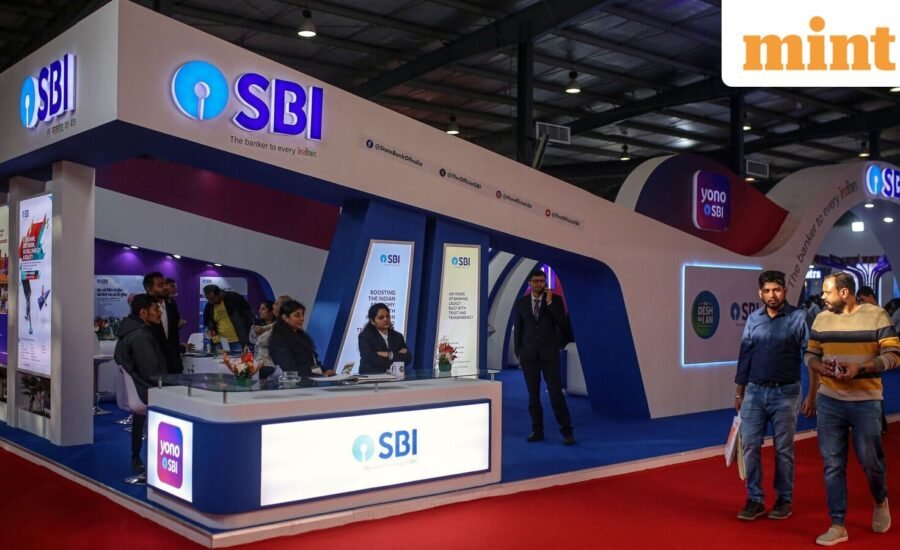
SBI Q1 Results: State Bank of India (SBI) on Friday, 7 August, reported a 10.23% year-on-year (YoY) rise in its standalone net profit for the June quarter (Q1FY27) to ₹21,121.22 crore, compared with ₹19,160.44 crore in the same period last year.
The public lender earned an interest income of ₹46,992 crore in the quarter under review, up 14.88% from ₹40,907 crore in the year-ago period.
SBI reported a sequential improvement in asset quality during the June quarter, with the gross non-performing asset (GNPA) ratio declining to 1.47% from 1.49% in the previous quarter. The net NPA ratio also improved marginally to 0.38%, compared with 0.39% in the March quarter.
The bank’s provisions increased to ₹5,047 crore in Q1 FY27 from ₹2,872 crore in the preceding quarter and ₹4,759 crore in the corresponding quarter last year. Despite higher provisioning, the credit cost remained stable sequentially at 0.27% and improved from 0.47% a year ago.
SBI’s domestic net interest margin (NIM) stood at 3%, while the whole-bank NIM expanded by 5 basis points quarter-on-quarter to 2.86%.
On the business front, gross advances grew 18.6% year-on-year and 2.3% quarter-on-quarter. However, fresh slippages rose to ₹7,359 crore during the quarter from ₹5,548 crore in the previous quarter, pushing the slippage ratio up to 0.57% from 0.47% sequentially.
Business growth remains strong
SBI’s total business crossed the ₹110 lakh crore milestone during the June quarter, driven by healthy growth in both deposits and advances. Total deposits rose 9.73% year-on-year to ₹60.06 lakh crore, while advances crossed ₹50 lakh crore. CASA deposits increased 9.3% to ₹22.61 lakh crore, with the CASA ratio standing at 39.24% as of 30 June.
Within the loan portfolio, domestic advances grew 18.15% year-on-year. Retail personal loans expanded 15.15%, corporate advances rose 18.05%, while SME and agriculture loans posted robust growth of 22.33% and 25.43%, respectively. Foreign office advances also increased 21.38% in rupee terms.
Profitability and capital position
For the quarter, SBI reported a return on assets (ROA) of 1.11% and a return on equity (ROE) of 17.87%.
The bank also strengthened its capital position, with the capital-to-risk weighted assets ratio (CRAR) improving to 15.67% from 14.63% a year ago. The Common Equity Tier-1 (CET-1) ratio rose to 12.89% from 11.10%, while the Tier-1 capital ratio increased to 13.90% from 12.45%.
SBI’s provision coverage ratio (PCR), excluding advances under collection accounts (AUCA), stood at 74.20%, while the PCR including AUCA was 91.82%.
Digital banking gains momentum
Digital adoption continued to accelerate during the quarter, with more than 64% of new savings bank accounts opened through SBI’s YONO platform. The share of transactions conducted through alternate digital channels increased to around 98.8%, up from 98.6% in the corresponding quarter last year, underscoring the bank’s continued focus on digital banking.
SBI share price today
SBI share price today opened at ₹1,081.95 apiece on the BSE, the stock touched an intraday high of ₹1,124.40 per share, and an intraday low of ₹1,075.30 per share.
According to Hitesh Rathi, Technical Analyst – Equity & Derivatives at Angel One, SBI’s technical structure remains largely range-bound, indicating continued uncertainty in the stock’s near-term direction. He noted that a bearish 100% pole in the ₹1,200–1,220 zone points to strong overhead supply, while a bullish 100% pole in the ₹940–950 range highlights robust buying interest at lower levels. As a result, the stock continues to trade within this broad range.
Rathi said the ₹1,115–1,135 zone is the immediate resistance area to watch. A decisive breakout above this range would mark an exit from the ongoing consolidation and confirm a breakout above the 45-degree objective trendline, signalling the potential start of a sustained uptrend. Until such a move occurs, he expects SBI to remain in a sideways trading phase, with the resistance zone holding the key to its next directional move.
Disclaimer: The views and recommendations made above are those of individual analysts or broking companies, and not of Mint. We advise investors to check with certified experts before making any investment decisions.