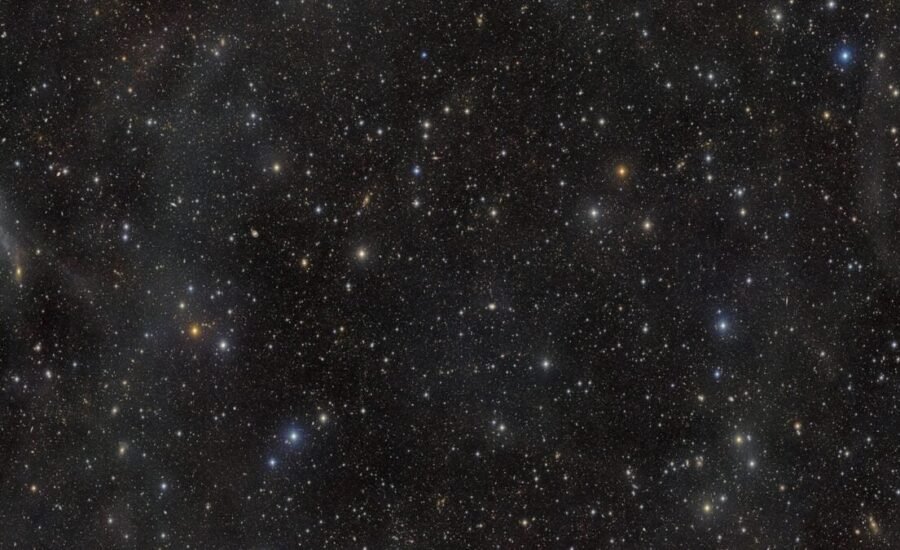
A new image from the Vera C. Rubin Observatory captures a well-documented patch of the universe in exceptional depth, revealing thousands of galaxies and stars that span across a wide range of distances and cosmic time.
Using its 3.2-gigapixel camera, Rubin observed a region of the sky known as the COSMOS field to reveal more than 650,000 galaxies and over 50,000 stars packed in a single view. The new image provides a closer look at one of the most observed patches of the universe, adding a more detailed and dynamic view of this area.
Familiar grounds
The COSMOS field contains over 2 million galaxies that span across 75% of the age of the universe, with some as far as 12 billion light-years away. It serves as a prime spot for space telescopes to carry out sky surveys because it faces away from the crowded plane of the Milky Way galaxy, with only a few nearby stars and clouds of dust obscuring the view of the distant universe.
Located in the constellation Sextans, COSMOS covers an area of the sky that’s around three times the size of the full Moon. By pointing telescopes toward this patch of the sky, astronomers can see a remarkably large number of distant galaxies, the light of which has traveled billions of years to reach Earth.
The Hubble and Webb space telescopes have been used to capture large mosaics of COSMOS, and now Rubin is joining the party. Rubin’s highly sensitive camera and wide field of view not only compliments previous observations of COSMOS, it also allows scientists to compare the new image with decades of data so that they can confirm the observatory is indeed delivering accurate, high-quality measurements.
A fresh take
Rubin’s recent image of COSMOS was combined using multiple observations. The telescope captured a wide variety of galaxies, including spirals with delicate arms, smooth ellipticals, distorted merging galaxies, and faint red galaxies from the distant Universe.
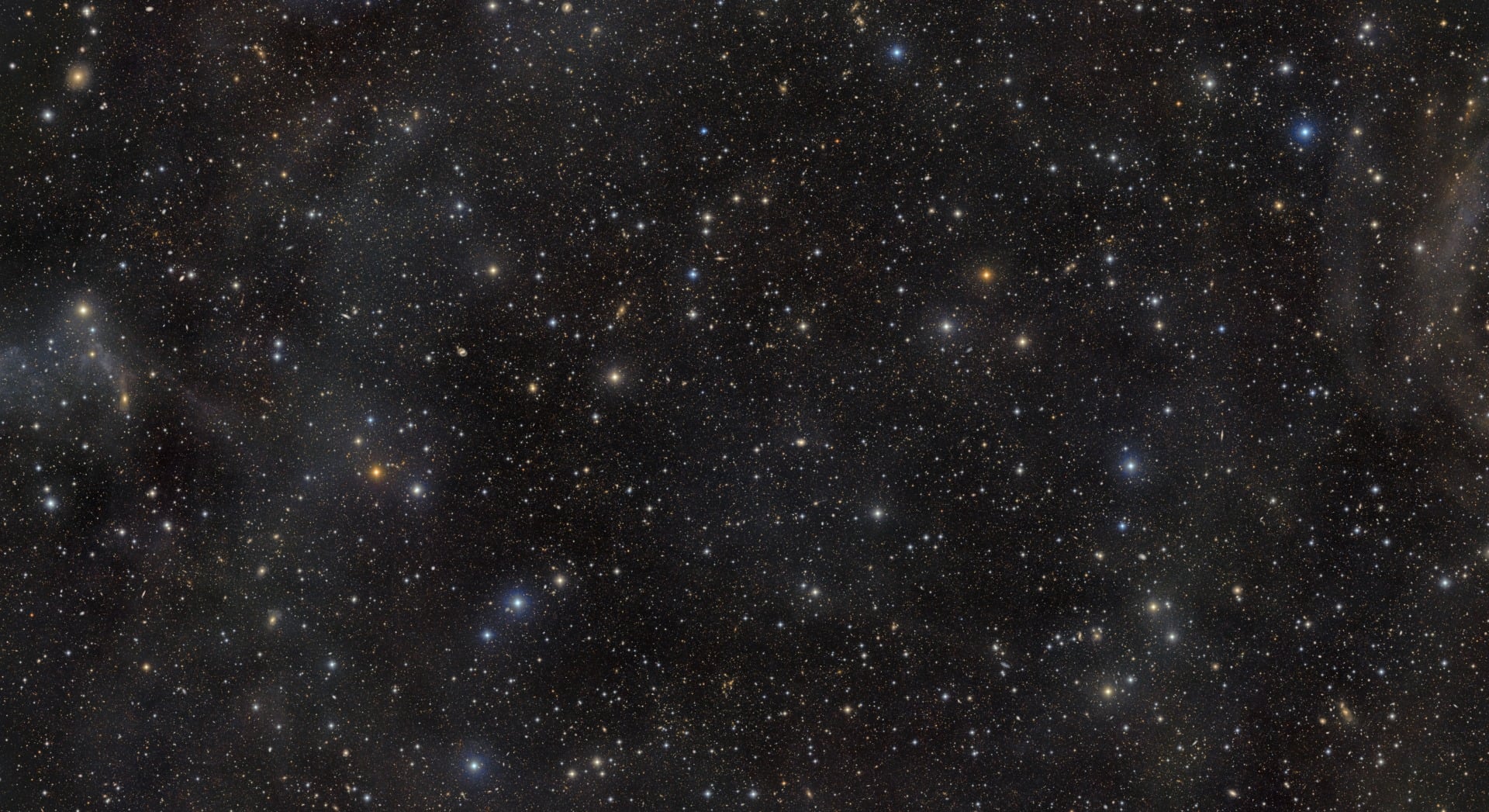
A few bright stars from the Milky Way appear in the foreground of Rubin’s exceptionally detailed view of the distant cosmic landscape, while soft traces of interstellar dust within our galaxy can also be seen in the image.
This won’t be the last time Rubin stares at this particular region of the skies. In fact, the COSMOS field is among the regions that Rubin will observe more frequently, compared to most of the areas included in its 10-year survey of the universe.
Rubin recently began its Legacy Survey of Space and Time (LSST), capturing hundreds of images each night to create the most comprehensive record of the universe in history. The telescope, overseen by the U.S. National Science Foundation (NSF) and the Department of Energy (DOE), is equipped with the largest digital camera ever built for astronomy and an ultra-sensitive 28-foot (8.4-meter) primary mirror.
During the decade-long cosmic survey, Rubin will generate a wide-field snapshot of the southern sky every few nights. Combining immense field of view with depth and speed to detect extremely faint objects, LSST will help enable discoveries related to dark matter, dark energy, supernovae, and near-Earth asteroids.
The Rubin Observatory released its first images to the public on June 23, 2025, capturing millions of galaxies and stars scattered across the Milky Way, in addition to 2,104 never-before-seen asteroids. When the LSST is complete, the final dataset will contain billions of objects with trillions of measurements, which will all be accessible through regular data releases.