Getting your audio player ready…
Ice Age hunters faced a large, dangerous animal, the woolly mammoth (Mammuthus primigenius), to obtain food to survive in a harsh environment. Adult females stood approximately 8 to 9.5 feet tall and weighed around 3 to 4 tons, while large males could exceed 11 feet and weigh up to 6 tons or more. A single charging mammoth had the power to trample or gore hunters with tusks that could reach up to 14 feet. Now, ancient DNA is revealing that prehistoric people were strategic in how they hunted these megafauna. By analyzing the genetic remains of butchered woolly mammoths, researchers have discovered that humans targeted female animals. This strategy may have increased food supplies while reshaping mammoth populations for millennia before the species vanished.

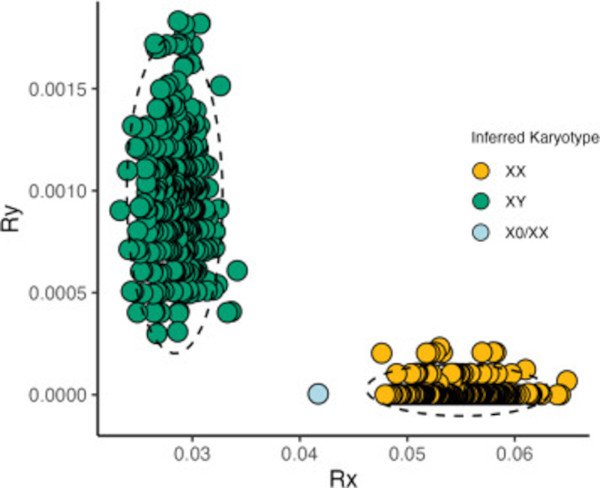
Genomic sex identification of ancient woolly mammoths based on X- and Y-chromosome DNA ratios, revealing distinct male and female clusters. (Moots/Current Biology)
Woolly Mammoths Were a Risky Resource for Ice Age Hunters
Ice Age hunters relied on close-range spear attacks and coordinated ambushes, forcing them to get dangerously close to their prey. Hunts often took place on tundra, icy riverbanks, or steep terrain where a slip could prove fatal. Cold weather, deep snow, and limited visibility added to the danger. Bringing down a mammoth could take hours or even days. Hunters often had to track wounded animals over long distances while avoiding counterattacks. Despite the risks, mammoths were worth hunting because a single animal could provide thousands of pounds of meat, along with fat for fuel, hides for shelter and clothing, bones for tools and construction, and ivory for weapons, artwork, and ornaments. Successfully killing one mammoth could sustain an entire community for weeks or even months.

Bone accumulation at the Langmannersdorf, Austria, 2025. (Marc Händel/ Austrian Academy of Sciences/Current Biology)
Sites with Thousands of Mammoth Bones Discovered
Over the past two centuries, archaeologists have discovered hundreds of sites containing mammoth bones across Europe, Asia, and North America. Many sites offer confusing evidence about whether humans hunted or merely butchered the animals. Some researchers maintain that the bones resulted from large numbers of deaths from natural causes. One of the most famous bone accumulation sites is Mezhyrich in Ukraine, where hunter-gatherers of 15,000 years ago constructed circular dwellings using the skulls, jaws, tusks, and other long bones of more than 100 mammoths. “Whether these massive mammoth bone accumulations were formed naturally or by human hunting has been debated for decades,” says David Díez del Molino, co-senior author of the study.
“By comparing the genetic sex ratios of hundreds of mammoths from natural settings with those found in these archaeological contexts, we can now infer that human activity was the primary driver behind these bone accumulations.”
Researchers Analyze Ancient Mammoth DNA
An international research team from the Centre for Palaeogenetics, a collaboration between Stockholm University and the Swedish Museum of Natural History, analyzed ancient DNA from 521 woolly mammoths, including 100 individuals recovered from 11 human-associated bone accumulation sites from 20,000 to 30,000 years ago and 421 mammoths from natural deposition settings across Europe and North America. They found that males made up 66 percent of mammoths recovered from natural settings, whereas females accounted for 70 percent of individuals from human-associated bone accumulation sites.
The study, “Paleogenomic sex inference of mammoth remains sheds light on the anthropogenic nature of bone accumulations,” published in Current Biology, provides new analysis on the hunting habits of ancient humans. According to study co-senior author Prof. Love Dalén, Professor of Evolutionary Genomics at Stockholm University:
“By scaling up sample sizes, ancient DNA can go beyond evolutionary history to teach us about animal behavior and human culture tens of thousands of years ago.”
Now, the researchers are grappling with the disparity that exists between hunted males and females: “While it is tempting to assume that hunters would have targeted females because they were smaller than adult males, the reality may have been more complex,” says study lead author Hannah Moots, a postdoctoral researcher at the Centre for Palaeogenetics.

Comparison of male and female mammoth remains from natural deposits and archaeological accumulation sites. Human-associated sites contain a significantly higher proportion of females than natural assemblages. (Moots/Current Biology)
Possible Causes of the Gender Disparity
The team’s research is ongoing. One possibility is based on sex-segregated herds. According to Moots, because female mammoths moved across the landscape more predictably than males. Professor Dalén furthers this explanation, saying, “One could also speculate that it would have been easier to pin down a herd with juveniles. The females would have been reluctant to run away.”
The researchers also hypothesized that solitary males were more likely to die in natural traps, such as sinkholes or landslides, explaining why there are more of their bones in natural settings.
The researchers also discovered a mammoth X0/XX mosaicism, a genetic condition known as Turner syndrome in humans, in which an individual has some cells with a single copy of the X chromosome and others with two. It’s the first time the condition has been documented in an extinct species. In humans, this condition is associated with short stature, infertility, and a range of other physical differences. The team identified this discovery as an area for future investigation.
Top Image: Examples of Ice Age mammoth bone accumulation sites analyzed in the study, together with the geographic distribution of archaeological and natural mammoth assemblages used for ancient DNA analysis. Source: Moots/Current Biology
By Ramsey Hardin
References
Hashemi, S. 2026. “Ice Age Humans Mostly Killed Female Woolly Mammoths, Suggests Ancient DNA.” Smithsonian Magazine, (July). https://www.smithsonianmag.com/smart-news/ice-age-humans-mostly-killed-female-woolly-mammoths-suggests-ancient-dna-180989241/.
Moots, Hannah M., et al. “Paleogenomic sex inference of mammoth remains sheds light on the anthropogenic nature of bone accumulations.” Current Biology, 2026. https://www.sciencedirect.com/science/article/pii/S0960982226008882
Moots, H. 2026. “Ancient DNA reveals Ice Age hunter-gatherers preferentially targeted female mammoths.” Stockholm University (July). https://www.su.se/english/news/articles/2026-07-30-ancient-dna-reveals-ice-age-hunter-gatherers-preferentially-targeted-female-mammoths.
Radley, Dario. 2026. “Ice Age hunters targeted female woolly mammoths, ancient DNA study finds.” Archaeology News Online Magazine, (July). https://archaeologymag.com/2026/07/ice-age-hunters-targeted-female-mammoths/.