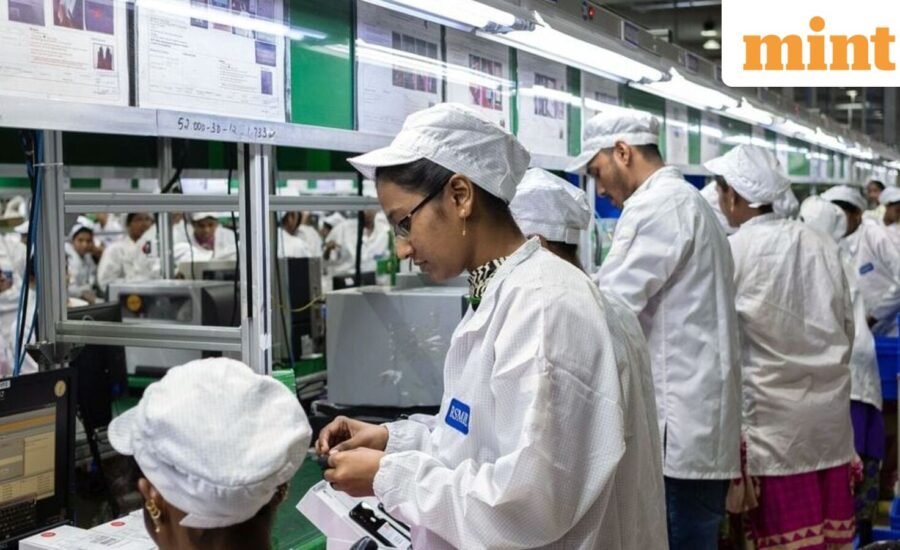
India’s manufacturing activity expanded at its slowest pace in over five years in July as a sharp moderation in new orders curbed input purchasing, even as export demand strengthened and inflationary pressures moderated, a survey data indicated on Monday.
The HSBC India Manufacturing Purchasing Managers’ Index (PMI) fell to 53.5 in July, down from 54.2 in June, and remained below the flash reading of 53.9, underscoring that renewed tensions in West Asia have raised fresh doubts among manufacturers. However, the reading remained above the 50-mark that separates expansion from contraction.
The index is a gauge of overall conditions derived from measures of new orders, output, employment, supplier delivery times, and stocks of purchases. The latest reading “was the lowest since August 2021 and below the long-run series average of 54.2,” the survey said.
Despite receding only marginally from June, the rate of growth in new orders was the second-weakest in over four years. Panel members indicated that advertising and demand resilience supported sales, which were somewhat curbed by increasingly challenging market conditions and reduced client interest for key items.
According to the survey, manufacturers in India continued to benefit from resilient demand, with a sustained rise in new orders underpinning further output expansion in July. Growth cooled again across some metrics, however, such as total sales, input purchasing and employment, it said.
However, the survey noted a welcome development in new export orders, which increased at a faster rate. Among many, firms noted gains from Canada, Egypt, Indonesia, Kenya, Nepal, South Africa, Thailand and the UAE. Also, there was a mild recovery in business optimism.
Operating expenses rose further, especially for transportation, but the overall rate of cost inflation eased to a five-month low. Hence, output charges increased only moderately, said the survey.
“The suppliers’ delivery times index rose in July, an encouraging sign that supply chain delays are continuing to unwind. However, renewed tensions in the Middle East have raised fresh doubts about how durable these improvements will be,” said Pranjul Bhandari, chief India economist at HSBC.
“In response, manufacturers appear to be rebuilding buffers: inventories of both inputs and finished goods increased alongside a rise in purchasing volumes, suggesting firms are securing supply and limiting exposure to potential disruption,” Bhandari added.
Meanwhile, output and new export orders strengthened, pointing to resilient demand, particularly from overseas markets. “Price pressures also shifted: input cost inflation moderated, but output charge inflation accelerated, indicating firms are once again passing through price increases to protect margins,” Bhandari said.
With sales remaining on an upward trajectory, companies scaled up production volumes. Little-changed from June, however, the pace of growth was among the softest since mid-2022, the survey noted.
Consumer goods were a particular area of weakness in July, posting notably softer increases in new orders and output. Intermediate and capital goods makers registered stronger rates of expansion for both measures.
Indian manufacturers remained focused on rebuilding reserve buffers by purchasing additional inputs. The pace of growth was marked, but retreated to a 31-month low, said the survey.
Supply chain
During the month in review, companies also saw a notable improvement in supply-chain conditions. In fact, input lead times shortened at a near survey-record pace. Hence, stocks of purchases rose further at the start of the second fiscal quarter. Moreover, according to the survey, the pace of accumulation accelerated from that seen in June.
Post-production inventories likewise expanded, following a solid drop in June. Here, the upturn was the most marked in over 11 years, the survey said.
Job creation across India’s manufacturing industry weakened for the third straight month in July. The rate of employment growth was the slowest in the current 29-month period of uninterrupted growth.
Cost pressures eased to their weakest level in five months, though companies continued to report higher transportation costs in particular.
Meanwhile, there was a moderate increase in selling prices, broadly similar to that in June.
Business sentiment strengthened from June’s recent low, with firms signalling a positive outlook for demand, infrastructure projects and new client enquiries. Some businesses expected market conditions to improve and hoped their marketing initiatives would pay off.
The HSBC India Manufacturing PMI is compiled by S&P Global from responses to questionnaires sent to purchasing managers in a panel of around 400 manufacturers. The panel is stratified by detailed sector and company workforce size, based on contributions to GDP.