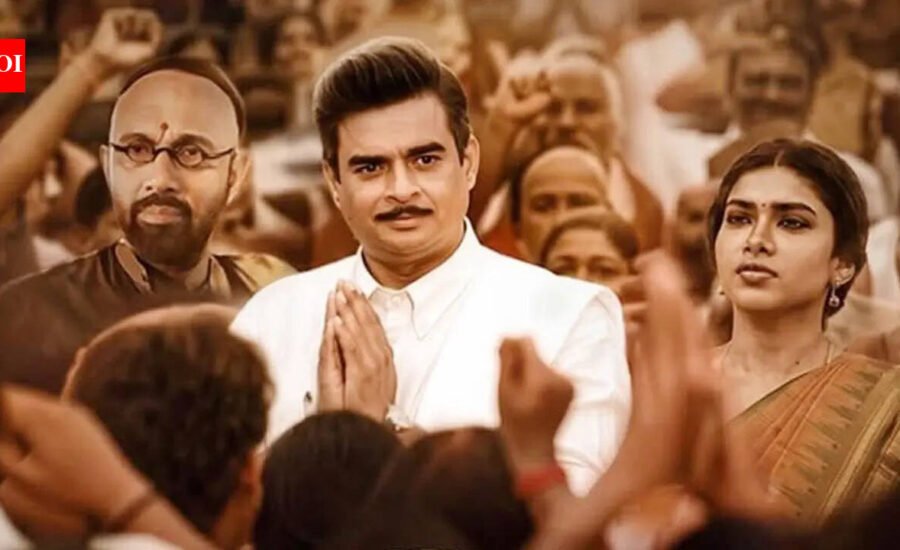
G.D.N. Movie Synopsis: The life of G. D. Naidu, the self-taught Coimbatore inventor and industrialist who built the UMS bus empire while battling colonial-era authorities.G.D.N. Movie Review: Here’s a man who built India’s first indigenous electric motor, ran a two-hundred-bus empire famous for its punctuality, met Hitler, and gave away nearly everything he owned. If none of that rings a bell, GDN knows. It opens with a textbook committee debating whether G. D. Naidu deserves a chapter in the school syllabus, and the committee is really arguing with the audience: most of us are meeting him for the first time.In the 1910s, Naidu waits tables in Coimbatore for three years to buy a motorcycle off Englishman Henry Adams (Carl Andrew Harte), then dismantles it within a week of finally owning it, because riding the thing was never the point. Knowing how it works is. The favour gets returned decades later, when Adams, as income tax commissioner, sets about dismantling everything Naidu builds. The film sees him as an entrepreneur before an inventor; tinkering is how he thinks his way towards self-sufficiency, and every fixation soon becomes a business. The best stretch has him talking rival bus operators into pooling their vehicles under UMS, a cooperative where the customer is boss and a single ticket stays valid for four days across the network. It’s startup thinking, sixty years before anyone had the vocabulary for it.It’s the shape that wears the film down. Village landlords, a jealous merchant, rival operators, forged ledgers, seized assets: each hurdle arrives on schedule, gets outsmarted, and makes way for the next, with tax officer Ambalapara Krishnan (Jayaram) proving the most persistent of the lot. The decades leap too. Chellamma (Priyamani), his first wife, asks him to leave her behind, and the film has changed eras before the moment can settle. He gets stranded in wartime Germany, leaving his second wife Ranganayakiammal (Dushara Vijayan) to stare down the raids at home; Dushara plays her as a woman built to outlast a siege, and the film is better for every minute she gets. He returns after a year-long detour around the planet, and suddenly it’s independence, with the same tax battles continuing under a new flag. Whenever the film stops racing the calendar, it finds something real. An auction of Naidu’s seized assets, where an entire town refuses to bid until his kinsman Ramiah Pillai (Sathyaraj) buys the lot for a rupee and three annas, says more about the man than any of his speeches.Director Krishnakumar doesn’t hide the flaws either: the hubris, the abandoned marriage, the admiring visit to Hitler’s Germany. A safer film would have buffed all of it out; he trusts his subject to survive the blemishes. Still, the film never quite settles the question of scale, and it’s hard to blame the makers. Biopics of towering figures arrive with the myth pre-installed; a Gandhi or an Oppenheimer walks in with the audience’s awe already secured, leaving the film the far more interesting job of complicating it. Naidu is important without being iconic, so GDN has to build the legend and sell it in the same sitting. No amount of pre-release talk about an unknown genius changes that arithmetic, and it’s hard to wring more drama from a man this steadily virtuous. This is likely the most dramatisation the material supports.This is Madhavan’s second rescue act for an unsung Indian innovator after Rocketry, and he stays compelling across four decades of Naidu, always the sharpest man in whatever room he’s arguing in. Jayaram plays a worthy adversary, a man who worships paperwork the way others worship gods. Sathyaraj has a fine time, though the writing mostly uses him as a second barrel for the hero’s punchlines; between the two of them, every opponent gets out-chessed twice over, and the perpetual one-upmanship borders on smug. Karunakaran, so often the comic relief, gets a villainous turn instead and does it justice.The period recreation is patchier: a heavy colour grade flattens the Coimbatore of the 1930s and 40s into one continuous sepia mood, and the film could have done without the couple of AI-generated shots that yank you right out of the era. Govind Vasantha’s score and Arvind Kamalanathan’s cinematography serve the proceedings capably throughout.Naidu’s instinct was to take apart whatever he admired to see how it worked. The film admires him too much to try it.Written By: Abhinav Subramanian‘GDN’ Twitter review: R. Madhavan’s performance wins praise; early viewers call it an inspiring biopic; fans hail Krishnakumar Ramakumar’s direction
Entertainment
G.D.N. Movie Review: Madhavan gives a forgotten pioneer his due