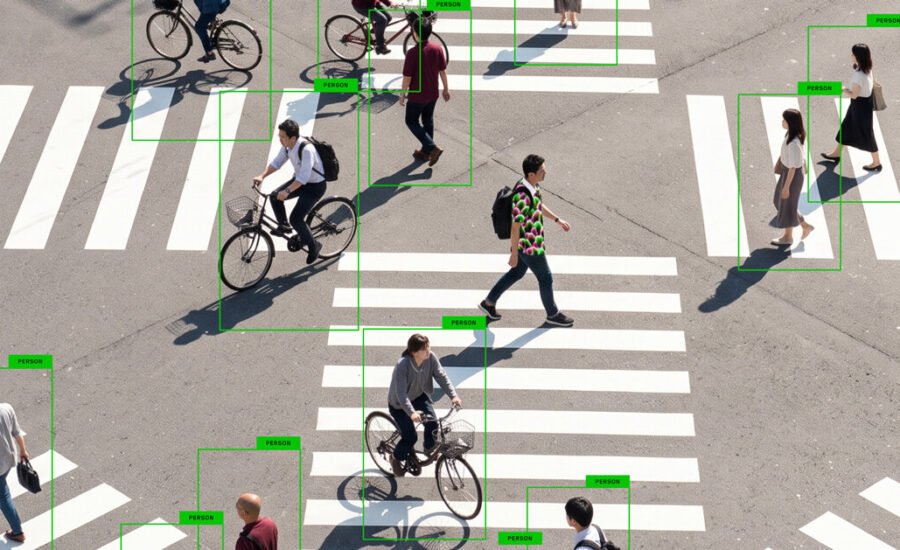
Digital Camouflage is Designed to Disrupt Machine Vision
Digital Camouflage is a conceptual garment collection by Simon Weckert that examines visibility, anonymity, and digital surveillance in public space. The garments are designed to interfere with artificial intelligence systems that use computer vision to detect people. At first glance, the clothing appears to feature an abstract graphic pattern, but the textile design is specifically developed to disrupt object-recognition algorithms used in surveillance, security, and autonomous systems.
The pattern is based on the concept of an adversarial attack, in which visual data is manipulated so that a machine incorrectly interprets what it sees. When worn, the garments are intended to make the wearer difficult for AI-based person detectors to recognize, disrupting the system’s ability to identify the human figure.

all images courtesy of Simon Weckert
Continuous Adversarial Texture Covers Garment Surface
Previous attempts to evade AI person-detection systems have relied on fixed printed patches, which can become ineffective when fabric folds or camera angles change. This vulnerability is known as the segment-missing problem. Digital Camouflage by designer Simon Weckert addresses this issue through a seamless Adversarial Texture (AdvTexture) that covers the entire garment.
The continuous pattern is generated using a specialized generative AI method known as TC-EGA, which optimizes a tileable textile design. Applied across the full surface of the garment, the texture produces high-frequency visual noise and false visual features from different viewing angles, disrupting the consistency required for AI-based object recognition.
The collection is manufactured in Latvia using a durable blend of 65% recycled polyester and 35% polyester. The adversarial texture is applied through digital textile printing, combining computational pattern generation with textile production to create garments designed to challenge machine-based systems of visual recognition.

Simon Weckert’s Digital Camouflage explores visibility and anonymity in the age of AI surveillance

the conceptual garment collection uses textile design to interfere with computer vision systems