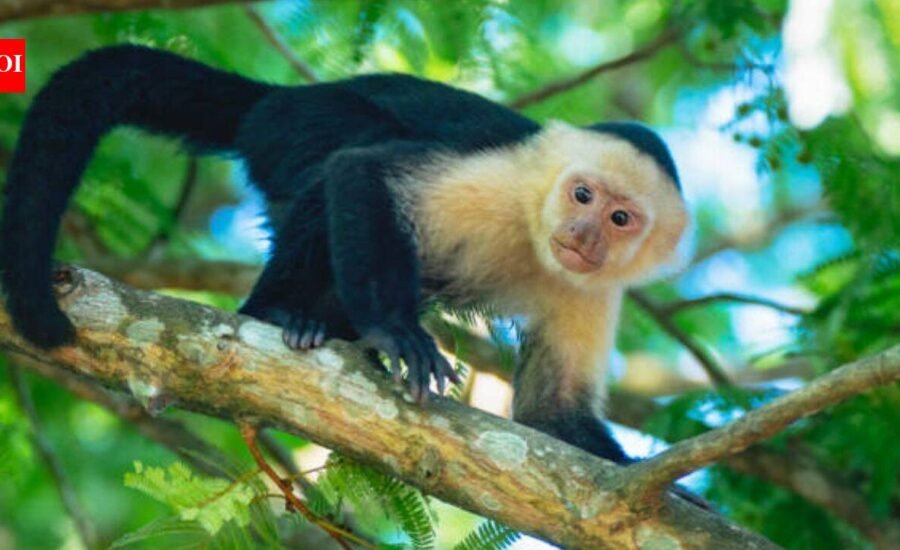
It is a known fact that humans have evolved from their ape ancestors. From crawling to walking we have come a long way and it seems that they are following suit, delving into the world of AI. In an experiment conducted in a Costa Rica forest reserve, capuchin monkeys learned to use an AI touchscreen to get banana rewards and even began kissing the screen.In the study published in The American Journal of Primatology, scientists created an AI system that uses facial recognition and real-time touchscreen testing to automate cognitive studies of capuchin monkeys in the wild. Dubbed CapuchinAI, it was developed by researchers at Emory University and Georgia Institute of Technology. It provides a roadmap for the first scalable, systematic way to evaluate and monitor the cognitive abilities of wild primates.“The primate brain didn’t evolve in a lab, it evolved in complex, competitive environments,” said Marcela Benítez, Emory assistant professor of anthropology and senior author of the paper. “Yet primate cognition is rarely studied in the wild because the experimental control needed to measure cognition is difficult in unpredictable environments.”
CapuchinAI
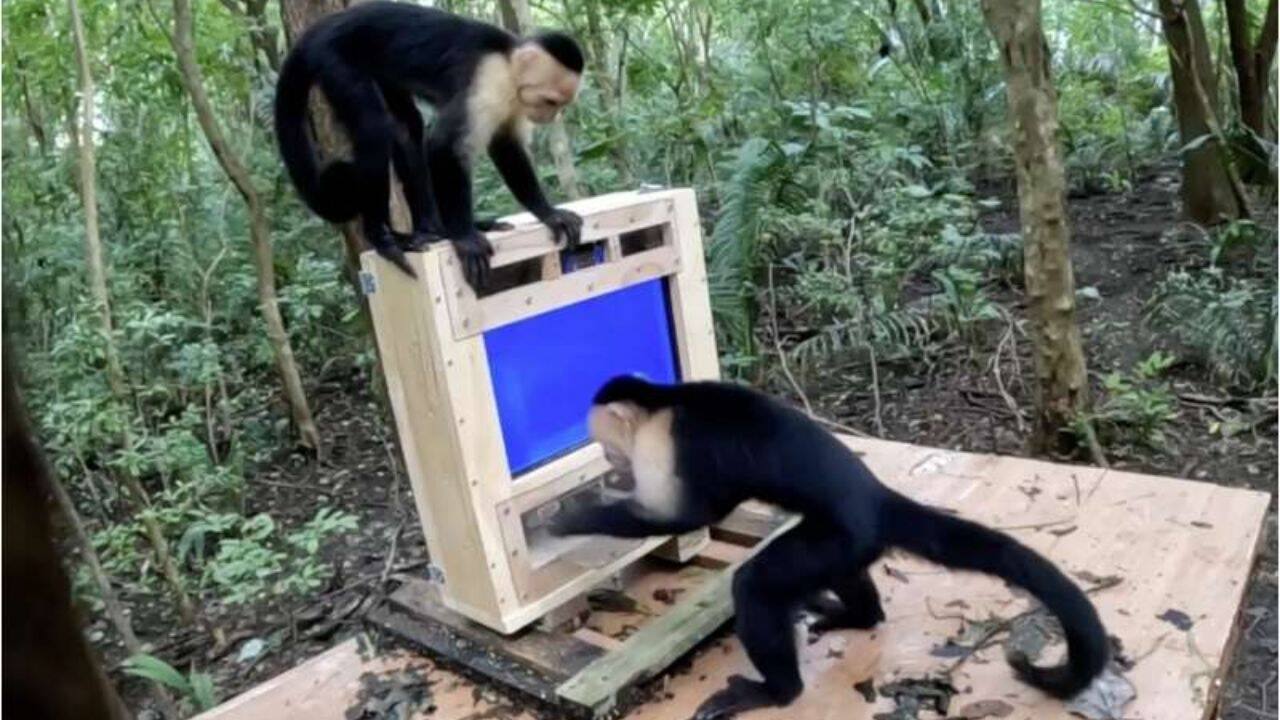
The system identifies an approaching monkey, presents a learning task tailored to that individual on a touchscreen and automatically delivers a food reward if the monkey performs the task correctly.
CapuchinAI integrates a compact, battery-powered computing system into a field research platform. The system identifies an approaching monkey, presents a learning task tailored to that individual on a touchscreen and automatically delivers a food reward if the monkey performs the task correctly.Field tests of the prototype in the Taboga Forest Reserve of Costa Rica found that CapuchinAI identifies individual capuchins with 97% accuracy, following training on still images and videos. Wild capuchins rapidly habituated and learned touchscreen-reward associations, demonstrating that the system provides a scalable field method for cognitive testing while also mapping individual differences across tasks.“This project builds on the legacy of Frans de Waal,” said Federico Sánchez Vargas, first author of the paper and an Emory Ph.D. student of anthropology. De Waal pioneered studies of animal cognition as director of Emory’s Living Links Centre for Advanced Study of Ape and Human Evolution while also writing best-selling books that helped popularise the field. He died in 2024.In addition to lab-based behavioural experiments, de Waal “gave us intimate, beautiful portraits of the lives of primates, treating them as individuals,” Sánchez Vargas said. “Our AI method allows us to more deeply understand individuals that we already have data on through field observation. We can now automate cognitive testing of them and quantify the findings. It’s a way of getting into the minds behind the personalities. Studying individuals in their natural environments, where there are tons of variations in their life experiences, lets us learn how environmental influences shaped them.”
Bringing lab to the field
Benitez’s work lies at the intersection of anthropology, psychology and evolutionary biology. She studies cooperation and other social behaviours in monkeys, including a captive population of tufted capuchins in a laboratory and wild white-faced capuchins in the Taboga Forest Reserve of northeastern Costa Rica. She is a co-director of Capuchinos de Taboga, a research project launched in 2017 in collaboration with the Universidad Nacional Técnica of Costa Rica.Animal behaviour experiments in the wild provide valid social and ecological contexts, but they are challenging to design and control. “I’m trying to bridge that gap,” said Benítez. She decided to investigate the potential of AI to achieve this aim. A seed grant from Emory’s AI. Humanities program launched a collaboration between Benítez and Abernethy to design an AI model for facial recognition of wild capuchins.Co-authors of the paper Jacob Abernethy, Georgia Tech associate professor of computer science, and Sai Rakshith Potluri, a former Georgia Tech graduate research assistant who is now a software engineer at ExtraHop in Seattle, used open-source software known as YOLO (You Only Look Once) to develop a model to run on a laptop. The researchers trained the model on high-quality GoPro imagery of six wild capuchins interacting with testing platforms in Taboga.Emory and Georgia Tech undergraduates performed the labour-intensive task of digitally placing “bounding boxes” to frame the faces of the monkeys in thousands of still images and videos tagged with their identities. The result was a facial-recognition system that could identify these six capuchins with 97% accuracy from static images, video and live footage in the field.Then, Sanchez Vargas, who joined Emory as a graduate student in 2023, took on the next phase of the project, figuring out how to integrate the facial recognition model into a field-friendly, scalable computer interface that could present tasks to interacting capuchins and dispense food rewards.“The model was great at identifying six monkeys, but there are 100 capuchins at the Costa Rica field site,” he said. “And we didn’t have high-quality video of all of these individuals, which is needed to train the model.” “I essentially dumbed it down,” he added, so that instead of classifying individual capuchin faces, the system recognised any capuchin monkey and only capuchins.The idea according to him, was to enable the system to trigger a webcam to record a video whenever a capuchin approached a computer touchscreen, rapidly generating a larger, more up-to-date data set of faces from the interacting monkeys. The resulting videos could then be used to keep training the facial-recognition model, expanding its face-recognition repertoire.The researchers created a simple stimulus to habituate the monkeys to the system: a blue square covering the computer touchscreen that records when a capuchin touches it. When the monkey touches it, the script signals a motor circuit to dispense a food reward. The entire system can run for eight hours on a lightweight battery pack before it needs recharging.
Build at home, test on the field
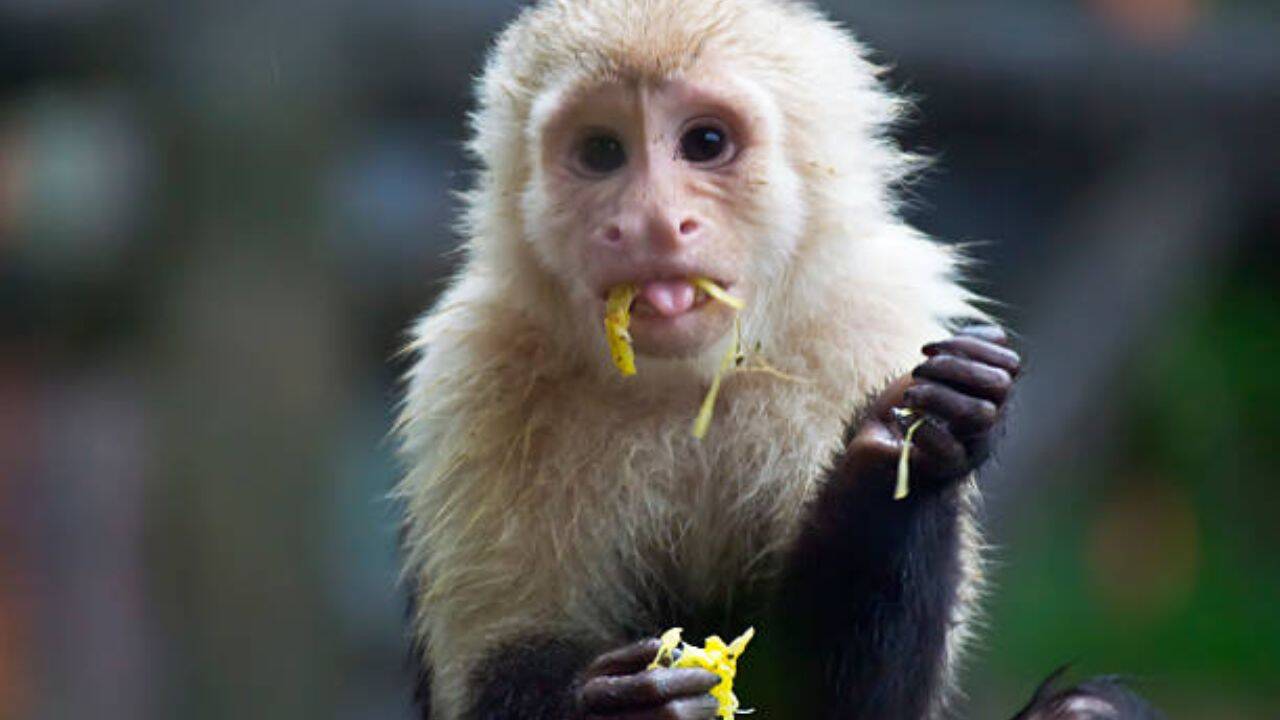
Individuals who investigated the box with their lips learned to kiss the screen to get a banana slice.
The next step was to create a wildlife-proof, weatherproof platform to house all the components of the system. “We built it in my garage,” said Benitez. She and Sánchez Vargas bought planks of pine, deck sealant, rubber insulating strips and plastic piping from Home Depot. Emory TechLab helped Sánchez Vargas create a 3D-printed plastic food dispenser. The two researchers put together a wooden box, only about 20 inches (51 centimetres) tall, to house the system’s components: a webcam, a computer touchscreen, the Raspberry Pi, the food dispenser and a rotary motor to power the dispenser.In the forest reserve, the team secured the CapuchinAI box to a platform, loaded its food dispenser with dried slices of forest banana and waited nearby. For the first couple of days, no capuchins visited. The third day, however, a large male capuchin named Trompudo, which means “big snout,” could not resist the scent of banana. “He climbs on the box and starts slapping the back of it,” Sánchez Vargas recalled. “Finally, he slaps the touchscreen and a banana slice pops out.“Trompudo gobbled up the food, then put his hand on the screen again. Another banana slice popped out. “It was almost like you could see him realising, ‘Ah, that’s what you have to do, touch the screen!'” Sánchez Vargas said. “It was amazing to watch an individual learn something so quickly.”After Trompudo, more monkeys began engaging with CapuchinAI, but differently. The researchers noted that every individual capuchin among the 16 engaged with the prototype differently during the pilot phase. Some capuchins are remarkably fast learners. Others take more time to figure out that they need to touch the screen to get a food reward. Individuals who investigated the box with their lips learned to kiss the screen to get a banana slice. Then there are the late adopters. They hang back and watch their friends interact with the box, seeing how the apparatus works before approaching it.The research team is now updating its facial-recognition model, training it on the recorded videos of the 16 capuchins from the pilot phase. They are developing cognitive experiments for four broad domains of cognition, including tests of individual capuchins’ ability to learn, their level of impulse control, their cognitive flexibility and their skill at both short- and long-term memory.If the model recognises a capuchin it was trained on, it will present a specific cognitive test on the touchscreen, depending on what “level” an individual is at in the testing sequence. If the individual is unfamiliar, the model will assign the baseline habituation stimulus—touch the screen to get a reward.Machine vision allows the model to quickly shift tests from one identified capuchin to another, so multiple individuals can participate. Moreover, the system is programmed to limit the number of food rewards an individual can receive during a session, discouraging a dominant capuchin from monopolising the platform.“We can explore outstanding questions about how the environment, individual experiences and behaviours connect to cognitive abilities,” Benítez said. “Why are some individuals better at some tasks than others? How do different individuals adapt to different situations? How do different cognitive strategies relate to fitness?” “It’s a powerful new tool in the primatology toolkit,” Benítez added.