
China’s state broadcaster recently released the first footage showing multiple DF-17 hypersonic missiles in a single frame, in what appears to be a deliberate power-projection message. The display comes at a time when hypersonic weapons have proven their lethality and ability to penetrate air defenses in the Ukraine and Iran wars.
On August 3, state-owned CCTV aired video from the PLA documentary series Zhìshèng (“Victory”) featuring at least six DF-17 transporter-erector-launchers (TELs) of the People’s Liberation Army Rocket Force (PLARF) together.
Military affairs expert Zhang Junshe told the Global Times that the display indicates the system has been mass-deployed and is reliably placed on combat duty.
Zhang emphasized that the DF-17 is a vital weapon that can alter the rules of modern air defense warfare, as it can precisely hit adversary forward air defense installations and strategic command targets by leveraging its hypersonic penetration advantage.
Typically, hypersonic weapons are very hard to intercept by conventional missile defense systems due to two main reasons: 1) these weapons travel faster than Mach 5, or five times the speed of sound, equivalent to approximately 100 kilometers (60 miles) per minute; 2) these are highly maneuverable weapons that follow an unpredictable trajectory.
Only a few countries have developed and combat-deployed hypersonic weapons, including China, Russia, and sanctioned countries like Iran and North Korea.
Of these, both Russia and Iran have used these weapons in combat with Ukraine and the United States, respectively.
On its part, Ukraine has intercepted some Russian Kinzhal hypersonic missiles with Patriot batteries.
However, these hypersonic missiles have been wreaking havoc on Ukrainian cities in recent weeks, as earlier reported by the EurAsian Times. Moscow purportedly exploits a gap in its air defense coverage and launches Kinzhal and Tsirkon hypersonic missiles to cause devastation in the embattled country. Additionally, Moscow has struck Ukraine with the Oreshnik hypersonic missile, which Ukraine has been unable to shoot down so far.
Meanwhile, Iran claimed to have fired hypersonic missiles (Fattah-class) on Israeli cities and US military bases across the Middle East during the hostilities earlier this year.
However, independent verification of claimed terminal speeds, maneuver performance, and interception rates remains limited. Previous video footage from Tel Aviv and other Israeli cities showed Iranian missiles dodging as many as 10 interceptor missiles and hitting their targets at hypersonic speeds.

Notably, the latest footage comes more than a month after CCTV published footage of a DF-17 hypersonic glide vehicle missile launch in June 2026. At the time, analysts noted that China was sending a deterrence message by emphasizing its strike capability to the United States, particularly amid tensions in the Taiwan Strait, the First Island Chain, and the South China Sea.
The same argument may apply to the latest footage, particularly since the DF-17 is the world’s first medium-range missile to field a hypersonic glide vehicle (HGV).
China has amassed a variety of deadly hypersonic missiles, including the DF-17, DF-27, YJ-21, and YJ-20. These weapons are part of the formidable Chinese A2/AD (Anti-Access/Area Denial) network along its coastline.
Chinese experts believe that even the most advanced missile defenses in the US, including the THAAD (Terminal High Altitude Air Defense) and PAC-3 Patriot, are not effective against hypersonic weapons.
“Existing US missile defenses can theoretically intercept some hypersonic weapons in their final stage, but high speed, maneuverability, and stealth make it very difficult,” read a previous Chinese paper titled “Tactical Missile Technology” on the ability of US missile defense systems to intercept hypersonic weapons.
The US and allied forces are developing countermeasures, including improved sensors, the Glide Phase Interceptor, SM-6 variants, and other technologies, but substantial challenges remain in tracking and engaging maneuvering hypersonic vehicles at scale for now.
Chinese experts have noted that the DF-17 is a potent strategic deterrent because it is a conventional, medium-range missile capable of reaching important targets in the first island chain—stretching from the Japanese archipelago through Taiwan to the Philippines—including strategic sites in Japan and other areas.
Chinese experts have previously noted that the missile may reach as far as parts of the Second Island Chain, extending from Japan through Guam, Micronesia, and Palau. They believe that coordinated multi-vehicle salvo launches may play a crucial role in both launch site security and strike effectiveness—compounding the threats faced by the US military forces in the Indo-Pacific region.
DF-17’s Mass Deployment
The DF-17 is China’s first operational road-mobile medium-range ballistic missile (MRBM) equipped with a hypersonic glide vehicle (HGV).
With a range of 1,800–2,500 kilometers, it is Beijing’s most operationally mature hypersonic strike system and is widely regarded as capable of penetrating nearly any missile defense network worldwide.
Like ICBMs, hypersonic glide weapons are launched by rockets high into the atmosphere. However, unlike ICBMs, whose warheads rely primarily on gravity once they begin their descent, hypersonic glide weapons dive back toward Earth sooner, then flatten their flight path. They make continuous course corrections to stay on target while traveling at speeds up to 12 times the speed of sound, using onboard navigation systems, making them much harder to detect by the adversary and allowing them to suppress enemy missile defenses at an early stage, clearing the way for follow-on strikes.
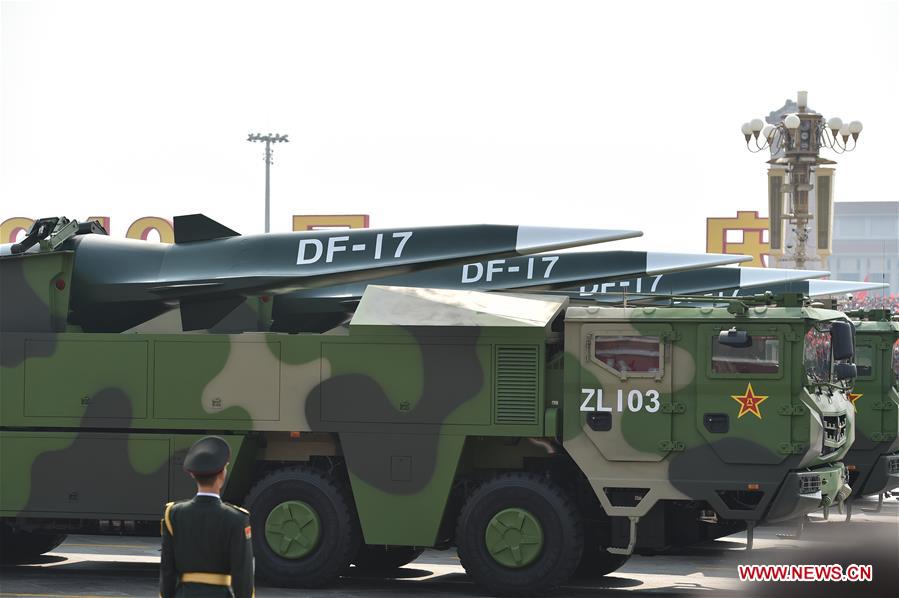
The DF-17 made its public debut in October 2019 at a military parade that marked the 70th anniversary of Communist Party rule in China.
In 2021, the PLA conducted its first known hypersonic test involving the DF-17 glide vehicle, rattling the United States. Later, the Pentagon published the China’s Military Power 2022 report, referring to the DF-17 as a critical threat in the Western Pacific.
“The DF-17 passed several tests successfully and is deployed operationally. While the DF-17 is primarily a conventional platform, it may be equipped with nuclear warheads,” the report added.
Zhang pointed out that the DF-17 can avoid adversary targeting and reconnaissance because it does not depend on fixed launch silos.
Moreover, DF-17’s powerful anti-jamming and precision strike capabilities greatly increase its battlefield survivability and make it well-suited for a variety of complex field combat scenarios, as it is difficult for adversary satellites to detect its operational patterns.
“In addition to a longer vehicle body and more wheels [of the TEL], the biggest change in the DF-17 is the shape of the missile itself. Unlike the cone-shaped warhead we are familiar with from past models, the DF-17’s warhead has undergone significant changes and now features four wings and a tail fin,” Gong Chunyu, a training staff officer from the DF-17 conventional missile formation, was quoted as saying by CCTV earlier.
“This design reflects a more scientific and advanced concept, with the missile capable of flexible and varied flight trajectories and greatly enhanced penetration capabilities,” he added.
It may be noted that China’s public releases of multiple TELs in formation and field launches demonstrate that the system is no longer experimental or small-scale, and it signifies distributed, mobile, ready forces that could hunt US-based targets quickly.
The missile’s range and penetration capability are repeatedly linked to targets in the western Pacific. Analysts interpret this as reinforcing China’s ability to hold at risk U.S. and allied bases, airfields, command nodes, and surface ships in a Taiwan or regional contingency—raising the cost of a US intervention.