
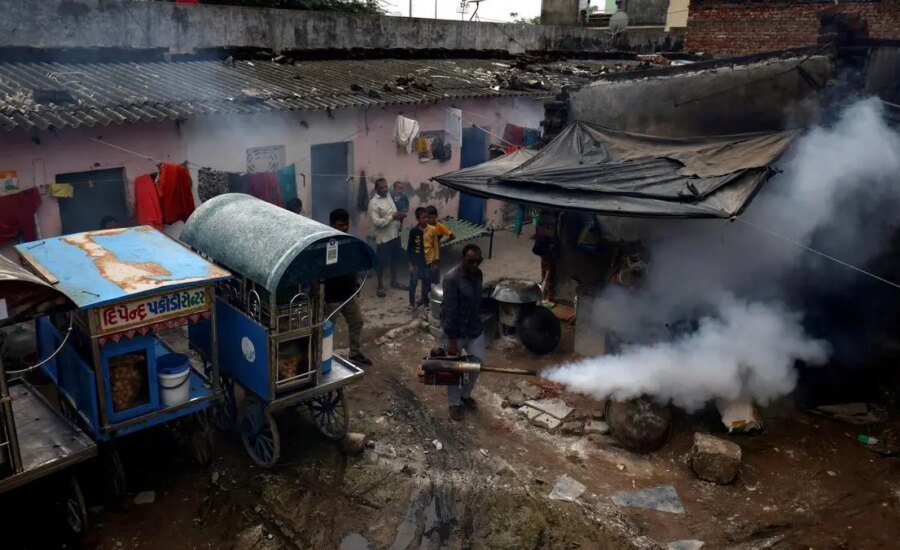

FILE PHOTO: The multi-agency effort will study the virus’s transmission, possible vectors, genetic changes and disease spectrum, while supporting surveillance, animal testing and genome sequencing to strengthen public health interventions.
| Photo Credit:
AMIT DAVE
In response to the ongoing Chandipura Virus Disease (CHPV) outbreak, the Centre has deployed a National Joint Outbreak Response Team (NJORT) to Gujarat and Rajasthan, a note from the Union Health Ministry said.
The exercise brings together specialists in epidemiology, virology, entomology, veterinary sciences, and laboratory diagnostics to understand the full clinical spectrum of Chandipura virus infection—from mild febrile illness to Acute Encephalitis Syndrome (AES), and to generate evidence for public health interventions, it added. Over 20 children have reportedly died from the infection caused by this virus in Gujarat this monsoon.
The team’s investigation seeks to unravel the virus’s transmission cycle. “While sandflies are the established vectors of Chandipura virus, scientists are also examining whether other arthropods—including mosquitoes, ticks and mites—may have a role in transmission,” the note said.
The Central team includes experts from the National Centre for Disease Control (NCDC), the Indian Council of Medical Research (ICMR) and the Department of Animal Husbandry and Dairying (DAHD). And its efforts are in addition to the disease surveillance under the Integrated Disease Surveillance Programme (IDSP), by the National Centre for Disease Control (NCDC), among others.
Multi-agency scientific investigation underway
The deployment comes amid one of the most comprehensive scientific investigations undertaken for the Chandipura virus in recent years, the note said. Experts from ICMR-National Institute of Epidemiology (ICMR-NIE), Chennai, ICMR-National Institute of Vector Control Research (ICMR-NIVCR), Puducherry, ICMR-National Institute of Virology (ICMR-NIV), Pune, ICMR-National Institute for Pre-Clinical Research (ICMR-NIPCR), Hyderabad, and ICAR-National Institute of Veterinary Epidemiology and Disease Informatics (ICAR-NIVEDI), Bengaluru are working in close coordination with the Gujarat State Health Department to investigate the outbreak, it added.
Animal surveillance and genome sequencing intensified
Blood samples from cattle, buffaloes and goats, along with milk samples, have also been collected for testing, the note said. Around 70 animal blood samples have been collected so far and are being analysed for Chandipura virus and other relevant pathogens. “Authorities have clarified that no conclusions can be drawn until laboratory investigations are completed,” it added.
During the 2024 Chandipura virus outbreak in Gujarat, several vector species, including sandflies, were collected and tested, but all samples were negative for CHPV, and no specific vector could be conclusively implicated, the note said.
Scientists are also examining whether the virus has undergone genetic changes. Whole-genome sequencing of virus samples from the current outbreak is being carried out at the Gujarat Biotechnology Research Centre (GBRC), Gandhinagar, it said. and preliminary analysis has identified minor genetic variations, it said, adding that experts called for detailed comparative genomic studies.
The current investigations are supported by the country’s Hospital-based Acute Encephalitis Syndrome (AES) Surveillance Network, a multicentric prospective surveillance programme spanning 15 tertiary care hospitals across the country, it said.
Published on August 5, 2026