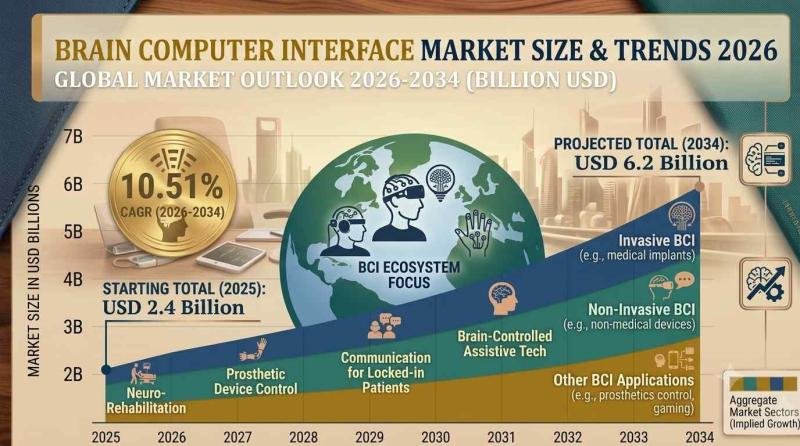
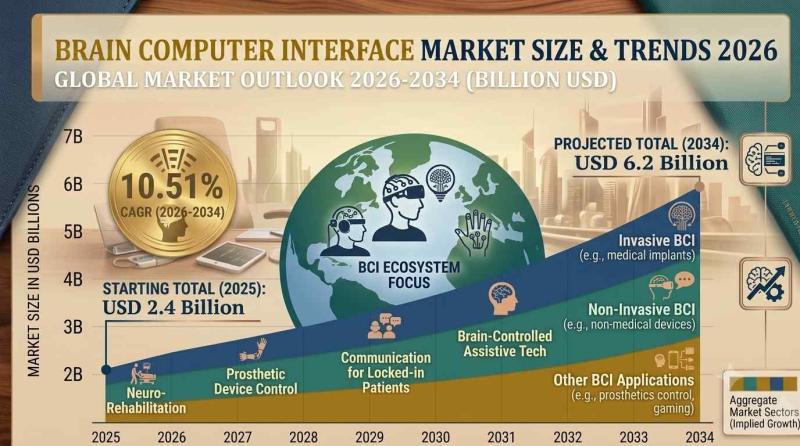
According to IMARC Group, the global Brain Computer Interface Market Size was valued at USD 2.4 Billion in 2025 and is projected to reach USD 6.2 Billion by 2034, exhibiting a CAGR of 10.51% during 2026-2034. This exceptional Brain Computer Interface Market Growth is fuelled by the rising prevalence of neurological disorders, rapid advances in AI-powered signal processing, expanding non-invasive BCI applications, and surging investment from both government agencies and private innovators worldwide.
Brain Computer Interface Industry Overview:
Brain Computer Interfaces are systems that establish a direct link between the brain and external hardware or software – bypassing conventional neuromuscular pathways. BCIs capture, interpret, and translate neural signals into actionable commands, enabling unprecedented interaction between human cognition and machines.
BCI systems are broadly classified by their mode of signal acquisition:
• Non-invasive BCI: EEG-based wearable systems that capture brain signals through the scalp – the dominant product segment (87.5% share in 2025), prized for safety, accessibility, and cost-effectiveness.
• Partially Invasive BCI: Electrodes placed on the brain surface (electrocorticography/ECoG), offering a balance between signal quality and surgical risk.
• Invasive BCI: Microelectrode arrays implanted directly into brain tissue for highest resolution – exemplified by Neuralink’s N1 implant and Synchron’s Stentrode.
Key application segments span healthcare, smart home control, communication and control, and entertainment and gaming – with healthcare commanding 63.3% of Brain Computer Interface Market Share in 2025.
Global Brain Computer Interface Market Size & Key Statistics:
Below are the key Brain Computer Interface Market statistics drawn from IMARC Group’s comprehensive market analysis:
Base Year – 2025
Historical Period – 2020-2025
Forecast Period – 2026-2034
Brain Computer Interface Market Size in 2025 – USD 2.4 Billion
Market Forecast in 2034 – USD 6.2 Billion
Market Growth Rate (2026-2034) – 10.51% CAGR
Largest Region – North America (40.8% share, 2025)
Leading Product Segment – Non-invasive BCI (87.5%, 2025)
Leading Application Segment – Healthcare (63.3%, 2025)
US Share within North America – 89.5%
Request for a Sample Report for Detailed Brain Computer Interface Market Share Evaluation: https://www.imarcgroup.com/brain-computer-interface-market/requestsample
Key Market Drivers & Brain Computer Interface Market Trends in 2026:
Several powerful forces are shaping the Brain Computer Interface Market Trends and fuelling strong double-digit growth expectations across global neurotechnology markets:
1. Rising Prevalence of Neurological Disorders:
The growing burden of neurodegenerative conditions is the primary catalyst for Brain Computer Interface Market Growth. Global dementia cases exceeded 55 million in 2020 and are expected to reach 78 million by 2030. In the United States alone, nearly 14 million adults are projected to have Alzheimer’s disease by 2060, according to the CDC. Parkinson’s disease, epilepsy, ALS, and spinal cord injuries collectively represent a vast patient population requiring innovative neurodiagnostic and neurorehabilitation solutions – precisely where BCIs excel.
2. Surging Geriatric Population Globally:
The worldwide population aged 65 and over is forecast to reach 2.2 billion by the late 2070s – surpassing the count of children under 18. This unprecedented demographic shift is driving demand for assistive neurotechnologies. BCIs are proving critical for this cohort by enabling early detection of cognitive decline, continuous neurological monitoring, rehabilitation support, and restoration of motor and communication functions – directly addressing the healthcare needs of an aging global population.
3. Rapid Advances in AI and Signal Processing:
The integration of artificial intelligence and machine learning into BCI systems is a defining Brain Computer Interface Market Trend in 2025. AI enables faster, more accurate interpretation of neural signals, improves device response times, and facilitates personalised adaptive algorithms that learn individual brain activity patterns. These advances are dramatically improving the usability, accuracy, and clinical reliability of both non-invasive wearable BCIs and fully implanted systems.
4. IoT and Virtual Reality Integration:
The convergence of BCIs with the Internet of Things (IoT) and virtual reality (VR) ecosystems is unlocking transformative new applications. With IoT-connected devices forecast to exceed 20.1 billion units globally, and 57% of US households projected to own smart home devices by end-2025, BCIs are increasingly being integrated with smart home systems, immersive VR environments, and connected healthcare platforms – creating seamless neural-device interaction ecosystems.
5. Expanding Non-Invasive BCI Accessibility:
Non-invasive BCIs are becoming more portable, affordable, and user-friendly, broadening their adoption beyond specialised clinical settings into rehabilitation centres, research institutions, gaming, education, and consumer wellness. Innovations in wearable electrode arrays, microneedle sensors (such as Georgia Tech’s hair-follicle-scale sensors unveiled in April 2025), and dry-electrode EEG headsets are making high-quality brain signal capture feasible during everyday activities.
6. Government Investment and Clinical Trial Momentum:
Government agencies worldwide are significantly expanding BCI research funding. The US BRAIN Initiative, DARPA’s N3 programme, and equivalent programmes in China, the EU, and Japan are accelerating BCI development and commercialisation. China launched its first invasive BCI clinical trial in 2025, successfully enabling a tetraplegic patient to control digital devices through thought alone. Neuralink received Health Canada approval in 2024 to launch the CAN-PRIME international BCI trial. This momentum of regulatory milestones and trial approvals is building the clinical evidence base critical for broad market adoption.
7. Landmark Milestones in BCI Commercialisation:
In May 2025, Synchron became the first BCI company to achieve native integration with iPhone, iPad, and Apple Vision Pro, enabling users with motor impairments to control Apple devices through thought alone. In June 2025, Paradromics completed its first-in-human Connexus BCI procedure at the University of Michigan. These commercial and clinical breakthroughs are reshaping Brain Computer Interface Market Trends and driving investor confidence in the sector.
Key Brain Computer Interface Market Segmentation:
By Product:
Non-Invasive BCI – Largest Segment (87.5% Share, 2025): Non-invasive BCIs dominate the market overwhelmingly due to their safety profile, cost-effectiveness, and breadth of application. EEG-based systems – combined with AI-driven signal interpretation – are increasingly accurate and are being deployed in clinical neurology, rehabilitation, consumer wellness, and research. Robust regulatory frameworks, growing product availability, and rising user awareness are consolidating non-invasive BCI as the cornerstone of the overall market.
Partially Invasive BCI: ECoG-based systems offer higher signal fidelity than non-invasive approaches and are used in epilepsy monitoring and functional mapping. They represent a growing niche in neurosurgical workflows.
Invasive BCI: Fully implanted microelectrode systems provide the highest neural signal resolution. Neuralink’s PRIME and CAN-PRIME trials, Synchron’s Stentrode commercial rollout, and StairMed’s limb-loss gaming milestone (July 2025) represent the frontier of invasive BCI clinical progress.
By Application:
Healthcare – Largest Segment (63.3% Share, 2025): Healthcare is the dominant application segment, driven by the critical need for advanced neurodiagnostic, neurorehabilitation, and assistive communication solutions. BCIs are deployed in hospitals, rehabilitation centres, and research institutions globally for epilepsy monitoring, motor rehabilitation post-stroke, ALS communication aids, and pain management. Significant capital investment, AI integration, and regulatory endorsement are reinforcing healthcare’s leadership position.
Communication and Control: BCIs are providing life-changing communication tools for patients with ALS, locked-in syndrome, and severe motor impairments – enabling text generation, device control, and environmental interaction through thought alone.
Smart Home Control: Integration with IoT-enabled smart home ecosystems allows BCI users to control lighting, appliances, and security systems neurally – an area growing rapidly with IoT device proliferation.
Entertainment and Gaming: Consumer-facing BCIs are entering mainstream gaming, immersive VR experiences, and neurofeedback wellness applications – expanding the total addressable market well beyond clinical use cases.
Regional Brain Computer Interface Market Analysis:
North America – Largest 40.8%:
US (89.5% of regional share) & Canada; Neuralink PRIME trial, Synchron Apple integration, BRAIN Initiative, Paradromics Connexus first-in-human, NIH & DARPA funding.
Europe – 22%
Germany, France, UK; aging population (247M aged 60+ by 2030), ERC neuroscience grants, neuroprosthetics research, NHS trials.
Asia-Pacific – Fastest Growing 19% –
China, Japan, India, South Korea; China’s first invasive BCI trial (2025), NMPA approvals, 40-90M disabled persons in India driving rehabilitation BCIs.
Latin America ~10%: Brazil, Mexico; rising urban disposable incomes (avg. BRL 40,200/yr in Brazil), growing tech-literate population driving consumer BCI demand.
Middle East & Africa – 9%
UAE (150+ hospitals, 5,000+ facilities), Saudi Arabia; healthcare modernisation, neuro-rehabilitation investment, Saudi Vision 2030 digital health push
North America holds the largest Brain Computer Interface Market Share at 40.8% of global revenue in 2025. The United States – commanding 89.5% of the regional market – benefits from its unrivalled concentration of BCI innovators (Neuralink, Synchron, Paradromics, NeuroSky, Medtronic), a robust DARPA-to-clinic innovation pipeline, and strong academic-industry collaboration across MIT, Stanford, UCSF, and Johns Hopkins.
Asia-Pacific is the fastest-growing regional market, driven by China’s government-backed BCI clinical programme, Japan’s PMDA regulatory progress, and India’s large disability and neurological patient population requiring affordable assistive neurotechnologies.
Connect for Detailed Brain Computer Interface Market Share Segmentation Analysis – Speak to an Analyst: https://www.imarcgroup.com/request?type=report&id=4025&flag=C
Leading Players in the Brain Computer Interface Industry:
The global BCI market features a blend of established medical device multinationals and focused neurotechnology innovators. Key companies covered in the IMARC Group report include:
Advanced Brain Monitoring Inc.
ANT Neuro
Compumedics Limited
EMOTIV
Medtronic plc
Natus Medical Incorporated
NeuroSky Inc.
Nihon Kohden Corporation
NIRx Medical Technologies LLC
Latest Industry Developments:
July 2025 – StairMed (China)
StairMed developed a brain-computer interface that enabled a man born without limbs to play computer games using only neural signals, as part of China’s expanding government-funded BCI clinical programme. The milestone reflects how China’s coordinated BCI trials are now progressing at a pace that rivals and in some respects exceeds earlier US-based efforts – a significant indicator of shifting Brain Computer Interface Market Growth dynamics globally.
June 2025 – Paradromics (United States):
Paradromics successfully completed its first-in-human procedure with the Connexus Brain-Computer Interface at the University of Michigan. The Connexus device was implanted, recorded high-fidelity brain signals, and removed intact in under 20 minutes – demonstrating a new paradigm for minimally disruptive, reversible invasive BCI procedures that could dramatically expand patient eligibility for clinical BCI interventions.
May 2025 – Synchron (United States):
Synchron became the first BCI company to achieve native integration with iPhone, iPad, and Apple Vision Pro, using Apple’s new BCI Human Interface Device protocol. This integration enables users with motor impairments to control Apple devices through thought alone – a landmark commercial milestone that signals mainstream consumer technology platforms opening up to BCI ecosystems and represents a pivotal Brain Computer Interface Market Trend for 2025.
April 2025 – UCSF / Robotic Arm Research:
UCSF researchers – with contributions from Indian scientists – developed a BCI that enabled a paralysed man to control a robotic arm for seven months using only his thoughts, allowing him to perform real-world tasks such as picking up objects and holding a cup. This breakthrough demonstrates the sustained real-world utility of BCI-driven neuroprosthetics in daily life rehabilitation.
April 2025 – Georgia Tech (United States)
Georgia Tech researchers unveiled a wearable brain-computer interface using microneedle sensors small enough to fit between hair follicles, enabling high-quality brain signal capture during everyday activities. The innovation overcomes the longstanding limitations of bulky electrode systems and represents a critical step toward seamless, always-on neural-device integration for both clinical and consumer BCI applications.
About Us:
IMARC Group is a leading global market research company providing data-driven insights and expert consulting services to businesses seeking to achieve their strategic objectives. With a multi-disciplinary team of industry experts, IMARC delivers thorough, reliable market intelligence across sectors including Technology, Construction, Healthcare, Energy, Food & Beverages, and more.
Contact US:
IMARC Group
134 N 4th St. Brooklyn, NY 11249, USA
Email: sales@imarcgroup.com
Tel No: (D) +91 120 433 0800
United States: +1-201971-6302
This release was published on openPR.