Taipei is the city of Tai Tzu-ying. For more than a decade, the former World No. 1 turned badminton into theatre, delighting spectators with strokes that seemed to bend geometry and deception that left opponents frozen.
On Sunday, the tournament found another teenage champion who left Taipei with a place in its history. At 17 years and 222 days, Tanvi Sharma became the youngest Taipei Open champion since Tzu-ying, who won the title at 18 years and 85 days.
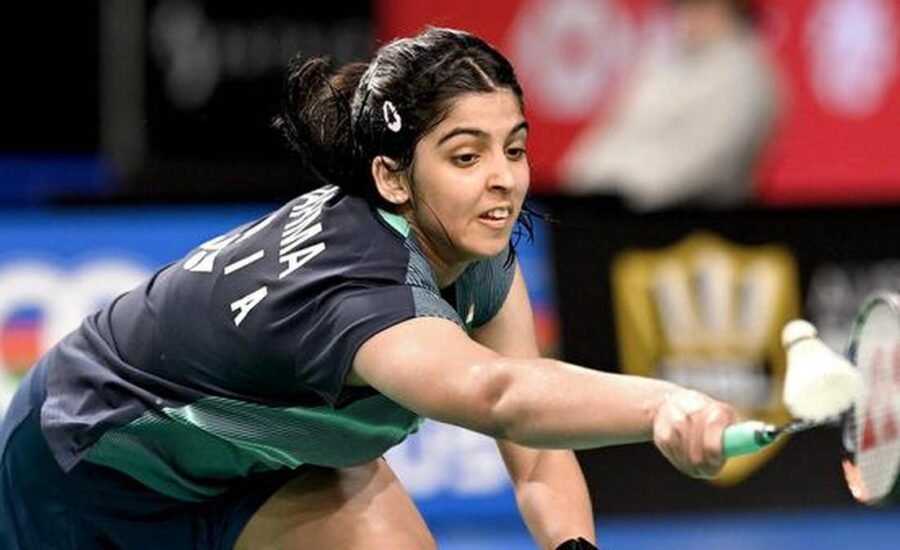
It was a fitting coincidence. For much of the week, Tanvi’s badminton too was defined not by brute force alone but by exquisite timing, late deception and a striking ease of shot-making that belied her age.
She defeated Vietnam’s Thuy Linh Nguyen 21-16, 21-16 in the final to lift her maiden BWF World Tour Super 300 title. Before soaking up the applause, she slipped her gold medal off her neck and placed it around coach Park Tae-sang’s neck. Later, the South Korean revealed that there had been moments when he had wondered whether he should leave India, but said Tanvi’s victory had given him “another powerful source of motivation to keep moving forward” after more than four years without a title.
Next gen
Indian badminton has been searching for the next leading woman ever since Saina Nehwal and P.V. Sindhu transformed the sport in the country. Every promising teenager has inevitably been measured against the two Olympic medallists.
But breakthroughs are remembered not just for the trophies, but for the style they reveal. Long before titles accumulate, the finest players develop an identity. Taipei offered the first clear glimpse of Tanvi’s. If Saina’s game was built on relentless pace and Sindhu’s on imposing physicality and steep cross-court smashes, Tanvi’s greatest weapon may well be her timing.
The shuttle seems to leave her racquet a fraction later than expected, making her intentions harder to read. Her drops and smashes emerge from nearly identical preparation. Opponents find themselves moving backwards, only to be dragged sharply forward. Even when rallies appear routine, she possesses the ability to inject sudden pace with a wristy straight smash or produce a delicate net shot that catches the opponent leaning the wrong way.
Those qualities were on full display throughout the week in the Taiwanese capital. Tanvi opened her campaign by defeating compatriot Tasnim Mir 21-16, 22-20 before overcoming Indonesia’s Titis Rahayu Widyawan 21-17, 22-20 in the second round. In both matches, the second game went down to the wire, with the teenager refusing to let tight scorelines alter her attacking instincts.
The level of opposition only grew tougher thereafter. In the quarterfinals, Tanvi stunned fourth seed Supanida Katethong of Thailand 21-15, 18-21, 21-14 before producing one of her most commanding performances of the week in the semifinal.
Facing local favourite Huang Yu-Hsun, ranked 10 places above her, Tanvi barely allowed the Taiwanese shuttler to settle, winning 21-17, 21-11. Her deceptive pushes to the back line, cross-court smashes and deft forecourt play repeatedly left Huang rooted, while a brief wobble late in the opening game proved little more than a passing interruption in an otherwise dominant display.
Against Nguyen in the final, Tanvi repeatedly opened up the court by concealing her drops with the same action as her smash before unleashing steep winners from either flank. She raced to a 10-2 lead in the opening game, repeatedly wrong-footing the experienced Vietnamese with deft touches at the net and powerful strokes.
The scoreline, however, does not fully capture the match.

Holding her own: Tanvi always stayed in control barring a few hiccups.
| Photo Credit:
Badmintonphoto
Like many gifted teenagers, Tanvi occasionally allowed brilliance and impatience to coexist. A flurry of unforced errors allowed Nguyen to close the gap to 10-8 in the opening game before Tanvi steadied herself to take it 21-16. The second game began with the Indian trailing 0-3, but she quickly wrested back control to lead 8-4 and later 15-8, mixing her trademark smash with clever deception at the net. There were brief lapses again, but Tanvi repeatedly produced moments of quality at crucial junctures, refusing to allow Nguyen’s comeback to gather momentum to close out another 21-16 victory.
It is perhaps this blend of audacity and vulnerability that makes her game so compelling. That balance is hardly unusual for a player still only 17. More importantly, her mistakes never dented her conviction to stay on the front foot. Even though she admitted to feeling nervous during the tournament, Tanvi continued trusting the strokes that had carried her into the final rather than retreating into safety.
“I was quite nervous, but I just thought I would give my 100 percent,” she said. That composure was built alongside coach Park Tae-sang, who has added focus to her explosive strokeplay. “I’m very happy to win this title. I didn’t expect to win a title here. I just thought I’d give my best. So I was going step by step, match by match.”
Beyond the title
The triumph also places her among an exclusive group of Indian women to have won a BWF World Tour Super 300 title, joining Saina, Sindhu and Devika Sihag. More importantly, it comes at an opportune moment, with the BWF World Championships in New Delhi later this month.
The transition from junior promise to senior consistency is one of the toughest in the sport. India has produced gifted juniors before, only to discover that success at higher levels demands far greater physical endurance, tactical discipline and mental resilience than talent alone can provide.
Tanvi’s own journey already reflects that progression. A former World Junior No. 1, she became the first Indian to win two medals at a single edition of the World Junior Championships, claiming silver in girls’ singles and bronze in the mixed team event. She reached the final of the U.S. Open Super 300 last year, finished runner-up at the Odisha Masters and Guwahati Masters, and was part of India’s historic Asian Team Championships triumph.
Taipei was not an overnight breakthrough. It was another milestone on a steadily rising trajectory.
There will inevitably be tougher tests ahead. Tanvi knows that better than anyone. Even after lifting the biggest title of her young career, she spoke less about the triumph than the effort it took to get there. “It was pretty hard for me as well, playing five matches. I just needed to be consistent,” she said, before adding that she still needed to “work harder” to compete regularly at the Super 500 and Super 750 level.
Sindhu, one of only three other Indian women to have won a BWF World Tour Super 300 title, perhaps summed it up best. Congratulating Tanvi on social media, the two-time Olympic medallist wrote that the teenager had “all the ingredients to become a very special player”, praising her talent, stroke-making and courage to take on the best.
The ingredients are certainly there. Natural timing cannot be taught. Neither can the instinct to disguise strokes until the last possible moment or the confidence to attack under pressure. Sindhu added that stability and experience had been the only missing pieces, calling the Taipei triumph “just the beginning” for one of Indian badminton’s brightest young prospects.
Moreover, Taipei has long had a habit of revealing special talents. Saina won the title there in 2008 before going on to redefine Indian badminton. Tzu-ying, the hometown favourite, also announced herself there as a teenager before redefining what artistry on a badminton court could look like. Tanvi’s journey is only beginning, but her victory carried echoes of both – Saina’s fearless ambition and Tzu-ying’s genius for deception and timing.