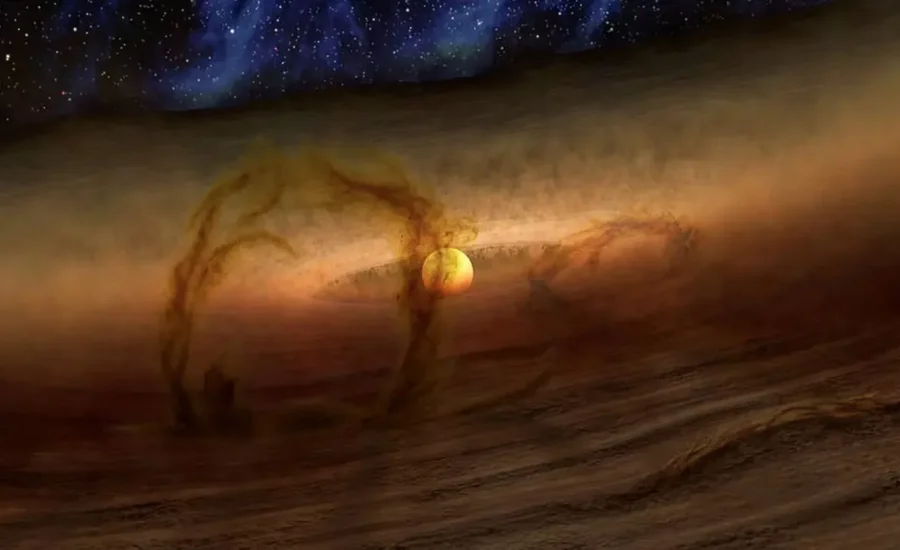
GW Orionis, a triple-star system boasting bizarre rings of dust misaligned with their orbits high in the constellation Orion, has captivated astronomers for years. Rather than lying in the same flat plane, like hula hoops tipped in different directions.
Astronomers have long puzzled over this strange geometry. Was it simply the gravitational tug-of-war between three stars? Or was something else at play?
A new study led by Maria Galloway-Sprietsma, a doctoral student at the University of Florida, offers a striking answer. Using data from the Atacama Large Millimeter/submillimeter Array (ALMA) in Chile, her team spotted a stream of gas flowing into the system.
The gas contained specifically 12CO and 13CO isotopologues. Multipoint observations showed the streamer stretching nearly 30 arcseconds across the sky, or about 12,000 astronomical units.
By measuring the gas, they estimated a mass of 1.6 Jupiter masses and calculated that it’s falling into the disk at a rate of 3.6 × 10⁻⁸ solar masses per year. That’s slower than the stars’ own accretion rate, suggesting we’re witnessing the final stages of infall.
This incoming river of material, they argue, gradually tilted the outer ring while leaving the inner one mostly unchanged. The result: misaligned rings that could one day form planets with tilted orbits.
“If these streamers are common, then we can naturally explain why planets may not necessarily end up in very orderly systems. They can have much more random orientations,” said Jaehan Bae, Ph.D., professor of astronomy at the University of Florida.
Our own solar system is tidy: all eight planets orbit the Sun in roughly the same plane. However, astronomers have detected a number of planetary systems throughout the galaxy containing worlds that take very unusual orbits. Rather than through chaos, this can happen quietly over time, and GW Orionis demonstrates how gas streams slowly bulge outward.

The team’s models showed that the streamer’s path intersected with the disk at its furthest dust ring. The angular momentum is strongly aligned with that ring (within ~3°) but almost exactly misaligned by 32° with the innermost ring.
This mismatch strongly suggests the streamer is the driver of GW Ori’s tilted disk structure. If planets form in these rings, their orbits will inherit the same skewed geometry.
The team, which included collaborators from Germany’s Max-Planck Institute for Astronomy, Ireland’s University of Galway, and Queen Mary University of London, published their findings on August 6 in The Astronomical Journal.
“What we need next is a systematic survey of young stars to see how many have streamers and how many don’t. That will tell us how important they are in shaping planetary systems,” noted Maria Galloway-Sprietsma, a doctoral student in Bae’s group.
Among the analyses made by ALMA was that of Total Power, whose results showed bright emission linking back to this streamer in a dense star-forming region. The distance also places GW Ori within the system’s Bondi–Hoyle radius, so it remains gravitationally bound to its cloud parent. As the stars moved through their natal environment, it is likely that accretion from Bondi–Hoyle was responsible for the formation of bonkers.
The collective results suggest that GW Ori is not a runaway but rather still bound to its cosmic birthplace. The streamer is still pumping material into the disk, tilting its rings and preparing a planet that could orbit at an odd angle.
Journal Reference:
- Maria Galloway-Sprietsma, Jaehan Bae, Toni Phillips, Jane Huang, Myriam Benisty, Matthew Porter, Christian Ginski, and Andrew Winter. A Streamer Driving Misalignment in the Circumtriple Disk of GW Ori. The Astronomical Journal. DOI: 10.3847/1538-3881/ae8bae