
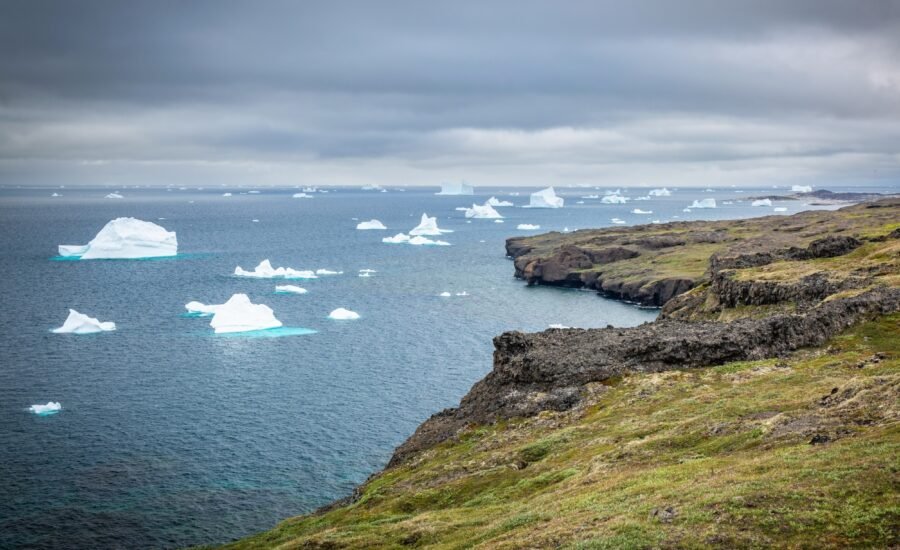
Thawing Arctic permafrost has always come with a grim assumption: when the frozen ground melts, the ancient carbon locked inside eventually becomes greenhouse gas.
A new study of the seafloor off a Canadian Arctic island suggests that assumption is only partly right.

Most of that carbon isn’t drifting into the atmosphere at all but settling into the seabed and staying there, at least for now.
The research was led by Manuel Ruben and colleagues at the Alfred Wegener Institute, Helmholtz Center for Polar and Marine Research (AWI).
An incomplete assumption about permafrost thaw
Arctic permafrost holds an enormous amount of carbon, somewhere around 1,300 gigatons built up from the remains of plants over thousands of years.
Ocean and river delta sediments hold another 400 gigatons on top of that.
As the Arctic warms faster than anywhere else on the planet, that frozen storage system is starting to fail, and carbon is spilling out through rivers and crumbling coastlines.
“Consequently, up to 0.02 gigatons are entering the sea each year, and according to forecasts, this outflow could rise by 70 to 150 per cent by the year 2100,” Ruben said.
“However, how much of this is released back into the atmosphere as a greenhouse gas and how much is stored in the seabed has, until now, been largely unknown.”
Drilling into fifty years of answers
To close that gap, the team pulled sediment cores from the seafloor near Herschel Island, capturing roughly 50 years of accumulated deposits. What they found ran against expectations.
“Although the sea here carries away huge quantities of organic carbon from the coast, surprisingly little of it ends up in the ocean’s active carbon cycle,” Ruben said.
“Microorganisms convert around ten percent of the organic carbon from the sediments into gases, which rise into the water and can then enter our atmosphere.”
The rest, the clear majority of it, simply stays buried in the seabed.
Reading carbon like a chemical fingerprint
To work out exactly where that carbon was coming from, and how much of it microbes had actually broken down, the researchers measured dissolved carbon trapped in pore water, the tiny pockets of liquid tucked between sediment grains.
The isotopes in that water function almost like a signature, revealing which carbon source the local microorganisms had actually been feeding on.
“Carbon isotopes represent our atomic indicators that can identify the food source of the microorganisms,” said Gesine Mollenhauer, a geochemist at the AWI.
“The 13C isotope, for example, tells us whether they have consumed carbon from land or from the sea.”
“By way of the 14C isotope, we were able to determine whether the single-celled organisms preferred old organic carbon from permafrost or fresh organic carbon from algae remains.”
Microbes turned out to be picky eaters
The isotope data showed that the bacteria living in these sediments have preferences, and ancient permafrost carbon isn’t their favorite.
“The sediment is home to ‘gourmet’ bacteria that apparently prefer fresh carbon stemming from, for example, more recent algal remains over the ‘old’ carbon from permafrost deposits,” Mollenhauer said.
That pickiness suggests carbon flowing off the land into the sea may end up contributing less to atmospheric greenhouse gases than researchers had once feared. Mollenhauer isn’t ready to call it good news outright, though.
“However, we do need further research here. This is because some of the organic carbon from the permafrost may already have been broken down before it reaches the seabed.”
More than just a carbon story
The consequences of all this sediment reach beyond the carbon ledger.
As eroded material clouds coastal waters and dissolved organic carbon darkens them, less sunlight reaches the algae and other single-celled organisms that convert light into biomass and oxygen.
That primary production underpins the entire coastal food web, feeding fish, crustaceans and seals, and by extension, the people who rely on them.
The team plans to dig into those broader ecological ripple effects as part of the international Arctic Pulse campaign set for 2027.
This campaign will combine measurements from the Polarstern research icebreaker, aircraft surveys, and fieldwork on land to track how quickly Arctic ecosystems are shifting.
For now, the sediment cores off Herschel Island offer something climate models have been missing: an actual measurement, rather than an assumption, of what happens to permafrost carbon once it reaches the sea.
“Our study shows, more precisely than ever before, how much carbon is safely stored in the seabed – and just how much of the decomposed material actually originates from the old permafrost,” Ruben said.
“This provides an important foundation for climate models that can predict the consequences of permafrost thawing for the global climate.”
The study is published in the journal Nature Geoscience.
—-
Like what you read? Subscribe to our newsletter for engaging articles, exclusive content, and the latest updates.
Check us out on EarthSnap, a free app brought to you by Eric Ralls and Earth.com.
——