
The Supreme Court on Wednesday observed that judicial officers are not government servants and constitute a distinct and separate class, while considering the proposal to increase the retirement age of District Judges from 60 to 62 years.
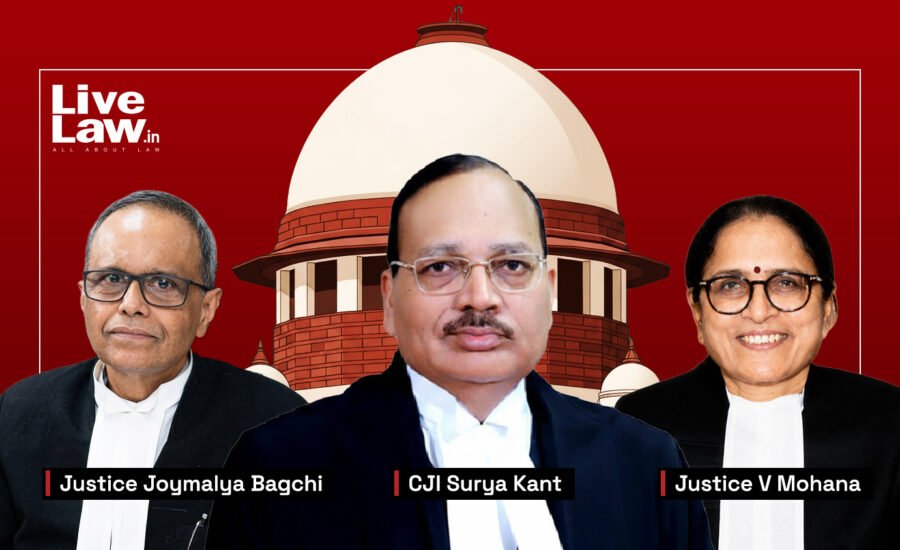
A bench of Chief Justice of India Surya Kant, Justice Joymalya Bagchi and Justice V Mohana made the observation while dealing with one of the objections raised by some State governments to the proposed enhancement.
The Court had on July 22 asked the High Courts to take a time-bound decision on increasing the retirement age of judicial officers. As an interim arrangement, it had said that where a State government and the jurisdictional High Court concurred on increasing the retirement age, the judicial officers concerned could be allowed to continue in service until the enhanced age of retirement. The Court had also clarified that any eventual decision on enhancement would relate back to superannuation taking place on or after April 1, 2026.


Yesterday, Amicus Curiae Senior Advocate Siddharth Bhatnagar informed the court that states that oppose the proposal cited disparity between the retirement age of judicial officers and State government employees as one of the reasons.
“Judicial officers are not government servants. Though they are appointed under the constitutional scheme by the State Government, they constitute a distinct and separate class,” the Court said in its order.
During the hearing, it was submitted that in States where government employees retire earlier, increasing the retirement age of judicial officers could lead other employees to claim discrimination since judicial officers are also employed by the State.
The Court rejected the comparison and said that judicial officers constitute a separate class for which a different age of superannuation could be based on a reasonable classification. IT pointed out that different retirement ages already exist for certain categories, such as professors and doctors. The Court also stressed the role of experience in determining the retirement age of professionals.
The Court also rejected the other objection raised by States, that increasing the age with cause additional financial burden. It observed that retiring a judicial officer entails payment of retirement benefits and pension while the resulting vacancy has to be filled and salary paid to a new officer. The Court said continuation of an experienced judicial officer could therefore result in lesser financial liability.
The Court ultimately rejects both reasons assigned by the State governments for declining to enhance the retirement age. “It seems to us that both the reasons assigned by the State Governments for declining to enhance the age of retirement are untenable”, the Court said.
It asked the States to independently revisit the proposal to enhance the retirement age from 60 to 62 years, irrespective of the retirement age prescribed for government employees.
During the hearing, the Court was informed that Telangana has enhanced the retirement age of judicial officers to 61 years. Further, Madhya Pradesh was willing to consider the request on the basis of the Full Court recommendation of the High Court. During the hearing, Tamil Nadu also informed the bench that it had no objection to increasing the age to 61 years. Some States, including Himachal Pradesh, Jharkhand and Nagaland, had opposed the proposal, citing financial implications. Assam and the NCT of Delhi sought further time to take a decision.
The Supreme Court in its 1991 judgment in All India Judges’ Association v. Union of India had then directed that the retirement age of judicial officers across States and Union Territories be increased to 60 years. It reasoned that judicial service has features distinct from executive service and that a judicial officer’s retirement age should be relatively higher than that of an executive officer. The direction was to take effect from December 31, 1992.
The States subsequently sought review of that judgment. They argued, among other things, that increasing the retirement age would have repercussions for other services and impose a financial burden. The Supreme Court rejected the argument for parity with other services as “irrelevant and erroneous” and maintained the higher retirement age for judicial officers.
CJI Surya Kant referred to these earlier rulings while questioning the objections now raised by the States. The Court said the States should revisit the issue through a “pragmatic approach” rather than treating the views expressed by their respective High Courts as binding on their decision.
Case no. – W.P.(C) No. 1022/1989
Case Title – All India Judges Association and Ors. v. Union of India and Ors.