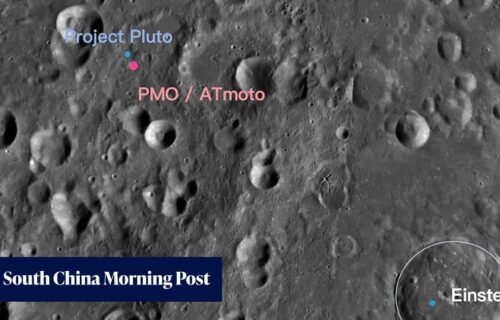
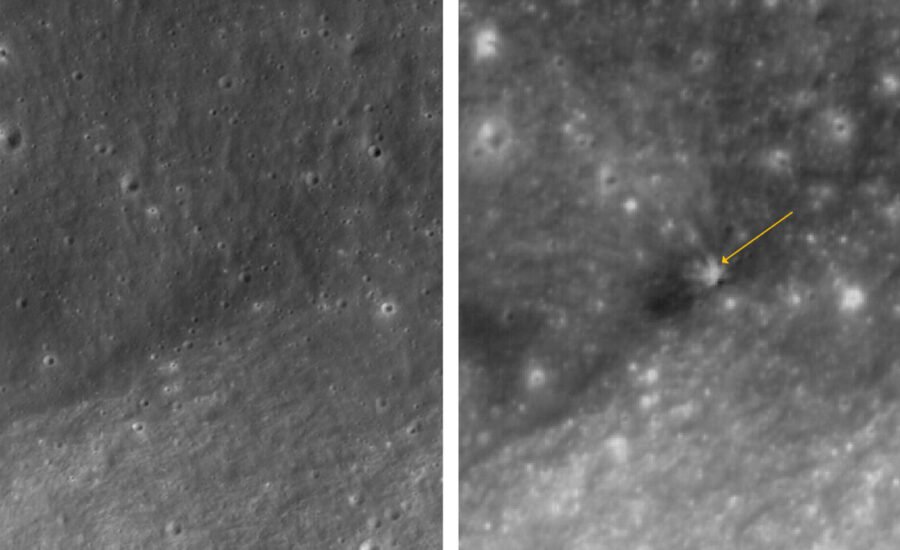
Korea’s lunar orbiter photographed a spent Falcon 9 stage before and after it struck the moon, offering scientists an unusually close record of surface changes.
Korea’s lunar orbiter Danuri photographed the impact site immediately before and after a used-up Falcon 9 rocket section struck near Einstein crater. The eight-image series gives scientists a rare close-up record of surface changes caused by a known artificial object.
Danuri photographed the site eight times around the collision, which occurred at 3:34 p.m. Wednesday, the Korea AeroSpace Administration (KASA) said Thursday.
The first image was taken at 3:01 p.m., 33 minutes before impact. Danuri made seven follow-up observations and completed the series at around 7 a.m. Thursday.
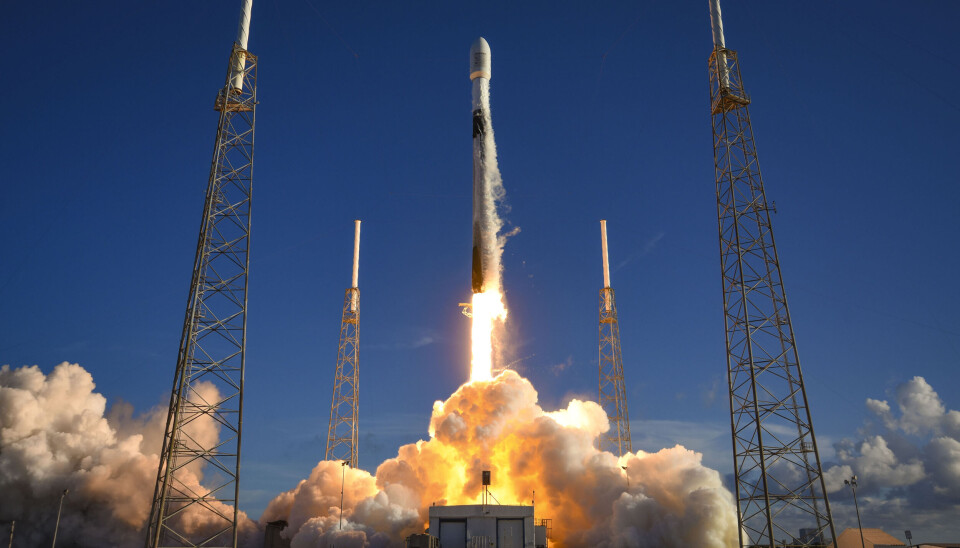
The object was the upper stage of the Falcon 9 launched in January 2025 with Firefly Aerospace’s Blue Ghost lunar lander and Japanese company ispace’s Resilience lander. It remained between Earth and the moon after the mission because it lacked enough propellant for a disposal maneuver. Solar activity and gravitational forces eventually put it on course to strike the moon.
Danuri was about 340 to 350 kilometers (211 to 217 miles) from the impact site during the observations.
“It’s like filming a collision in Busan while traveling 150 kilometers above Seoul at 1.5 kilometers per second (0.9 miles per second),” KASA explained.
The images show changes to the terrain near the impact point and traces of ejecta spreading across the surface.
Researchers have generally studied artificial lunar impacts through images taken long after the collision. But this time, Danuri had already photographed the expected impact area twice on July 9, and those baseline images are expected to help researchers isolate the changes caused by the collision.
Research institutions will analyze the images to determine the size and shape of the new crater, map the distribution of ejecta and examine changes in surface reflectivity and polarization.
Because the mass and speed of the upper stage were known, the data could also help researchers study the physical properties of the lunar surface and refine interpretations of natural meteoroid impacts.
Danuri’s observations will also support international research. NASA’s Lunar Reconnaissance Orbiter (LRO) was on the opposite side of the moon at the time of impact and could not photograph the immediate aftermath.
Danuri’s images are expected to help NASA plan LRO observations of the site about a month later.
BY KIM MIN-JEONG [cho.yongjun1@joongang.co.kr]